Origin
Scotland
Scotland's military tradition is marked by fierce independence and distinctive weapons. The claymore two-handed sword, dirk, and targe shield defined Highland warfare. Scottish Highland regiments later became some of the most feared infantry in the British Empire.
Overview
Scotland's weapon tradition is shaped by its highland terrain, clan culture, and centuries of conflict with England and internal between clans. Scottish Highland warriors developed a distinctive fighting style centered on the charge — closing distance as fast as possible to bring edged weapons to bear before the enemy could reload firearms. This tactic was effective into the mid-18th century and utterly catastrophic at Culloden (1746) against disciplined musket volleys.
Highland Weapons
Claidheamh Mòr (Claymore)
The Scottish two-handed sword — "claymore" comes from the Gaelic claidheamh mòr, "great sword." Two distinct forms:
- Two-handed claymore — A large two-handed sword with distinctive forward-angled quillons (crossguard) ending in four-leaf clover terminals; used by highland warriors of the 15th–16th centuries; 130–140 cm overall
- Basket-hilted broadsword — Often also called "claymore"; a one-handed cut-and-thrust sword with a complex steel cage protecting the hand; the weapon of the later highland warriors and Scottish officers; one of the finest functional sword designs ever made
Dirk
A long single-edged dagger, 30–50 cm blade; the universal Highland sidearm. Used as a backup weapon and everyday tool. Often paired with a pistol in the other hand during a charge.
Targe
A small round shield of wood covered with leather and decorated with brass studs; 45–55 cm diameter. Gripped in the left hand during combat; a dirk or pistol was held in the same hand as the targe, pointing forward over its rim.
Lochaber Axe
A large pole weapon with a long curved blade and hook; a Scottish form of the glaive/bill; associated with Highland and Lowland infantry.
Scottish Regiments in the British Army
After the Jacobite risings ended, Highland regiments became some of the most celebrated in the British Army — the Black Watch, the Gordon Highlanders, the Argyll and Sutherland Highlanders. These regiments carried standard British weapons but retained the broadsword and dirk as ceremonial arms.
This article is a stub.
Battles & Operations
-
Battle of Stirling Bridge (11 September 1297)
The Battle of Stirling Bridge was fought on 11 September 1297 beside the River Forth at Stirling. A Scottish army led by William Wallace… Continued…
-
Battle of Culloden (16 April 1746)
The Battle of Culloden, fought on Drummossie Moor near Inverness on 16 April 1746, ended the last Jacobite rising. A British government… Continued…
Weapons
-
Bombard
A bombard was a large, short-ranged cannon of the fourteenth to sixteenth centuries that fired heavy stone balls against castle and town… Continued…
-
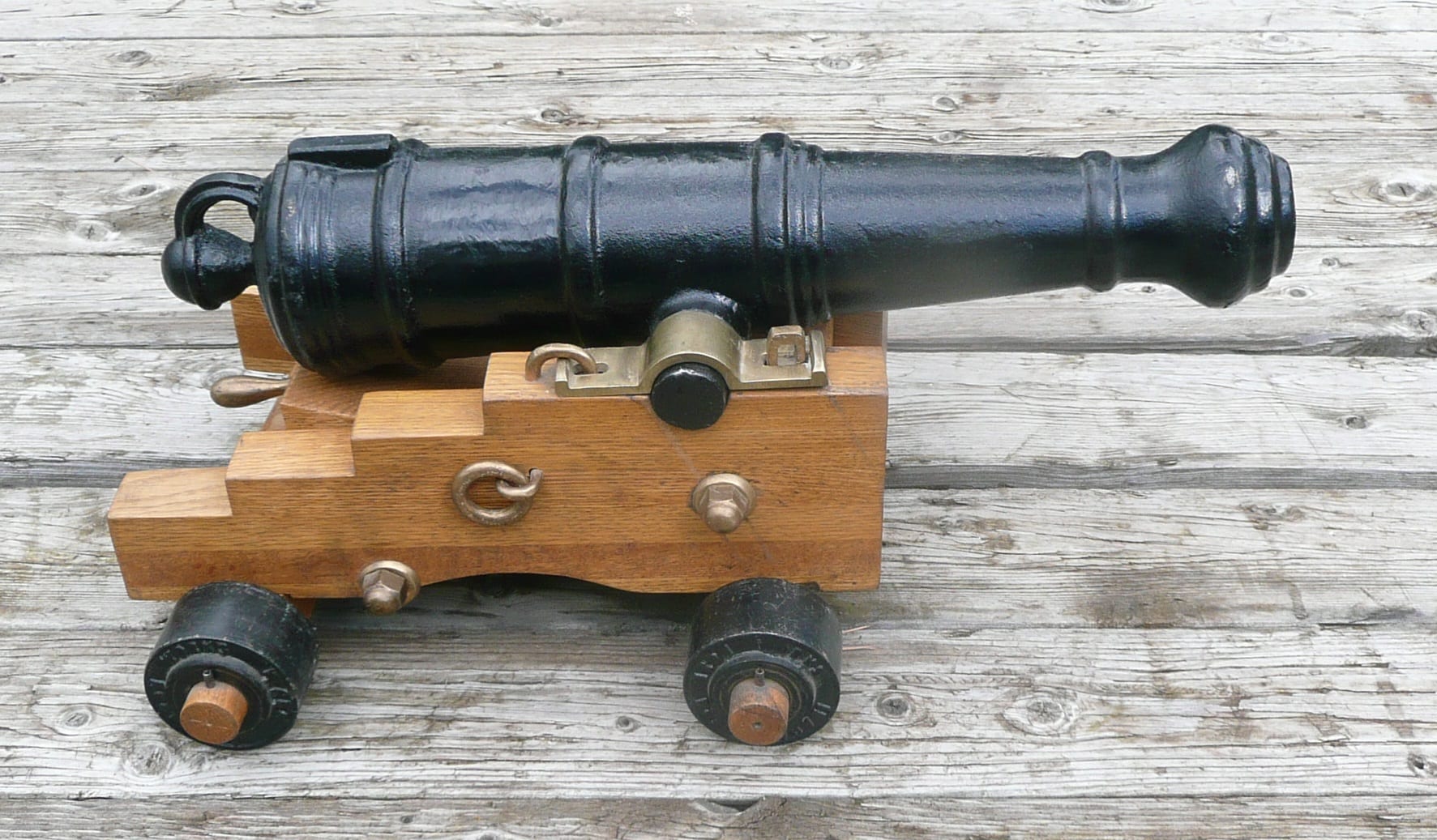
Carronade
The carronade was a short, light, large-bore naval gun first cast by the Carron Company of Falkirk, Scotland, in 1778. It fired a heavy… Continued…
-
Highland Dirk
The Highland dirk is the long, single-edged dagger of the Scottish Highlands, known in Gaelic as the biodag. It developed from the medieval… Continued…
-
Kettle Hat
The kettle hat was an open-faced iron or steel helmet with a wide brim, known in French as the chapel de fer, the iron hat. It appeared in… Continued…
-
Lochaber Axe
The Lochaber axe is a Scottish polearm with a long, narrow, cleaver-like blade fixed to a wooden shaft, often with a hook at the top of the… Continued…
-
Pike
The pike is the longest infantry weapon ever carried in formation: an ash shaft of 16 to 22 feet tipped with a small steel head, used by… Continued…
-
Plug Bayonet
The plug bayonet was the first bayonet: a dagger with a tapered handle that was pushed into the muzzle of a musket, turning the gun into a… Continued…
-
Schiltron Spear
The schiltron spear was the long infantry spear carried by Scottish foot soldiers in the Wars of Scottish Independence. Held in both hands… Continued…
-
Scottish Claymore
Claymore — Gaelic claidheamh-mòr, 'great sword' — names the two-handed sword of the Highland clans of the fifteenth to seventeenth… Continued…
-
Targe
The targe is the round shield of the Scottish Highlands, used from the late Middle Ages until the Jacobite Rising of 1745. Made of two… Continued…