Weapon Type
Shields
Hand-held defensive implements.
Armor — Subcategory
Overview
The shield is a handheld or body-mounted barrier used to intercept and deflect incoming attacks. It is the oldest and most universal defensive tool in human history — every culture that fought, from prehistoric hunter-gatherers to 19th-century African warriors, produced some form of shield. Unlike armor worn on the body, the shield is an active defensive tool: the user moves it to intercept attacks, creating a mobile barrier that can also be used offensively (pushing into opponents, bashing, trapping weapons).
Materials
Shields have been constructed from nearly every available material:
- Wood — The most universal material; planks, wicker, or carved solid wood; covered with hide or linen; core of most ancient and medieval shields
- Hide/leather — Often the primary or covering material; hardened (cuir bouilli) leather was surprisingly rigid
- Wicker — Light; quick to make; arrows could stick in it (slowing penetration)
- Bronze — Facing or entire construction; expensive; the bronze aspis
- Iron/steel — Facing plates or full metal construction; heavy; primarily boss and rim elements rather than full panels
- Modern ballistic materials — Polycarbonate, Kevlar, UHMWPE; ballistic shields for law enforcement
Ancient Shields
Mycenaean Tower Shield
- Full-body length; oval; covered the entire figure
- Depicted in Mycenaean frescoes and Homer
- Required a leather baldric slung over the shoulder to carry; very heavy
Mycenaean Figure-8 Shield
- Waisted in the middle; the iconic Mycenaean form
- Depicted throughout Minoan and Mycenaean art
Greek Aspis (Hoplon)
- Circular; 80–100 cm diameter; heavy (6–8 kg)
- Bronze facing over a wood core; concave inner surface
- The distinctive offset grip — the arm through a bronze arm band (porpax) at the center, hand gripping a cord at the rim — distributed weight and allowed one-handed use
- The overlapping aspis of the phalanx created a shield wall; retreating meant exposing the unshielded right side of the man to the left — the origin of "come back with your shield, or on it"
Roman Scutum
- Large rectangular (later oval) curved shield; 60×130 cm
- Laminated plywood construction with leather facing and iron boss
- The curve wrapped around the body; combined with the gladius, the system was: push the scutum into the enemy, thrust the gladius over, under, or around it
Medieval Shields
Kite Shield
- Teardrop-shaped; pointed bottom protecting the leg; upper section covering the torso and face
- Standard Norman shield at Hastings (1066) and through the 12th century
- Evolved from the older round shield with added lower protection for cavalry
Heater Shield
- Smaller; flat top, pointed bottom; heraldic device painted on it
- The iconic medieval knight's shield; "heater" from its iron shape resemblance to a clothes iron
- Carried on the left arm; right arm free for sword or lance
Viking Round Shield
- Circular; 75–90 cm; wooden planks with iron boss covering the grip
- Used in the shield wall (skjaldborg); overlapping shields created a continuous barrier
Targe
- Scottish round shield; Highland warriors
- Small (45–60 cm); leather-faced wood with iron boss and spikes
- Used with the broadsword in the Highland charge; held in the left hand, broadsword in the right
Shield Walls
The shield wall was the primary tactical formation of many cultures:
- Anglo-Saxon fyrd; Norse; Greek phalanx (aspis overlapping)
- Overlapping shields created a nearly impenetrable barrier frontally
- The challenge was always the flanks — shield walls could be enveloped
Decline
Shields declined as:
- Firearms made handheld shields irrelevant (a shield cannot stop a musket ball)
- Two-handed weapons required both hands
- Plate armor made the left hand available for a two-handed longsword grip
Modern police and military ballistic shields revived the concept for specific environments.
This article is a stub. Contributions covering specific shield types, tactics, and cultures are welcome.
Battles & Operations
Weapons
-
Chimalli
The chimalli was the round shield of Aztec warriors and other peoples of central Mexico. War shields were usually made of woven cane or… Continued…
-
Greek Aspis
The aspis was the great round shield of the Greek hoplite: a deep bowl of laminated wood about 90 centimeters across, often faced in thin… Continued…
-
Hussite Pavise
The Hussite pavise was a large rectangular shield used by the Hussite armies of Bohemia in the fifteenth century. Tall enough to cover a… Continued…
-
Norman Kite Shield
The kite shield is the long, round-topped, tapering shield carried by the Norman knights of the Bayeux Tapestry and by armored horsemen… Continued…
-
Roman Scutum
The scutum was the large shield of the Roman legionary: an oval, and later rectangular, shield curved to wrap around the body, made of… Continued…
-
Targe
The targe is the round shield of the Scottish Highlands, used from the late Middle Ages until the Jacobite Rising of 1745. Made of two… Continued…
-
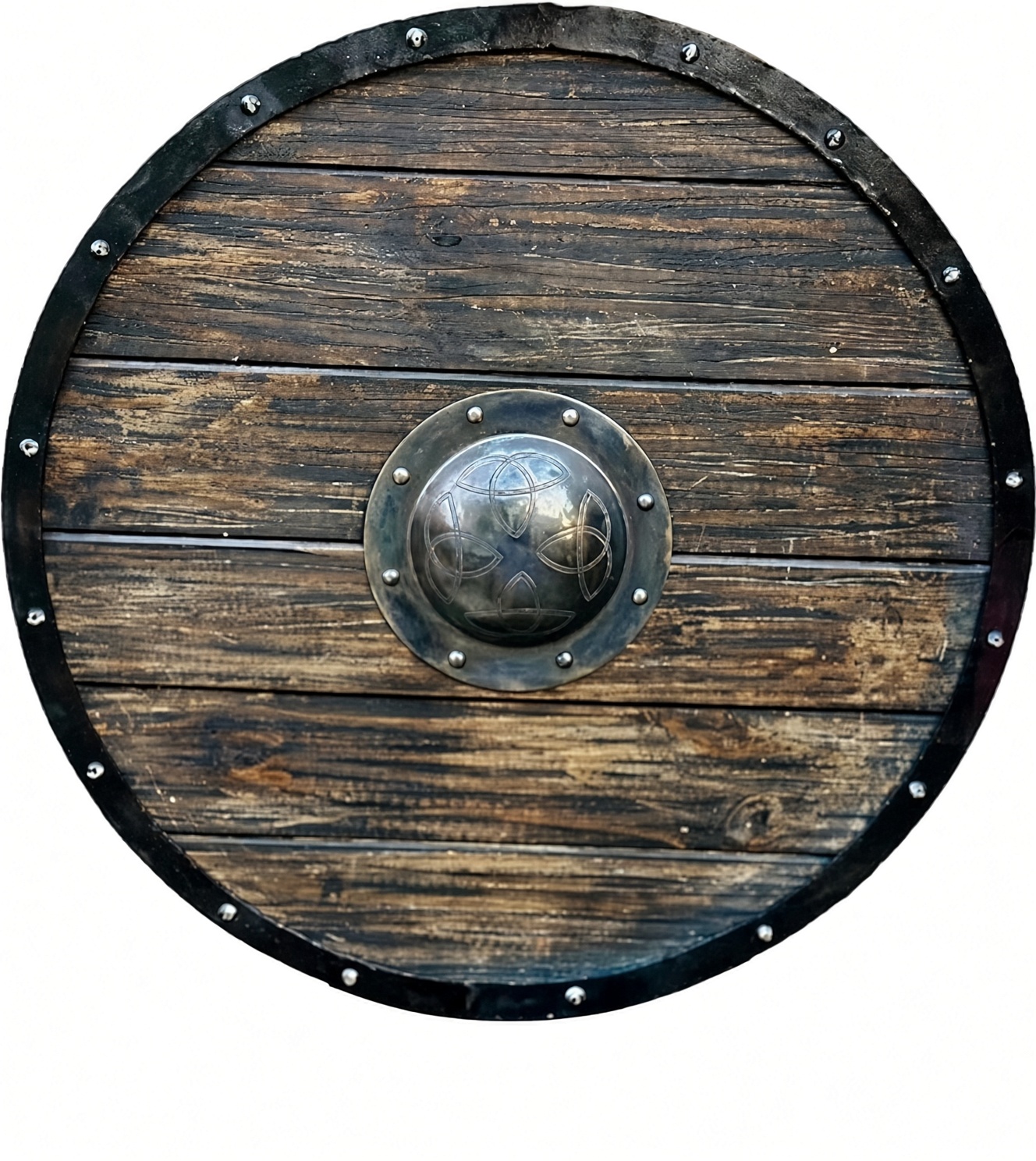
Viking Round Shield
The round shield was the main defense of the Viking warrior: a disc of wooden boards, usually about 80 to 95 centimeters across, with an… Continued…
-
Zulu Isihlangu
The isihlangu was the large oval cowhide war shield of the Zulu army. It stood about as high as a man's shoulder and is closely tied to the… Continued…