Force
Golden Age Pirates
The buccaneers and freebooters of the Age of Sail, armed with cutlass, boarding axe, and flintlock pistols.
Origins
The Golden Age of Piracy, roughly 1650 to 1730, was the Atlantic world's crime wave during the Age of Sail. It had three phases. First came the buccaneers, hunters and outlaws of Hispaniola and Tortuga who raided the Spanish colonies, often with licenses from English or French governors. From Port Royal in Jamaica, Henry Morgan led them against Portobelo in 1668 and Panama in 1671. Next, in the 1690s, pirates sailed to the Indian Ocean to prey on rich shipping. Finally, after the War of the Spanish Succession ended in 1713, thousands of sailors and privateers were thrown out of work, and many turned outlaw. These crews of the 1710s and 1720s took ships of every flag from Newfoundland to the Guinea coast. Nassau in the Bahamas was their republic in all but name until 1718.
Organization & Training
Crews ran by written articles that every man signed. They elected their captain and could vote him out, chose a quartermaster to keep order and share the loot, and set payments for men who lost a limb. It was a rough democracy that scandalized the navies hunting them. Most pirates were experienced merchant or navy seamen in their twenties, and crews included many Black sailors, some escaped from slavery. Ships were chosen for speed and shallow draft, so they could outrun warships and hide in coastal waters. Many crews started in small sloops and moved up to larger captured ships.
Weapons & Equipment
Pirate fighting was boarding work, and the arsenal matched. The Boarding Cutlass was the weapon for the crowded deck. The Boarding Axe cut rigging and helped men climb the side of a ship. Pirates carried flintlock pistols like the Sea Service Pistol, often several at once, since each fired only one shot. Johnson's history says Blackbeard wore three brace, six pistols, in slings across his chest. Muskets and the Blunderbuss swept enemy decks, and small cannon such as the Swivel Gun were mounted on the rails. Pirates also threw hand grenades, called grenadoes, and stinkpots that filled a deck with choking smoke.
Notable Actions
The terror was tactical. Pirates flew black flags and cultivated fearsome reputations so that their prizes would surrender without a fight, and most did. Real battles were rare. Blackbeard blockaded Charleston, South Carolina, in 1718, holding hostages until the town handed over a chest of medicine. Bartholomew Roberts captured hundreds of ships between 1719 and 1722, more than any other pirate of the age. In 1718 Woodes Rogers arrived in Nassau as governor with a royal pardon, and many pirates took it. That November, Lieutenant Robert Maynard of the Royal Navy killed Blackbeard in a hand-to-hand fight at Ocracoke Inlet, North Carolina.
Legacy
The hunt won. Pardons, naval patrols and mass hangings ended the age by the late 1720s, with Roberts' death in battle with HMS Swallow in 1722 the effective full stop. Fifty-two of his men were hanged at Cape Coast Castle. Captain Johnson's 1724 General History then made the legend permanent. Through it, every treasure map, black flag and film pirate since traces back to a few decades of Atlantic outlaws who mostly died young.
-
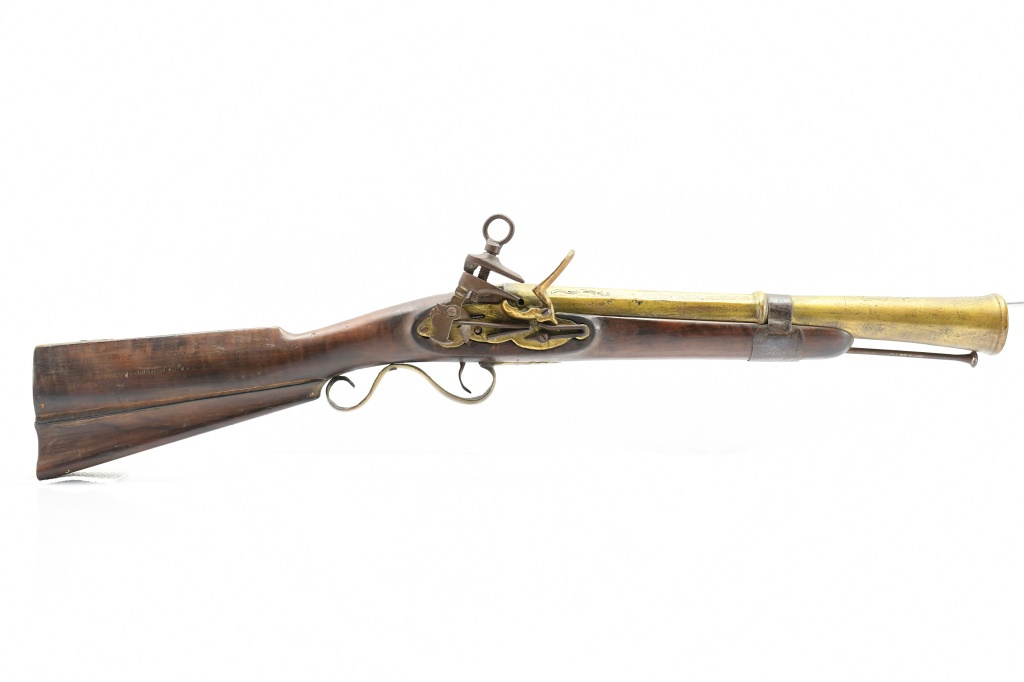
Blunderbuss
The blunderbuss was a short, large-bore, muzzle-loading gun with a flared muzzle, built to fire a handful of shot at very close range. From… Continued…
-
Boarding Axe
The boarding axe was the short-handled naval axe of the age of sail, with a cutting blade on one side and a spike on the other. It was a… Continued…
-
Boarding Cutlass
The cutlass was the sailor's sword of the Age of Sail: short, broad-bladed, and basket-guarded, built for the crowded chaos of a boarding… Continued…
-
Sea Service Pistol
The Sea Service pistol was the Royal Navy's standard sidearm through the age of sail: a heavy, plain, single-shot flintlock with a brass… Continued…
-
Swivel Gun
The swivel gun was a small cannon mounted on a forked iron yoke that pivoted in a socket on a ship's rail, fighting top or boat bow, so… Continued…