Historical Context
Gunpowder Revolution
The spread of gunpowder from China into Europe and the Islamic world fundamentally transformed warfare. Early hand cannons, arquebuses, and artillery gradually rendered heavy plate armor obsolete and shifted battlefield tactics toward massed ranged firepower and volley fire.
c. 1300 – 1600
Overview
The Gunpowder Revolution describes the period during which gunpowder weapons — invented in China and spreading westward through the Islamic world to Europe — displaced medieval weapons technology and fundamentally restructured warfare. The transformation took roughly three centuries: from crude fire tubes and early bombards in the 1300s to refined matchlock arquebus tactics, disciplined field artillery, and the pike-and-shot infantry system by 1600.
Origins: China and the Islamic World
Chinese Gunpowder Weapons
Gunpowder was developed in China during the Tang Dynasty (7th–9th century), initially as an accidental byproduct of alchemical experimentation. Military applications followed:
- Fire lance (10th century) — A bamboo tube filled with gunpowder mixture held in front of a spear; created a jet of fire; the first firearm
- Thunderclap bombs (12th century) — Gunpowder-filled ceramic or iron containers; thrown or catapulted; fragmentation weapons
- Fire arrows — Rockets attached to arrows; used en masse for area suppression
- Early cannon (13th century) — Metal-barreled guns firing stone or iron projectiles; the Mongols may have spread cannon technology across Eurasia through their conquests
Islamic Development
Arab and Persian engineers received gunpowder technology from China by the 13th century and developed:
- Madfaa — Early Arab cannon; wooden barrel bound with iron; fired stone balls
- Explosive grenades — Used in the Crusades and Mongol wars
European Cannon: Siege Revolution
Early European Cannon (1300–1420)
The earliest European cannon were bombards — simple iron or bronze tubes firing stone balls:
- Wrought iron stave construction (iron rods welded into a tube, reinforced with iron hoops) or cast bronze
- Ammunition — Stone balls; enormous; some bombards fired 300–500 lb projectiles
- Rate of fire — 1–2 shots per day for the largest pieces
- Effect — Devastating to medieval masonry walls, which were designed to absorb arrow and ram attack but not repeated impact at the base
The End of Medieval Fortification
Medieval castles — designed around high walls to keep attackers out and provide platforms for defenders — became obsolete:
- Crécy (1346) — Primitive English cannon used, probably as noise-makers; but the principle was established
- Constantinople (1453) — Ottoman Sultan Mehmed II's enormous bombards (including the famous Orban/Basilica cannon, firing 600 lb stone balls) breached the Byzantine walls that had held for 1,000 years in 54 days
- Charles VIII's Italian campaign (1494) — French bronze field artillery on wheeled carriages reduced Italian fortresses that had held for years in a matter of hours; triggered a revolution in European fortification design (the star fort / trace italienne)
The Trace Italienne Response
Military engineers responded to cannon with a new defensive architecture:
- Low, thick earthwork and masonry walls — Absorbed cannon fire rather than crumbling
- Bastions — Angular projections allowing defenders to fire along the walls, eliminating dead ground
- Moats — Wide and deep, preventing close approach for undermining
- This new design made fortresses resistant to cannon again — but required enormous resources to build and garrison
Small Arms Development
Hand Cannon (1300s–early 1400s)
The earliest personal firearms were essentially small cannon:
- An iron or bronze tube with a touch-hole; required two operators (one to aim, one to ignite)
- Inaccurate; slow; unreliable; used for psychological effect as much as physical
Matchlock (late 1400s–1600s)
The matchlock mechanism attached a burning slow-match to a pivoting arm (serpentine) that lowered into the flash pan on trigger activation:
- One-person operation
- Allowed aimed fire (the hand previously needed to apply the match could now hold the stock)
- Slow-match (smoldering cord) required maintenance but was reliable in dry conditions
- Arquebus — The standard matchlock infantry weapon; .60–.80 caliber; smoothbore; effective to 50–75 yards
- Musket — Larger-bore matchlock; required a forked rest; greater range and penetration; replaced the arquebus by the late 1500s
The Matchlock's Tactical Impact
The matchlock killed the armored knight:
- Plate armor thick enough to stop a musket ball became too heavy to wear in combat
- As firearms proliferated, armor progressively reduced to the breastplate and helmet (half-armor)
- Infantry armed with arquebus/musket began to dominate cavalry
The Pike-and-Shot System
The integration of firearms with pike phalanxes created the dominant tactical formation of 1500–1700:
- Pikemen — Protected musketeers against cavalry; 16–18 foot pikes
- Musketeers/Arquebusiers — Provided firepower; needed pike protection while reloading
- The proportion shifted over time from pike-heavy (1500) toward musket-heavy (1650+) as firearms improved
The Spanish tercio — a combined pike-and-shot formation typically 1,000–3,000 strong — was the dominant military unit of the 16th century, winning battles across Europe, the Americas, and beyond.
Legacy
By 1600, the Gunpowder Revolution had:
- Ended the military relevance of full plate armor
- Made medieval castle design obsolete
- Created professional standing armies replacing feudal levies
- Extended European military power globally through ship-mounted cannon
- Established firearms as the dominant personal weapon for the next 400 years
This article is a stub. Contributions covering specific weapons, battles, and regional developments are welcome.
Battles & Operations
Weapons
-
Arquebus
The arquebus was the first practical infantry firearm, a matchlock long gun light enough to be fired from the shoulder or chest without a… Continued…
-
Bombard
A bombard was a large, short-ranged cannon of the fourteenth to sixteenth centuries that fired heavy stone balls against castle and town… Continued…
-
Culverin
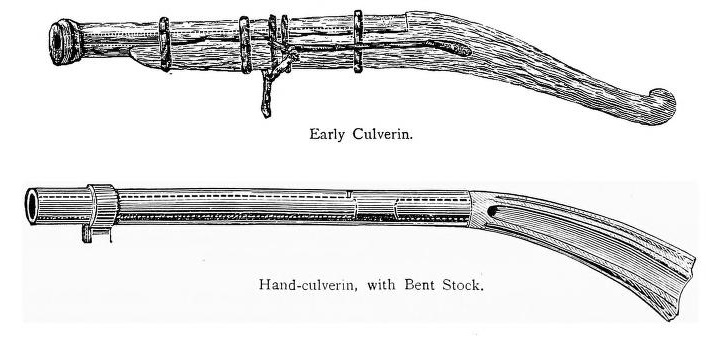
The culverin was a long-barreled muzzle-loading gun of the sixteenth and seventeenth centuries. Compared with the heavier 'cannon' class it… Continued…
-
Fire Lance
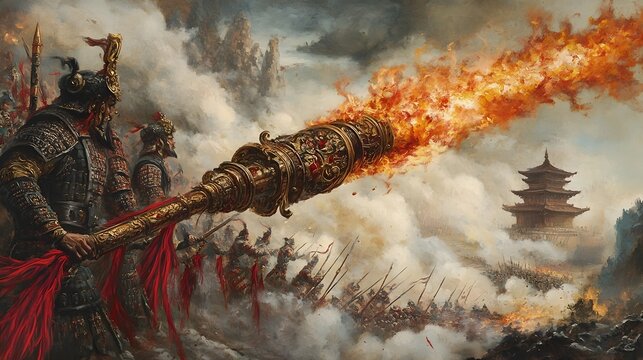
The fire lance was the first gunpowder weapon to be held in the hand: a tube of bamboo or paper, packed with gunpowder and tied to a spear… Continued…
-
Galleon
The galleon was the large ocean-going sailing ship of the sixteenth and early seventeenth centuries, used both as a warship and as an armed… Continued…
-
Halberd
The halberd combined axe blade, thrusting spike, and back hook on a two-meter haft — a complete toolkit for infantry facing armored… Continued…
-
Hand Cannon
The hand cannon is the first true firearm: a small bronze or iron barrel on a pole or stock, loaded with powder and ball and touched off by… Continued…
-
Janissary Tüfek
The tüfek, the Turkish word for a gun, was the long-barreled musket carried by the Janissaries, the elite infantry of the Ottoman Empire.… Continued…
-
Korean Hwacha
The hwacha, or 'fire cart,' was a Korean multiple-rocket launcher of the Joseon dynasty: a two-wheeled wooden cart carrying a rack that… Continued…
-
Matchlock Musket
The matchlock was the first firearm a soldier could aim and fire without taking his eyes off the enemy: a serpentine lever lowered a… Continued…
-
Military Flail
The military flail was a two-handed weapon made from the farmer's threshing flail: a long wooden haft joined by a hinge or short chain to a… Continued…
-
Morion Helmet
The morion is the open steel helmet with a tall comb and a brim swept up to points at front and back that armed pikemen and arquebusiers… Continued…
-
Ottoman Kilij
The kilij is the curved saber of the Ottoman Turks, and the name — simply 'sword' in Turkish — covers a family of blades carried from the… Continued…
-
Pike
The pike is the longest infantry weapon ever carried in formation: an ash shaft of 16 to 22 feet tipped with a small steel head, used by… Continued…
-
Plug Bayonet
The plug bayonet was the first bayonet: a dagger with a tapered handle that was pushed into the muzzle of a musket, turning the gun into a… Continued…
-
Swivel Gun
The swivel gun was a small cannon mounted on a forked iron yoke that pivoted in a socket on a ship's rail, fighting top or boat bow, so… Continued…
-
Tanegashima
Tanegashima is the Japanese name for the matchlock arquebus, taken from the island of Tanegashima where, by the traditional account… Continued…
-
Venetian Galleass
The galleass was a large, heavily gunned warship of the sixteenth-century Mediterranean, built by Venice from its great merchant galleys.… Continued…