Origin
Multi-national
Used for weapons with contributions from multiple nations or with unclear singular national origin — common in mercenary forces, coalition armies, and weapons produced under license across many countries.
Overview
Not every weapon belongs neatly to one country. Throughout history, weapons have crossed borders through military alliances, licensed manufacture, conquest, trade, and parallel independent development. This category covers arms that are genuinely multi-national in character.
Common Cases
Licensed production — Many weapons were produced under license in multiple countries. The Mauser 98 action was manufactured in Germany, Spain, Belgium, Czechoslovakia, Yugoslavia, and dozens of other nations. The FN FAL was produced in over 90 countries.
Captured and reissued weapons — Armies routinely used captured enemy weapons, especially when supply lines were strained. Germany reissued enormous quantities of Soviet, Czech, Polish, and French weapons in WWII.
Coalition and mercenary forces — Medieval mercenary companies (condottieri, Landsknechts) drew soldiers from across Europe, each bringing their own arms. Modern coalition forces often operate with mixed equipment inventories.
Parallel development — Some weapons were developed independently but are nearly identical, reflecting convergent engineering solutions to the same tactical problems.
Standardized NATO/Warsaw Pact arms — Cold War alliance standardization meant weapons like the AK-47 (Warsaw Pact) and M16/FN FAL (NATO) were used across entire blocs of nations.
This category is used when no single national origin is appropriate. See individual country entries for national weapon traditions.
-
Assyrian Composite Bow
The composite bow of the Neo-Assyrian Empire, built of wood, horn and sinew bonded with glue, was the principal weapon of the most… Continued…
-
Boarding Cutlass
The cutlass was the sailor's sword of the Age of Sail: short, broad-bladed, and basket-guarded, built for the crowded chaos of a boarding… Continued…
-
Bombard
A bombard was a large, short-ranged cannon of the fourteenth to sixteenth centuries that fired heavy stone balls against castle and town… Continued…
-
Bone Harpoon
The bone harpoon is a barbed point of bone or antler, made to be hafted on a spear or dart and to hold fast in its prey. Barbed bone points… Continued…
-
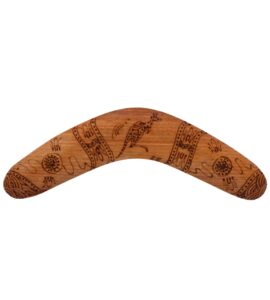
Boomerang
The boomerang is a curved throwing stick, and the returning kind is only one small branch of a very old family. A boomerang carved from… Continued…
-
Copper Age Axe
The copper axe was the first metal weapon and tool of prehistoric Europe, made in the Copper Age of the fourth and early third millennia… Continued…
-
Crossbow
The crossbow put a bow on a stock, held its own draw, and released on a trigger — trading the archer's lifetime of training for a weapon… Continued…
-
Fire Ship
A fire ship was a vessel filled with flammable material, set alight and sent drifting or sailing into an enemy fleet. Wooden ships with… Continued…
-
Flint Hand Axe
The flint hand axe is the signature tool of the Acheulean tradition: a teardrop-shaped stone flaked on both faces to a sharp, symmetrical… Continued…
-
HK MP5
The Heckler & Koch MP5 is the submachine gun by which every other has been judged since the 1970s. It shrank the roller-delayed blowback… Continued…
-
Hand Cannon
The hand cannon is the first true firearm: a small bronze or iron barrel on a pole or stock, loaded with powder and ball and touched off by… Continued…
-
Knight's Lance
The knight's lance was the defining weapon of medieval European heavy cavalry: a long wooden shaft with an iron head, held tight under the… Continued…
-
Linothorax
The linothorax was a body armor made of many layers of linen glued or stitched together, worn by Greek hoplites and later by the Macedonian… Continued…
-
Mail Hauberk
The mail hauberk was the principal body armor of European warriors for most of the Middle Ages: a long shirt of thousands of interlinked… Continued…
-
Matchlock Musket
The matchlock was the first firearm a soldier could aim and fire without taking his eyes off the enemy: a serpentine lever lowered a… Continued…
-
Medieval Mace
The mace is concentrated impact: a weighted head of iron or bronze on a stout haft, built to transmit force THROUGH armor rather than cut… Continued…
-
Molotov Cocktail
A Molotov cocktail is a glass bottle filled with gasoline or another flammable liquid, lit by a burning rag or a chemical igniter and… Continued…
-
Naue II Sword
The Naue II sword is the most widespread sword type of the European Late Bronze Age: a leaf-shaped bronze blade cast in one piece with a… Continued…
-
Prehistoric Sling
The sling is one of the oldest and simplest projectile weapons: a pouch on two cords, whirled and released to throw a stone or a shaped… Continued…
-
Satchel Charge
A satchel charge is a bag of explosive blocks, with a carrying strap and a fuse, that a soldier throws or places against a bunker, pillbox… Continued…
-
Siege Mortar
A siege mortar was a short, wide-mouthed cannon that fired at a high angle, so that its projectile rose over walls and earthworks and fell… Continued…
-
Socket Bayonet
The socket bayonet is a blade fixed to the side of a metal tube that slides over the muzzle of a musket and locks in place. Unlike the… Continued…
-
Stone Mace-head
The stone mace-head is a shaped, perforated stone mounted on a wooden handle — one of the first weapons made specifically to kill people… Continued…
-
Swivel Gun
The swivel gun was a small cannon mounted on a forked iron yoke that pivoted in a socket on a ship's rail, fighting top or boat bow, so… Continued…
-
Trebuchet
The counterweight trebuchet was the heaviest artillery of the Middle Ages: a great pivoting beam whose short arm carried a box of earth or… Continued…
-
Vickers Machine Gun
The Vickers was the British Army's medium machine gun for more than fifty years. Adopted in 1912, it was a lighter, improved version of the… Continued…