Boomerang
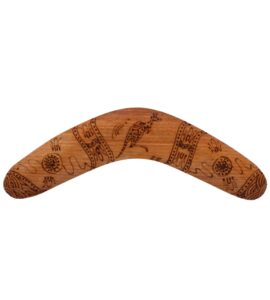
The boomerang is a curved throwing stick, and the returning kind is only one small branch of a very old family. A boomerang carved from mammoth tusk found in Obłazowa Cave in Poland is more than 20,000 years old; wooden boomerangs from Wyrie Swamp in South Australia are about 10,000; and Tutankhamun was buried with a collection of throwsticks. Most were non-returning hunting and fighting sticks. The famous returning Aboriginal boomerang was mostly used for play, sport and bird-hunting, not for war.
Also known as Throwing stick, rabbit stick, kylie, Egyptian throwstick
Origins
A boomerang is, at its simplest, a flat, curved stick thrown so that it spins. Spinning keeps it flying far and straight, and its curve and cross-section give it lift, so that a well-made throwing stick travels much farther than a club thrown end over end. The oldest known example is not wood but ivory: a curved blade carved from a mammoth tusk, found in Obłazowa Cave in southern Poland and dated to more than 20,000 years ago. In Australia, wooden boomerangs preserved in the peat of Wyrie Swamp in South Australia date to about 10,000 years ago, and rock art shows them much earlier. Throwing sticks were also known in ancient Egypt, among Native American peoples of the Southwest and California, and in India.
Design & Construction
Throwing sticks were carved from hardwood, often from a naturally curved branch or root so that the grain followed the bend. The non-returning kind — by far the most common — is long and heavy, with a gentle curve, and is built to fly low and fast, striking with force at the end of its flight. The returning boomerang is lighter and more sharply angled, with its arms shaped like airfoils; thrown correctly, it flies in a circle and comes back to the thrower, but it hits with far less force. Egyptian throwsticks were flat and curved, and some were made of ivory or faience for ceremonial use. The collection buried with Tutankhamun in the fourteenth century BC includes plain working sticks and ornamented ones, among them examples of the returning type.
Combat Use
The throwing stick was mainly a hunting weapon. In Egypt it was used to bring down waterfowl in the marshes, a scene often painted in tombs, and in Australia heavy non-returning boomerangs were thrown at kangaroos and other game. They were also used in fighting: Aboriginal warriors threw heavy boomerangs in battle and in formal duels, and some were made with a hooked end to catch an opponent's parrying shield. It is a common mistake, though, to think of the famous returning boomerang as a war weapon. Returning boomerangs were light and relatively weak; they were used for sport, for play, and for hunting birds by throwing over a flock, not for killing people.
Legacy
The boomerang became one of the best-known symbols of Aboriginal Australia, and returning boomerangs are thrown today in international sport competitions. Its wider family — the throwing sticks of ancient Egypt, Europe and the Americas — belongs among humanity's oldest ranged weapons, alongside the Atlatl and the Prehistoric Sling. The Obłazowa ivory boomerang in particular shows how much ingenuity hunters of the last Ice Age put into their weapons, carving a working aerodynamic tool out of mammoth ivory with stone tools.
Sources
Valde-Nowak, Paweł, Adam Nadachowski and Mieczysław Wolsan. 'Upper Palaeolithic Boomerang Made of a Mammoth Tusk in South Poland.' Nature 329 (1987): 436-438.
Luebbers, Roger A. 'Ancient Boomerangs Discovered in South Australia.' Nature 253 (1975): 39.
Jones, Philip. Boomerang: Behind an Australian Icon. Wakefield Press, 1996.
Suggest an edit · account required · reviewed before publishing · how it works