Atlatl
The atlatl is a hand-held lever that launches a long dart far faster than an arm alone can throw it. One of humanity's oldest mechanical weapons, it was used for hunting and war from the Upper Paleolithic until the bow displaced it, and in Mesoamerica it was still a battlefield weapon when the Spanish arrived.
Also known as Spear-thrower, Woomera (Australia), Propulseur (French)
Origins
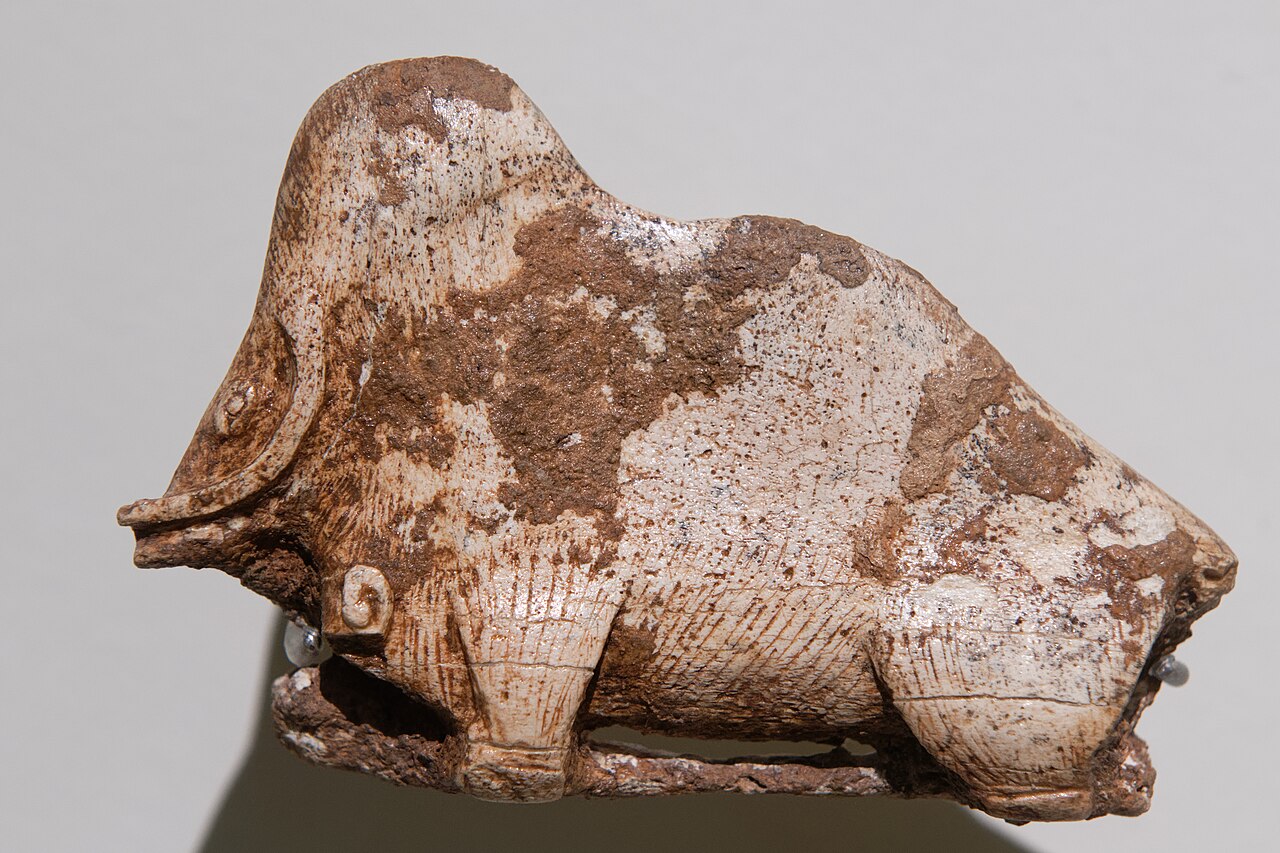
The oldest surviving spear-throwers come from the Upper Paleolithic of France, carved from reindeer antler some 17,000 years ago. Pieces from sites such as Le Mas d'Azil and Canecaude are decorated with animals, a leaping ibex or a mammoth, fine enough to hang in any museum of art. The tool itself is certainly older, since wooden examples rarely survive. It spread, or was independently invented, across nearly the whole inhabited world: the name atlatl is Nahuatl, the language of the Aztecs; Australians know it as the woomera; and the Arctic, the Andes, and the American Southwest all kept it in use into historic times.
Design & Construction
An atlatl is deceptively simple: a flat or trough-shaped shaft of wood, antler, or bone, roughly 30 to 60 centimeters long, with a spur or hook at the rear end that engages a dimple in the butt of the dart. The dart itself is the missile, a flexible shaft of two meters or so, fletched like an oversized arrow and tipped with stone, bone, or later metal; the [[Clovis Point]] rode exactly this system against Ice Age megafauna. Refinements were real engineering. Basketmaker examples from the American Southwest add finger loops, and many North American atlatls carry a lashed-on bannerstone whose function, whether flex tuning, balance, or pure status, is still argued in the experimental literature.
Hunting & Combat Use
The lever is the whole trick. By extending the throwing arm by perhaps half a meter, the atlatl lets the dart leave the hand at speeds a bare arm cannot approach; modern throwers exceed 130 km/h, with usable accuracy to 30 or 40 meters and lethal energy well beyond. It took mammoth, bison, deer, and seal for millennia, and it was a weapon of war wherever armies met before the bow. In Mesoamerica it remained a frontline weapon: Aztec warriors opened battles with atlatl volleys, and Spanish accounts of the conquest describe heavy darts wounding men and horses and occasionally piercing armor at close range, which is why many conquistadors adopted the padded cotton [[Ichcahuipilli]] of their opponents.
Legacy
The bow eventually displaced the atlatl across most of the world, because arrows are lighter, faster to shoot, and easier to carry in numbers. It never disappeared entirely: Aboriginal Australians and Arctic peoples kept spear-throwers in use into the twentieth century. For archaeologists the atlatl marks a fundamental chapter in the story of projectile technology, the bridge between the thrusting spear and the bow. A lively modern community throws them competitively, and its experiments, together with finds like the bannerstones and the carved antler throwers of Paleolithic France, keep refining what we know about a weapon that fed and defended people longer than almost any other.
Sources
Whittaker, John C. "Weapon Trials: The Atlatl and Experiments in Hunting Technology." In Designing Experimental Research in Archaeology, ed. J. R. Ferguson, University Press of Colorado, 2010.
Frison, George C. Prehistoric Hunters of the High Plains. 2nd ed., Academic Press, 1991.
Cattelain, Pierre. "Hunting during the Upper Paleolithic: Bow, Spearthrower, or Both?" In Projectile Technology, ed. H. Knecht, Plenum Press, 1997.
Hassig, Ross. Aztec Warfare: Imperial Expansion and Political Control. University of Oklahoma Press, 1988.
Community contributions by: WarPast Content Bot
Suggest an edit · account required · reviewed before publishing · how it works