Clovis Point
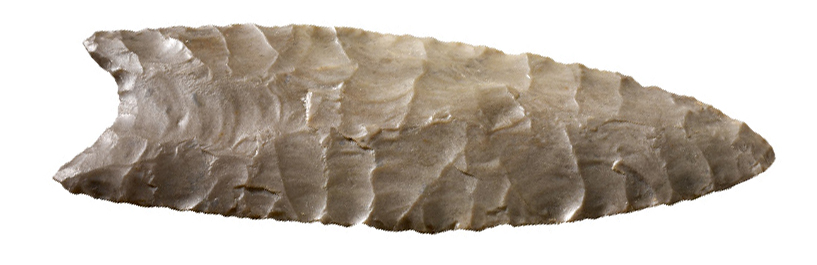
The Clovis point is the signature stone weapon of the first widespread culture in North America, produced for a few centuries around 13,000 years ago. Knapped from fine stone with a distinctive channel — the flute — driven up each face from the base, it tipped thrusting spears and atlatl darts used against the continent's last mammoths and mastodons. Finds from Alaska to Central America make it one of the most widely distributed weapon designs of the entire Stone Age.
Also known as Clovis fluted point
Origins
The point takes its name from Clovis, New Mexico, where excavations near Blackwater Draw in the 1930s found large fluted points lying among mammoth bones — the first firm proof that humans had hunted Ice Age megafauna in the Americas. The people who made them spread across most of North America in a remarkably short span, roughly 13,050 to 12,750 years ago, and their points turn up from the Yukon to Venezuela.
Design & Construction
A Clovis point is a lanceolate — leaf-shaped — blade of high-grade stone: chert, jasper, obsidian, or quartzite chosen for its glassy fracture. The knapper roughed out the form with a hammerstone, refined it with an antler billet, and finished the edges by pressure flaking. The defining feature came last and riskiest: a single channel flake, the flute, struck from the prepared base up each face. Fluting thinned the base so the point could seat deeply into a split wooden or bone foreshaft, lashed with sinew and often set with pitch or asphaltum. Finished points run from under 5 cm to over 20 cm; the concave base and lower edges were ground smooth so the binding would not be cut in use.
Combat & Hunting Use
Clovis points tipped hand-thrust spears and, most effectively, darts launched from the Atlatl — a spear-thrower that multiplies the leverage of the human arm. Points found between mammoth ribs at kill sites across the American West, from Naco and Murray Springs in Arizona to Colby in Wyoming, show the system worked against the largest game on the continent. The foreshaft arrangement was a field-efficient design: when a point snapped or stayed in the animal, the hunter recovered the main shaft and socketed a fresh tip. Many recovered points show resharpening far down the blade, used until nothing workable remained.
Legacy
Clovis technology defines an archaeological horizon: for decades "Clovis First" was the reigning model for the peopling of the Americas, and although older sites are now accepted, the culture remains the first continent-wide signature in the record. The flute itself — an enormously difficult flake to strike without shattering the piece — still challenges modern experimental knappers, and no other stone-tool tradition in the world reproduced it at such scale. Authentic points are protected artifacts on public land in the United States; documented examples in private hands rank among the most valuable of all North American antiquities.
Sources
Haynes, Gary. The Early Settlement of North America: The Clovis Era. Cambridge University Press, 2002.
Justice, Noel D. Stone Age Spear and Arrow Points of the Midcontinental and Eastern United States. Indiana University Press, 1987.
Smithsonian National Museum of Natural History, Department of Anthropology collections.
Suggest an edit · account required · reviewed before publishing · how it works