Weapon Type
Spears & Lances
Thrusting pole weapons.
Pole Weapons — Subcategory
Overview
The spear — a sharpened point on a shaft — is the oldest deliberately shaped human weapon, appearing in the archaeological record over 300,000 years ago. In its thrown form it served as the primary hunting and war weapon of prehistoric humanity; in its thrusting form it was the dominant close-combat weapon for most of recorded history. The lance is the cavalry version — adapted for use from horseback, especially for the mounted charge.
The Spear
Prehistoric Spears
- Wooden spears — The Schöningen spears (Germany, c. 300,000 BCE) are the oldest known wooden weapons; balance indicates they were thrown
- Atlatl-propelled darts — The spear-thrower (atlatl) was the major ranged weapon until the bow; significantly increased range and velocity
- Stone tips — Knapped flint and obsidian spearheads appeared from the Upper Paleolithic onward
Ancient Military Spears
- Greek doru — 2–3 meter hoplite spear; counterbalanced bronze butt-spike; held in overhand or underhand grip in the phalanx
- Roman pilum — Not a thrusting spear but a heavy javelin; lead-weighted iron shank designed to bend on impact; thrown before closing with the gladius
- Germanic framea — Short throwing and thrusting spear; Tacitus noted the Germans relied primarily on the framea
Medieval Spears
The spear never disappeared from medieval warfare but was often overshadowed by the lance and pike:
- Infantry spear — Simple weapon; 1.5–2.5 meters; used with shield in shield-wall formations
- Winged spear — Projections below the blade prevent over-penetration and catch opponent's weapons; Norse and Carolingian
- Hunting spear — Heavy crossbar below the blade stops a charging boar; same principle applied to the military boar spear
Asian Spears
- Yari (Japan) — The primary weapon of Japanese infantry; multiple forms (straight, cross-bladed); see Feudal Japan
- Qiang (China) — The universal Chinese military spear; flexible shaft that vibrated unpredictably on impact
- Voulge, glaive, fauchard — European and Asian weapons in the spear-polearm continuum
The Lance
The lance is the cavalry spear — optimized for the mounted charge:
Ancient and Medieval Lances
- Xyston — Macedonian cavalry lance; 3.5 meters; used by Alexander's Companion cavalry in the wedge charge
- Medieval lance — Progressive development from a light throwing/thrusting spear to the couched lance by the 11th century
- Couched lance — Held under the armpit, braced against the body; transfers the full momentum of horse and rider into the lance point; the defining weapon of medieval heavy cavalry
- Coronel tip — Blunt star-shaped tip for jousting tournaments; reduced lethality for sport
Later Lances
- Polish winged hussar lance — 5–6 meters; hollow wood; remarkably lightweight; delivered devastating charges in 17th century warfare
- Military lance (19th century) — Revived by Napoleonic-era lancers (Polish and French uhlan regiments); proven effective in pursuit of routing infantry; used through WWI by some cavalry units
This article is a stub. Contributions covering specific spear and lance types, cultures, and battles are welcome.
-
Bone Harpoon
The bone harpoon is a barbed point of bone or antler, made to be hafted on a spear or dart and to hold fast in its prey. Barbed bone points… Continued…
-
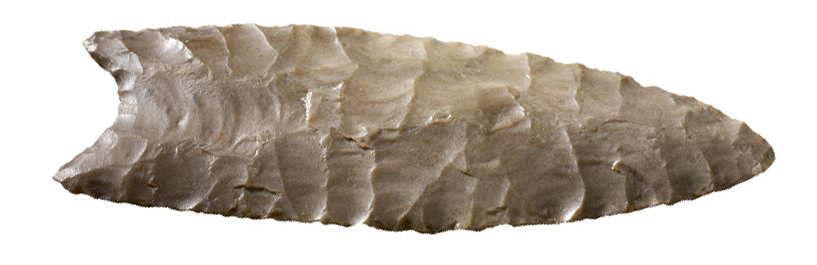
Clovis Point
The Clovis point is the signature stone weapon of the first widespread culture in North America, produced for a few centuries around 13,000… Continued…
-
Frankish Winged Spear
The Frankish winged spear was a spear whose iron head carried two small projections, called wings or lugs, on the socket just below the… Continued…
-
Hoplite Dory
The dory was the thrusting spear of the Greek hoplite, the main weapon of the citizen soldiers who fought in the phalanx from the seventh… Continued…
-
Knight's Lance
The knight's lance was the defining weapon of medieval European heavy cavalry: a long wooden shaft with an iron head, held tight under the… Continued…
-
Roman Hasta
The hasta was the thrusting spear of the early Roman army. In the manipular legion of the Punic Wars it was the weapon of the triarii, the… Continued…
-
Roman Pilum
The pilum was the Roman legionary's heavy javelin: a barbed iron head on a long, thin iron shank socketed into a wooden shaft, thrown in a… Continued…
-
Schiltron Spear
The schiltron spear was the long infantry spear carried by Scottish foot soldiers in the Wars of Scottish Independence. Held in both hands… Continued…
-
Schöningen Spear
The Schöningen spears are the oldest complete hunting weapons ever found: about ten wooden spears, most of spruce, excavated between 1994… Continued…
-
Tepoztopilli
The tepoztopilli was the thrusting spear of the Aztec warrior: a wooden spear whose broad, flat head was edged on both sides with… Continued…
-
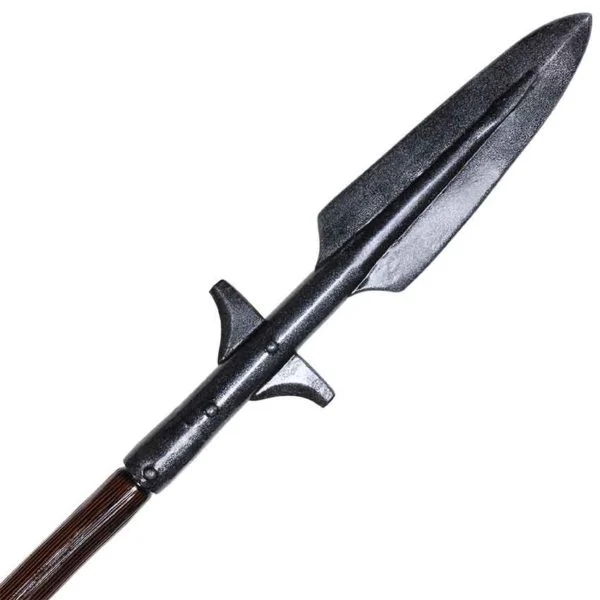
Viking Spear
The spear was the most common weapon of the Viking Age, carried by farmers and kings alike. It had an iron head, socketed onto an ash shaft… Continued…
-
Winged Hussar Lance
The kopia was the lance of the Polish-Lithuanian winged hussars, the heavy cavalry that dominated Eastern European battlefields for more… Continued…
-
Yari
The yari is the Japanese straight-bladed spear. It came into wide use in the fourteenth century and by the Sengoku period of the sixteenth… Continued…
-
Zulu Iklwa
The iklwa was the short stabbing spear of the Zulu warrior — a broad blade up to 45 centimeters on a stout haft under a meter long… Continued…