Viking Spear
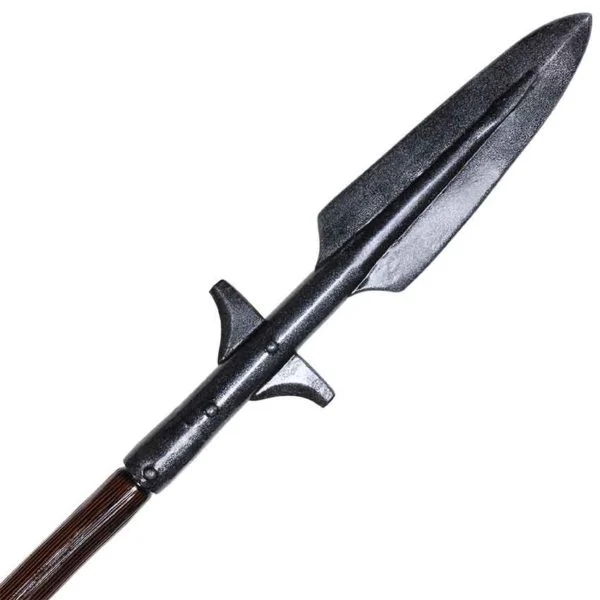
The spear was the most common weapon of the Viking Age, carried by farmers and kings alike. It had an iron head, socketed onto an ash shaft about as tall as a man or taller, and it was used for thrusting from the shield wall and for throwing. Heads ranged from long, narrow blades to broad leaf shapes and the 'winged' Frankish type, and the best were pattern-welded and inlaid with silver. Odin's spear Gungnir made it the weapon of the chief god, and every account of battles like Maldon is full of spears.
Also known as Spjót, Old Norse spear, Viking-age spear, winged spear, Anglo-Saxon spear, gár
Origins
The spear is the oldest weapon in Europe, and by the Viking Age it had been the basic arm of Scandinavian warriors for more than a thousand years. Norse law expected every free man to own a spear and shield, and they are the weapons found most often in Viking graves, far more often than the sword. A spear was cheap. It needed only a modest amount of iron and a straight length of ash. It was also useful for hunting and easy to learn. In Old Norse it was the spjót, and poets gave it many other names. Odin, the chief of the gods, carried the spear Gungnir, and the sagas describe the custom of opening a battle by throwing a spear over the enemy army to give them to Odin.
Design & Construction
A Viking spear had an iron head with a hollow socket that fitted over the end of the shaft and was held by a rivet. Heads varied greatly in size and shape: long, narrow blades up to two feet long for piercing mail, broad leaf-shaped heads for cutting, and the 'winged' type, with two small lugs at the base of the blade, copied from Frankish spears. Winged spears may have been made to stop the blade going in too deep or to hook an enemy's shield. The finest heads were pattern-welded from twisted bars of iron and steel, and their sockets were decorated with silver or copper inlay. Shafts were usually of ash, about an inch thick, and the whole spear stood from about seven to ten feet. Lighter throwing spears, with smaller heads and shorter shafts, were carried as well.
Combat Use
In the shield wall, spears were used overarm or underarm over and around the shields, striking at faces, throats and legs. The sagas describe skilled warriors throwing two spears at once or catching a thrown spear in the air and hurling it back. The Old English poem about the Battle of Maldon in 991 is full of spear-fighting: Byrhtnoth is wounded by a spear, kills the thrower, and is killed in a new exchange. The spear was used with the Viking Round Shield, and it outlasted every other weapon when the axe or sword broke. The Dane Axe and sword were the weapons of wealthier or specialist fighters, but the spear was in every hand.
Legacy
Viking spearheads are found in graves, in rivers, and on battlefields across Scandinavia, the British Isles and Russia, and archaeologists use their changing shapes to date finds. The spear stayed the main infantry weapon of the Middle Ages, and it developed into the knight's lance on horseback and later into the pike and halberd on foot. The mounted Knight's Lance and the infantry spear of the later medieval armies both came from the same simple weapon.
Sources
Short, William R. Viking Weapons and Combat Techniques. Westholme Publishing, 2009.
Hjardar, Kim, and Vegard Vike. Vikings at War. Casemate, 2016.
Harrison, Mark. Viking Hersir, 793-1066 AD. Osprey Publishing, 1993.
Pedersen, Anne. Dead Warriors in Living Memory: A Study of Weapon and Equestrian Burials in Viking-Age Denmark, AD 800-1000. National Museum of Denmark, 2014.
Suggest an edit · account required · reviewed before publishing · how it works