Viking Round Shield
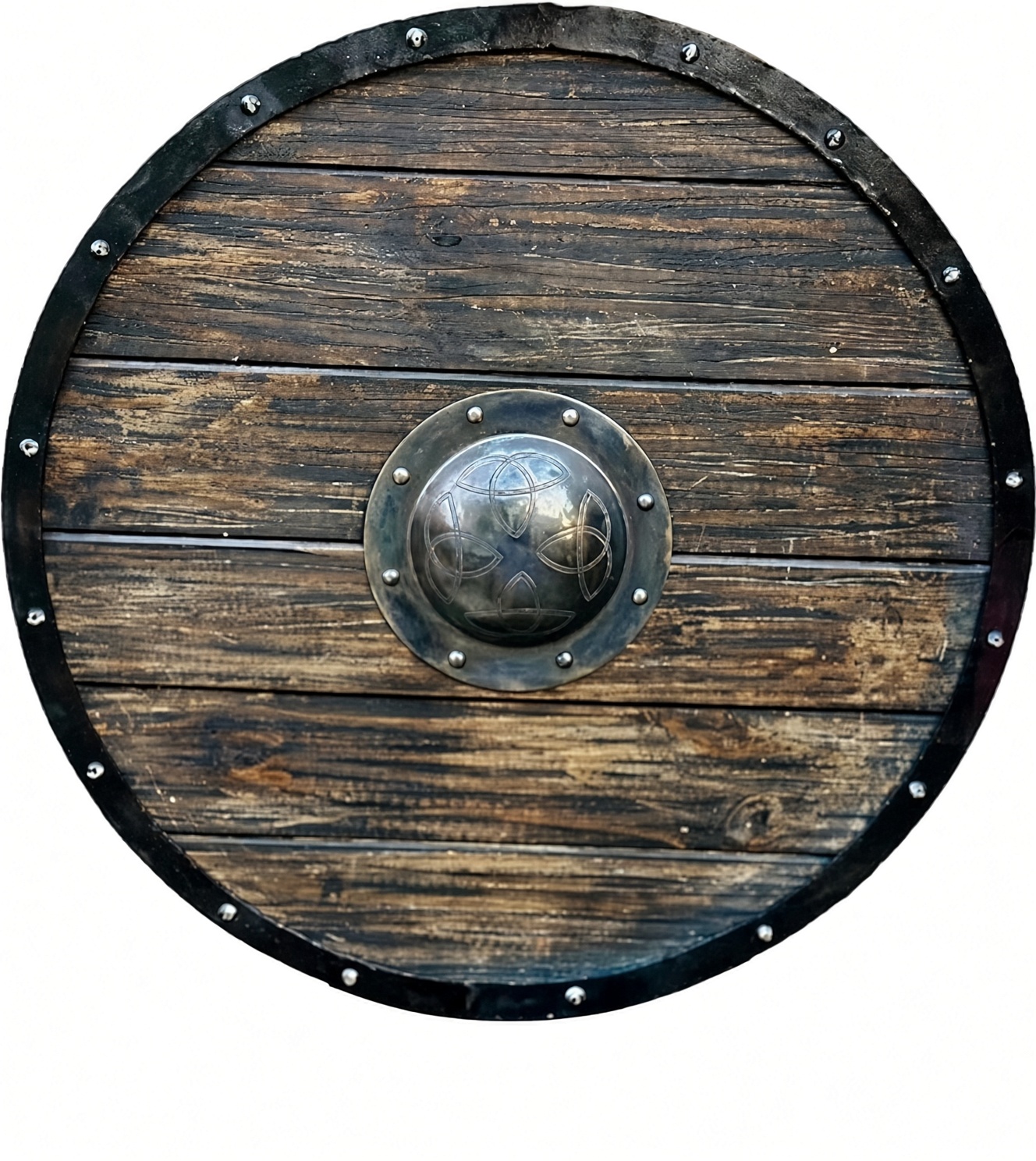
The round shield was the main defense of the Viking warrior: a disc of wooden boards, usually about 80 to 95 centimeters across, with an iron boss protecting the hand at the center. Light, cheap and quick to make, it was held by a single central grip, and in battle warriors locked their shields together in the shield wall. The best surviving examples are the 64 shields found with the Gokstad ship in Norway, painted black and yellow. It was used from the Iron Age until the kite shield replaced it in the eleventh century.
Also known as Viking shield, round shield, Gokstad shield, skjöldr
Origins
Round wooden shields had been used across northern Europe since the Iron Age. Bog finds in Denmark, such as those from Illerup Ådal and Thorsberg, preserve shields from the Roman Iron Age, and the round shield remained standard among Germanic and Scandinavian peoples through the Migration Period and the Vendel era. By the Viking Age, from the end of the eighth century, it was the defensive equipment every free warrior was expected to own, together with a spear and an axe or sword. The most important surviving examples come from the Gokstad ship burial in Norway, dug in 1880, where 64 shields had been hung along the sides of the ship.
Design & Construction
A Viking round shield was made of a single layer of wooden boards — often spruce, pine or fir — glued or butted edge to edge to form a disc, typically eighty to ninety-five centimeters in diameter and less than a centimeter thick. The Gokstad shields are about 94 centimeters across and were painted alternately black and yellow. The center was cut out and covered by a domed iron boss, which protected the hand holding a wooden grip that ran across the back. The front may have been faced with leather or linen, and the rim was probably bound with rawhide, which shrank tight as it dried; clips of iron or bronze sometimes survive. The shield was light, around five kilograms or less, and was not strapped to the arm but held at arm's length and moved to meet blows.
Combat Use
In single combat the round shield was an active weapon: the warrior punched with the boss, caught blows on the face or edge, and turned the shield to open his opponent's guard. The sagas describe fighters wearing out several shields in a duel. In a battle the shields were locked together in the shield wall, the skjaldborg, with each man's shield overlapping his neighbor's, the spears of the rear rank reaching over the front. Axes such as the Dane Axe and Viking Battle Axe were used to hook and split shields. The shield wall fought great battles from Maldon to Stamford Bridge, and the Jomsvikings fought behind round shields at the sea battle of Hjörungavágr around 986. The Varangian Guard of the Byzantine emperors carried round shields as well.
Legacy
In the eleventh century the round shield was largely replaced by the longer Norman Kite Shield, which protected a mounted man's leg, and by the heater shield of the later Middle Ages. It remains the defining image of the Viking warrior, together with the Ulfberht Sword, and it is standard equipment for Viking reenactors. Its predecessors include the bronze-faced Greek Aspis of the classical world, used in a very different way in the hoplite phalanx.
Sources
Nicolaysen, Nicolay. The Viking-Ship Discovered at Gokstad in Norway. Cammermeyer, 1882.
Short, William R. Viking Weapons and Combat Techniques. Westholme Publishing, 2009.
Harrison, Mark. Viking Hersir 793-1066 AD. Osprey Publishing, 1993.
Suggest an edit · account required · reviewed before publishing · how it works