Dane Axe
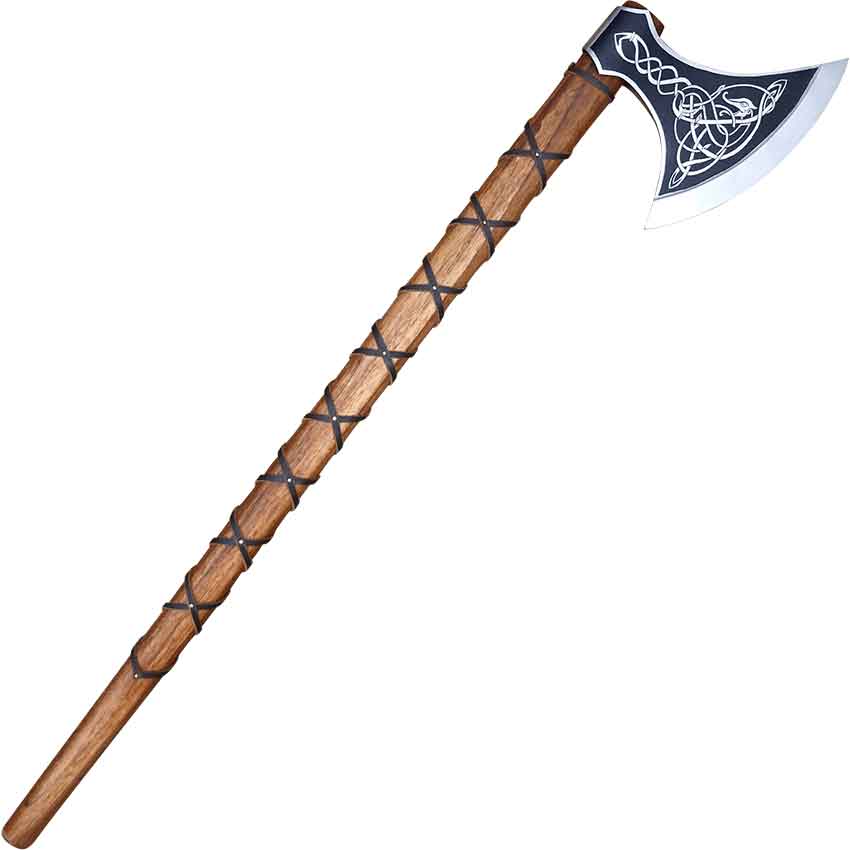
The Dane axe is the great two-handed axe of the Viking Age and its aftermath: a thin, broad, crescent-edged head on a haft about a meter long, swung with both hands to cut through shield, mail and man. Carried by the Scandinavian elite, by the Anglo-Danish housecarls who died around Harold at Hastings, and by the Byzantine emperor's Varangian Guard, it was the most feared infantry weapon of the eleventh century and survived in Scotland and Ireland as the sparth axe for three hundred years more.
Also known as Danish axe, Dane axe, broad axe, hafted axe, breiðöx, English long axe, sparth axe
Origins
The axe was the everyday tool of the Norse world, and the bearded fighting axes of the early Viking Age were little more than heavy tools with longer edges. Toward the end of the tenth century a distinct war axe appeared, classified by Jan Petersen as his Type M: a head of much larger size and much thinner section, its cutting edge swept into a broad crescent, mounted on a long haft for two-handed use. Contemporaries called it the breiðöx, the broad axe; the English, who met it in the hands of Cnut's Danes, called it the Danish axe, and so it has stayed. The Vikings carried it in the last great campaigns of the age and the Anglo-Danish kingdom of England adopted it as the weapon of its professional soldiery.
Design & Construction
A Dane axe head is a study in economy: the crescent edge may span 20 to 30 centimeters, yet the blade thins to two millimeters or less behind the edge, and the whole head weighs only about a kilogram. The best examples were made with a hardened steel edge forge-welded to a softer iron body, and some were inlaid with silver. The haft, of ash or oak, ran from roughly 0.9 to 1.2 meters — long enough for a two-handed swing with real reach, short enough to fight in a shield wall. The thinness that made the axe light and fast also made it vulnerable; heads are found broken, and the weapon was a killer rather than a parrying tool, used from behind the front rank or in the open when the wall broke.
Combat Use
The Norwegian who held Stamford Bridge alone in 1066, cutting down forty Englishmen before he was speared from beneath, is the axe's legend; the Bayeux Tapestry is its record, showing Harold's housecarls swinging long axes two-handed at the Norman cavalry and one cleaving a horse's head. A Dane axe stroke could split a shield, shear through mail and the arm inside it, or fell a horse, and William's knights learned to respect it. In Constantinople the Varangian Guard — first Rus and Scandinavians, later exiled Englishmen — were known simply as the emperor's axe-bearers. The weapon coexisted with the sword and spear rather than replacing them: a warrior with a Dane axe had no shield hand and depended on his neighbors.
Legacy
After the Norman Conquest the great axe faded in England but flourished at the Celtic fringe. Gallowglass mercenaries in Ireland and the Highlanders of Scotland carried the sparth or "sparr" axe, a direct descendant with a longer haft, into the sixteenth century, and the Halberd and other staff weapons of the later Middle Ages owe something to it. Modern reconstructions based on Petersen Type M finds from Scandinavia, England and Ireland are a staple of Viking re-enactment, and the axe appears in almost every popular depiction of the era.
Sources
Petersen, Jan. De Norske Vikingesverd. Kristiania, 1919 (axe typology).
Halpin, Andrew. 'Irish Medieval Swords c. 1170-1600.' Proceedings of the Royal Irish Academy, 1986.
Bayeux Tapestry, Musée de la Tapisserie de Bayeux (housecarls with axes).
Wilson, David M. The Vikings and Their Origins. Thames & Hudson, 1970.
Suggest an edit · account required · reviewed before publishing · how it works