Weapon Type
Short Swords
Single-handed blades under 24 inches.
Edged Weapons → Swords — Subcategory
Overview
Short swords occupy the range between the dagger and the longer military sword — typically 30–60 cm blade length. In a close-packed infantry formation (Roman legion, Greek phalanx, medieval shield wall), a longer sword cannot be effectively swung — there is no room. The short sword's limited length is actually an advantage in these conditions: it can thrust between bodies, between shields, and into gaps without requiring the fighter to step back.
Major Historical Short Swords
Greek Xiphos
- Blade length — 45–60 cm; double-edged; leaf-shaped; acute point
- The standard sidearm of Greek hoplites — warriors who carried the 2-meter doru (spear) as their primary weapon
- When the spear broke or opponents closed too near to use it, the xiphos was drawn
- Used in tight phalanx fighting where the long spear was useless
Roman Gladius
The gladius is arguably the most influential short sword in history:
- Blade length — 40–55 cm (varies by type); double-edged; acute point
- Width — Broad at the base; tapering sharply
- The Roman scutum (large curved shield) created a fighting system: the shield pushed into the enemy, the gladius thrust into the gaps
- Optimized for the stab rather than the cut — a thrust to the abdomen was quicker, more reliable, and used less space than a cut
- Types: Mainz (earlier; longer point), Fulham (transitional), Pompeii (shorter; parallel sides; most common)
Roman Spatha
- Blade length — 60–85 cm; the longer sword adopted from Celtic cavalry
- Replaced the gladius as Roman cavalry expanded; eventually replaced the gladius in infantry use in Late Rome
- Direct ancestor of the medieval sword
Viking Seax
- Blade length — 15–75 cm; huge range; single-edged; utility knife up to short sword length
- The universal tool-weapon of Germanic and Norse peoples
- The Saxons derived their name from the seax
Medieval Arming Sword
- Blade length — 70–80 cm; in the borderland between short sword and longsword
- The standard one-handed knightly sword of 9th–15th centuries
- Carried at the hip as the primary or sidearm weapon; versatile cut and thrust
Modern Short Sword / Long Knife
- In the modern era, the short sword has essentially merged with the combat knife category
- The distinction between a large fighting knife (e.g., Bowie knife) and a short sword is primarily one of classification, not function
This article is a stub. Contributions covering specific short sword examples, cultures, and combat systems are welcome.
-
Greek Kopis
The kopis was the forward-curved, single-edged chopping sword of classical Greece. Its blade is concave near the hilt and swells toward the… Continued…
-
Greek Xiphos
The xiphos was the sidearm of the Greek hoplite: a double-edged, leaf-bladed short sword drawn when the spear — always the primary weapon … Continued…
-
Infantry Hanger
The infantry hanger was the short, slightly curved sword carried by private soldiers and grenadiers of the British foot for much of the… Continued…
-
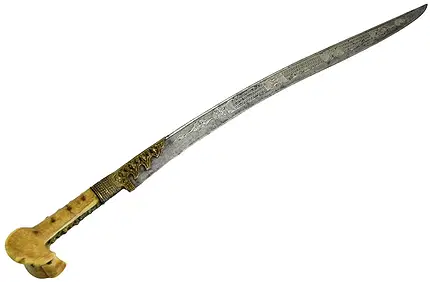
Ottoman Yatagan
The yatagan is the signature short sword of the Ottoman world: a single-edged blade curving forward like the kopis and kukri family, a hilt… Continued…
-
Persian Akinakes
The akinakes is the straight, double-edged short sword of the Achaemenid Persian Empire, borrowed from the Scythian horsemen of the steppe… Continued…
-
Roman Gladius
The gladius was the short sword of the Roman legionary and the weapon that conquered the Mediterranean world. Adopted from Iberian patterns… Continued…