Historical Context
English Civil War
Armed conflict between Royalist and Parliamentary forces in England. Both sides fielded matchlock and early flintlock muskets alongside cavalry pistols and pikes, and the war drove early standardization of military firearms and tactics in Britain.
1642 – 1651
Overview
The English Civil War was fought between the forces of King Charles I (Royalists, or "Cavaliers") and the English Parliament (Parliamentarians, or "Roundheads"). It ended with Charles I's execution in 1649, the establishment of the Commonwealth, and eventually the Protectorate under Oliver Cromwell. The war coincided with similar conflicts in Scotland and Ireland, collectively known as the Wars of the Three Kingdoms.
Militarily, the war was fought with the transitional weapons of the mid-17th century — the pike-and-shot system still dominant, but with flintlock muskets beginning to replace matchlocks, and the cavalry tactics of the era under active development.
Infantry Weapons
Muskets
Both sides initially relied on matchlock muskets, with flintlocks becoming more common as the war progressed:
- Matchlock musket — The dominant infantry arm at the war's start; .75–.80 caliber; required a lit match at all times
- Flintlock (doglock) — The English doglock — a transitional flintlock with an external safety catch — appeared during the war and was increasingly issued, particularly to Parliamentary forces
- Musket rest — Early in the war, heavy muskets required a forked rest; lighter muskets that could be fired without one were increasingly used
Pike
Pikemen remained roughly equal in numbers to musketeers at the war's start, with proportions shifting toward musketeers as the war continued. A 16-foot pike was standard; some forces shortened them for practicality.
The Plug Bayonet
The plug bayonet appeared toward the war's end — a blade inserted into the musket's muzzle, converting it temporarily to a pike. Its limitation (the musket cannot be fired with it inserted) made it only a transitional solution.
Cavalry Arms
Royalist Cavalry (Prince Rupert's Horse)
Prince Rupert of the Rhine commanded Royalist cavalry in the aggressive Continental style — heavy charge with sword, pistols discharged at the moment of contact. Effective tactically but prone to pursuing routed enemies too far (a recurring problem at Edgehill and Marston Moor).
Parliamentary Cavalry (Ironsides)
Oliver Cromwell developed the Ironsides — cavalry trained to charge hard but maintain discipline after a charge, rallying and returning to the battlefield rather than pursuing. This discipline proved decisive.
Cavalry weapons:
- Cavalry saber — Broad straight or slightly curved blade; primary melee weapon
- Horse pistols — Typically a brace (pair) of flintlock or doglock pistols in saddle holsters
- Carbine — A shorter musket for mounted use
Cuirassier Armor
Heavy cavalry (cuirassiers) wore back and breastplate, gorget, and often three-quarter armor. The distinctive pot helmet (lobster-tail pot) became the iconic Parliamentary cavalry helmet. Royalist cavalry often wore less armor, relying on speed.
Artillery
Both sides used artillery in sieges and in the field. The New Model Army (formed 1645) standardized Parliamentary artillery under professional command.
- Demi-culverin — Medium field gun; 9-pounder; standard field piece
- Saker — Lighter field gun; 5–6 pounder
- Mortar — High-trajectory siege weapon; used in the numerous castle and town sieges
The New Model Army
Parliament's creation of the New Model Army in 1645 was a significant military development — a professional force with standardized pay, training, and equipment. Its weapons were increasingly standardized, anticipating later army organization. The New Model Army's discipline and equipment superiority proved decisive at Naseby (1645).
This article is a stub. Contributions covering specific battles, weapons, and commanders are welcome.
Battles & Operations
Weapons
-
Cuirassier Armor
Cuirassier armor was the three-quarter plate armor worn by heavy cavalry in Europe from the late sixteenth century to the middle of the… Continued…
-
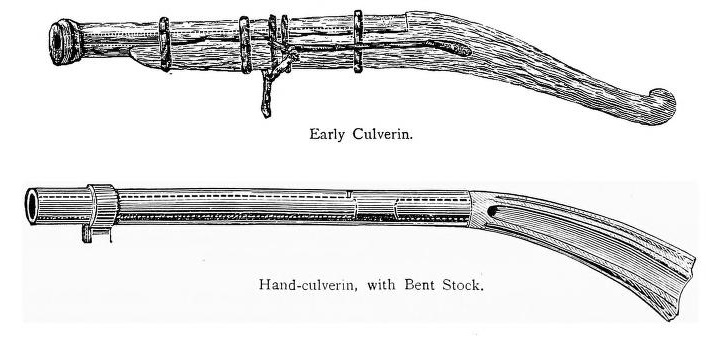
Culverin
The culverin was a long-barreled muzzle-loading gun of the sixteenth and seventeenth centuries. Compared with the heavier 'cannon' class it… Continued…
-
Lobster-Pot Helmet
The lobster-pot helmet was the standard helmet of European light-armored cavalry in the seventeenth century. Known in German as the… Continued…
-
Matchlock Musket
The matchlock was the first firearm a soldier could aim and fire without taking his eyes off the enemy: a serpentine lever lowered a… Continued…
-
Pike
The pike is the longest infantry weapon ever carried in formation: an ash shaft of 16 to 22 feet tipped with a small steel head, used by… Continued…
-
Wheellock Pistol
The wheellock was the first self-igniting firearm: a spring-driven steel wheel spun against pyrite to shower sparks into the pan, no… Continued…