Culverin
The culverin was a long-barreled muzzle-loading gun of the sixteenth and seventeenth centuries. Compared with the heavier 'cannon' class it fired a smaller ball, usually about 15 to 18 pounds for a full culverin and about 9 pounds for the demi-culverin, but its long barrel gave it greater range. Culverins armed fortresses, siege trains and warships. The English fleet that fought the Spanish Armada in 1588 relied heavily on culverins and demi-culverins to engage the Spanish ships at a distance.
Also known as Culverin, couleuvrine, colubrina, culebrina, demi-culverin, whole culverin, culverin royal, hand culverin
Origins
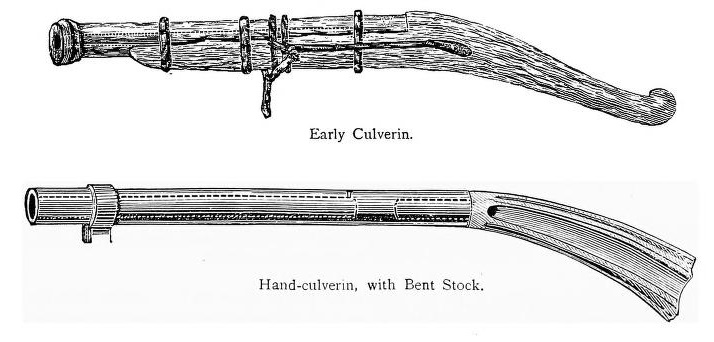
The name culverin comes from the French couleuvrine, from the Latin word for a snake, a reference to the gun's long, thin shape. In the fifteenth century the word was used for a range of early gunpowder weapons, from small hand-held guns like the Hand Cannon to light field pieces. By the early sixteenth century it had settled on one class of artillery: long guns that fired a moderate iron ball. Gunners of the period sorted their guns into families. The 'cannon' family fired heavy balls from relatively short barrels and was used to batter walls at close range. The culverin family had much longer barrels for their caliber and fired lighter shot, and it was valued for range and accuracy. Smaller members of the same family included the saker, minion and falcon. The culverin was part of the wider Gunpowder Revolution that changed siege warfare and war at sea in this period.
Design & Construction
Culverins were cast in one piece, most often in bronze, which gunfounders called brass. Bronze guns were strong and less likely to burst, but they were expensive. From the 1540s English founders in the Weald of Sussex learned to cast guns in iron, which cost far less, and iron culverins became common on English merchant ships and later on warships. Sizes were never fully standard, and every country and founder used slightly different figures. A typical English full culverin had a bore of about 5 to 5.5 inches, fired a ball of roughly 15 to 18 pounds, and weighed around 4,000 pounds or more. Its barrel was often thirty calibers or more in length, around 11 to 13 feet. The demi-culverin fired a ball of about 9 pounds. The gun was loaded from the muzzle with a charge of black powder, a wad and the ball, and fired by putting a slow match or linstock to the touch-hole. On land it rode on a two-wheeled field carriage. At sea the English increasingly mounted it on compact four-wheeled truck carriages, which made it quicker to run in, reload and run out again.
Combat Use
Culverins served in siege batteries and in fortress walls across Europe, and armies of the period dragged them on campaign when roads allowed. At sea they were the main long-range guns of the sixteenth-century sailing warship. Guilmartin notes that the heavy centerline bow gun of a Mediterranean war galley was often a cannon or a culverin. The weapon's best-known campaign was the Spanish Armada in 1588. The English royal ships, led by galleons such as Ark Royal and Revenge, carried a high share of culverins and demi-culverins, and the English captains used them to fire on the Spanish fleet from beyond boarding distance. For most of the week-long running fight up the Channel this long-range fire did little serious damage. At Gravelines on 8 August the English closed to much shorter range, and their guns killed many men and badly damaged several Spanish ships. Culverins also armed the Galleon on both sides, and they went on to serve in the English Civil War and the Thirty Years War.
Legacy
During the seventeenth century the old family names fell out of use. Navies and armies began to describe guns by the weight of shot they fired, and the demi-culverin became, roughly, the 9-pounder and the culverin the 18-pounder. The long iron gun on a truck carriage led directly to the broadside guns of the eighteenth century, such as the 32-Pounder Naval Long Gun. The word culverin survives mostly in the names of old guns displayed at forts and museums.
Sources
Hall, Bert S. Weapons and Warfare in Renaissance Europe: Gunpowder, Technology, and Tactics. Johns Hopkins University Press, 1997.
Guilmartin, John F. Gunpowder and Galleys: Changing Technology and Mediterranean Warfare at Sea in the Sixteenth Century. Cambridge University Press, 1974.
Martin, Colin, and Geoffrey Parker. The Spanish Armada. Hamish Hamilton, 1988.
Caruana, Adrian B. The History of English Sea Ordnance 1523-1875, Volume I: The Age of Evolution, 1523-1715. Jean Boudriot Publications, 1994.
Suggest an edit · account required · reviewed before publishing · how it works