Spanish Armada
The Spanish Armada was the fleet of about 130 ships that Philip II of Spain sent against England in 1588. It was meant to sail up the English Channel and escort the Duke of Parma's army from Flanders to invade England. The English fleet fought it in a running battle up the Channel, drove it from its anchorage off Calais with fire ships, and attacked it at Gravelines on 8 August. The Armada escaped north around Scotland and Ireland, where storms wrecked many ships, and the invasion never took place.
Also known as Spanish Armada, Armada of 1588, Invincible Armada, Grande y Felicísima Armada, Enterprise of England, Battle of Gravelines, Armada campaign
Background
In the 1580s Spain under Philip II was the strongest power in Europe. England under Elizabeth I supported the Protestant rebels fighting Spain in the Netherlands, and English captains such as Francis Drake raided Spanish colonies. In 1585 Elizabeth agreed by the Treaty of Nonsuch to send an army to help the Dutch, and open war followed, the start of the Anglo-Spanish War. The execution of the Catholic Mary, Queen of Scots, in February 1587 removed Philip's last hope of a friendly ruler in England. His plan, called the Enterprise of England, was for a great fleet to sail up the Channel and protect the crossing of the Duke of Parma's veteran army from Flanders. Drake's raid on Cádiz in April 1587 delayed the preparations, and in February 1588 the fleet's experienced commander, Álvaro de Bazán, Marquis of Santa Cruz, died. Command passed to the Duke of Medina Sidonia, a great nobleman with little experience at sea. The Armada left Lisbon at the end of May 1588 with about 130 ships and roughly 18,000 soldiers and 7,000 to 8,000 sailors. Storms forced it into A Coruña, and it did not sail again until 22 July.
The Battle
The dates here follow the Gregorian calendar used in Spain; English records of the time are ten days earlier. The Armada was sighted off the Lizard in Cornwall on 29 July. The English fleet under Lord Howard of Effingham, with Drake, John Hawkins and Martin Frobisher, worked out of Plymouth and got to windward. The Spanish kept a tight crescent formation. Actions followed off Plymouth on 31 July, off Portland Bill on 2 August and off the Isle of Wight on 4 August. The English fired a great deal of shot at long range and did little damage, but they took two Spanish ships crippled by accidents, including Nuestra Señora del Rosario, which surrendered to Drake. On 6 August the Armada anchored off Calais. Parma's army was not ready, and Dutch ships blockaded his invasion barges in port. Around midnight on 7 to 8 August the English sent in eight fire ships. The Spanish cut their cables and scattered. On 8 August, off Gravelines, the English closed in to much shorter range than before. In a day of hard fighting several Spanish ships were shattered, and two drifted onto the Flemish banks and were taken by the Dutch. A shift in the wind the next day kept the rest of the Armada off the sandbanks of Zeeland.
Weapons
This was a gunnery battle between sailing ships. Both fleets were built around the Galleon, but the English ships were generally faster and handier. The English relied on long guns like the Culverin mounted on compact truck carriages that were quick to reload. Many Spanish guns sat on large two-wheeled carriages, and evidence from Armada wrecks suggests that they fired few rounds. The Spanish counted on boarding, with soldiers carrying the Arquebus and Matchlock Musket and wearing the Morion Helmet, and small Swivel Gun pieces to clear enemy decks. The four Neapolitan galleasses were larger versions of the Venetian Galleass. The decisive weapon off Calais was the Fire Ship.
Aftermath
With the wind against it, the Armada could not turn back to meet Parma. It sailed north around Scotland and then down the west coast of Ireland, where autumn gales drove many ships onto the rocks. Estimates of the losses vary, but between a third and a half of the ships never returned to Spain, and perhaps 15,000 or more men died from battle, shipwreck, disease and killings on shore. The English lost no ships and fewer than 100 men in the fighting, but thousands of sailors died of disease afterward. The war continued until 1604, and Spain sent further armadas in 1596 and 1597. In England the defeat of 1588 became a lasting symbol of national survival.
Weapons used
-
Galleon
Galleons formed the fighting core of both fleets, from Medina Sidonia's San Martín to Howard's Ark Royal and Drake's Revenge. Continued…
-
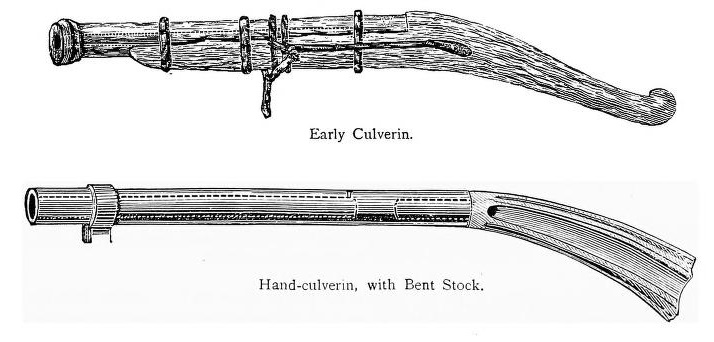
Culverin
English ships carried many culverins and demi-culverins and used them to fight at a distance, most effectively at close range off… Continued…
-
Fire Ship
Eight English fire ships sent in off Calais on the night of 7 to 8 August drove the Armada out of its anchorage in disorder. Continued…
-
Venetian Galleass
Four Neapolitan galleasses sailed with the Armada; the San Lorenzo ran aground at Calais and the Girona was wrecked off Ireland. Continued…
-
Swivel Gun
Light swivel pieces on rails and castles were meant to sweep enemy decks in the boarding fight that the Spanish never got. Continued…
-
Arquebus
The Armada carried thousands of Spanish soldiers armed with arquebuses, both for boarding and for the landing in England. Continued…
-
Matchlock Musket
Spanish musketeers aboard fired from the upper decks and castles when English ships came within range. Continued…
-
Morion Helmet
The helmet of the Spanish infantry embarked on the Armada, many of them veterans of the war in the Netherlands. Continued…
Sources
Mattingly, Garrett. The Armada. Houghton Mifflin, 1959.
Martin, Colin, and Geoffrey Parker. The Spanish Armada. Hamish Hamilton, 1988.
Fernández-Armesto, Felipe. The Spanish Armada: The Experience of War in 1588. Oxford University Press, 1988.
Konstam, Angus. The Armada Campaign 1588: The Great Enterprise against England. Osprey Publishing, 2001.
Suggest an edit · account required · reviewed before publishing · how it works