Historical Context
Anglo-Spanish War
The undeclared war between Elizabethan England and Habsburg Spain from 1585 to 1604, fought at sea, in the Netherlands, in Ireland and in the Americas. Its best-known episode was the defeat of the Spanish Armada in 1588, a campaign decided by galleons and long-range guns.
1585 – 1604
Overview
Relations between England and Spain had been getting worse for years before open war began. Elizabeth I was a Protestant queen, Philip II the leading Catholic ruler of Europe, and English sailors such as John Hawkins and Francis Drake had raided Spanish trade and colonies since the 1560s. The war began in 1585, when Elizabeth signed the Treaty of Nonsuch and sent an army under the Earl of Leicester to support the Dutch rebels against Spain. Drake raided the Caribbean in 1585 and 1586 and attacked Cádiz in 1587. Philip's answer was the Spanish Armada of 1588, which failed to carry the Duke of Parma's army to England. The next year an English counter-expedition under Drake and John Norris failed at A Coruña and Lisbon. In 1591 the galleon Revenge was lost fighting a Spanish squadron in the Azores, and in 1595 and 1596 both Hawkins and Drake died of disease on a last expedition to the Caribbean. In 1596 an English and Dutch force under the Earl of Essex and Lord Howard captured and sacked Cádiz. Spain sent new armadas in 1596 and 1597, but both were scattered by storms. In 1601 a Spanish force landed at Kinsale in Ireland to support the Irish rebellion of Hugh O'Neill, but the Irish were defeated outside the town and the Spanish surrendered early in 1602.
Ships and Weapons
The war at sea was fought mainly by the Galleon, armed with long guns like the Culverin, alongside armed merchant ships and privateers. The English favored fast, low 'race-built' galleons and fighting at a distance, while the Spanish relied on soldiers and boarding. The Fire Ship broke the Armada's formation off Calais in 1588. On land, in the Netherlands, France and Ireland, both sides fought with pike and shot: the Pike, the Arquebus and the heavier musket, with infantry wearing helmets such as the Morion Helmet. Spain's Army of Flanders was the most experienced army in Europe.
Legacy
Neither side won outright. Philip II died in 1598 and Elizabeth in 1603, and their successors, Philip III and James I, made peace in the Treaty of London in 1604. Spain kept its American empire and its treasure fleets, which were rarely caught, and England gave up its open support for the Dutch. But England had survived as a Protestant state, the Dutch Republic had established itself, and English sailors had gained the experience and confidence that later helped build colonies in North America. In English memory the defeat of the Armada became one of the founding stories of the nation's sea power.
Battles & Operations
Weapons
-
Arquebus
The arquebus was the first practical infantry firearm, a matchlock long gun light enough to be fired from the shoulder or chest without a… Continued…
-
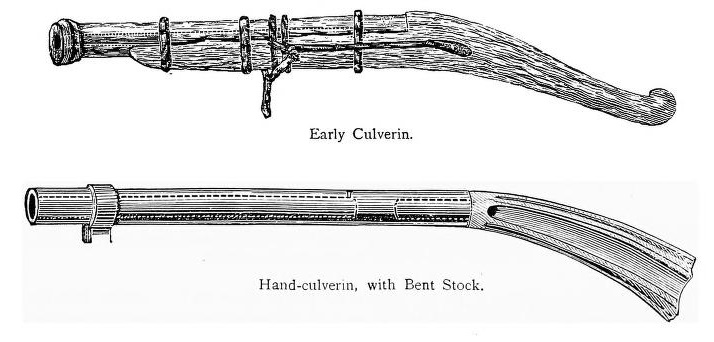
Culverin
The culverin was a long-barreled muzzle-loading gun of the sixteenth and seventeenth centuries. Compared with the heavier 'cannon' class it… Continued…
-
Fire Ship
A fire ship was a vessel filled with flammable material, set alight and sent drifting or sailing into an enemy fleet. Wooden ships with… Continued…
-
Galleon
The galleon was the large ocean-going sailing ship of the sixteenth and early seventeenth centuries, used both as a warship and as an armed… Continued…
-
Matchlock Musket
The matchlock was the first firearm a soldier could aim and fire without taking his eyes off the enemy: a serpentine lever lowered a… Continued…
-
Morion Helmet
The morion is the open steel helmet with a tall comb and a brim swept up to points at front and back that armed pikemen and arquebusiers… Continued…
-
Swivel Gun
The swivel gun was a small cannon mounted on a forked iron yoke that pivoted in a socket on a ship's rail, fighting top or boat bow, so… Continued…
-
Venetian Galleass
The galleass was a large, heavily gunned warship of the sixteenth-century Mediterranean, built by Venice from its great merchant galleys.… Continued…