Weapon Type
Siege Weapons
Large weapons used to attack or defend fortifications.
Category Overview
Overview
Siege weapons are specialized weapons systems designed to attack or reduce fortifications — to breach walls, destroy gates, kill defenders on walls, or project incendiary and biological agents over defensive perimeters. The history of siege weapons is the history of the contest between attack and defense in fixed positions, driving both weapons innovation and architectural innovation in parallel.
Categories of Siege Weapons
Direct Assault
- Battering ram — Heavy beam (often suspended) swung against gates and walls; iron-shod tip; protected by a penthouse; among the oldest siege weapons
- Siege tower — Mobile tower on wheels rolled against walls; allowed attackers to fight on the same level as defenders
Indirect Fire (Pre-Gunpowder)
- Catapult (tension/torsion) — Uses wound rope, sinew, or hair under torsion; throws projectiles in a low trajectory
- Ballista — Giant crossbow; fires bolts or stones accurately at long range; torsion-powered
- Onager — Single-arm sling catapult; throws heavy stones in a high arc
- Trebuchet — Counterweight engine; the most powerful pre-gunpowder siege weapon; could throw 150+ kg stones 200+ meters with accuracy; the dominant siege weapon of the 12th–14th centuries
Gunpowder Artillery
- Bombard — Early cannon; heavy stone or iron ball; the fall of Constantinople (1453) demonstrated the bombard's power against medieval walls
- Mortar — Short-barreled, high-angle; fires shells in a plunging arc over walls
- Siege gun — Heavy cannon; reduced fortifications systematically; drove the trace italienne defensive revolution
Area Weapons
- Greek fire — Byzantine incendiary; projected by pump; burned on water; composition unknown; devastating against wooden ships and siege equipment
- Incendiary projectiles — Pitch-coated burning materials catapulted into besieged areas
- Disease (biological) — Corpses catapulted into besieged cities to spread plague; recorded at the Siege of Caffa (1346)
The Fortification Response
Every advance in siege weapons drove fortress design evolution:
- Thick earthwork walls absorbed cannon fire (replacing thin stone walls)
- Bastion forts eliminated dead ground where rams could approach
- Concentric castles doubled the defensive perimeter
- Modern hardened bunkers use reinforced concrete
This article is a stub. Contributions covering specific siege weapons, fortifications, and famous sieges are welcome.
-
8.8 cm Flak
The 8.8 cm Flak was the German family of heavy anti-aircraft guns known to Allied soldiers simply as the 88. The Flak 18 of 1933 and the… Continued…
-
Bofors 40 mm Gun
The Bofors 40 mm gun is a light anti-aircraft gun designed by the Swedish firm AB Bofors in the early 1930s. It fired a two-pound explosive… Continued…
-
Bombard
A bombard was a large, short-ranged cannon of the fourteenth to sixteenth centuries that fired heavy stone balls against castle and town… Continued…
-
Congreve Rocket
The Congreve rocket was a British military rocket developed by William Congreve at the Royal Arsenal, Woolwich, from 1804, based on the… Continued…
-
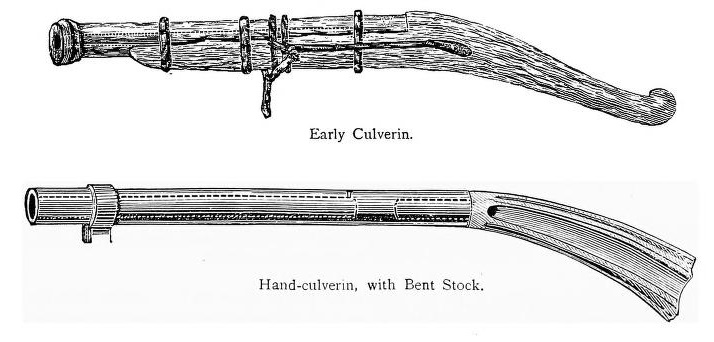
Culverin
The culverin was a long-barreled muzzle-loading gun of the sixteenth and seventeenth centuries. Compared with the heavier 'cannon' class it… Continued…
-
French 75
The French 75, the Canon de 75 modèle 1897, was the first modern quick-firing field gun. A hydraulic and air recoil system let the barrel… Continued…
-
Grasshopper Cannon
The grasshopper was a light British 3-pounder field gun of the later eighteenth century, a short bronze barrel on a small carriage that… Continued…
-
Katyusha Rocket Launcher
The Katyusha was a Soviet multiple rocket launcher of the Second World War. Its best-known form, the BM-13, carried rails for sixteen 132mm… Continued…
-
Korean Hwacha
The hwacha, or 'fire cart,' was a Korean multiple-rocket launcher of the Joseon dynasty: a two-wheeled wooden cart carrying a rack that… Continued…
-
Napoleon 12-Pounder
The 12-pounder Napoleon was the most common field gun of the American Civil War: a bronze smoothbore gun-howitzer of 4.62-inch bore… Continued…
-
Parrott Rifle
The Parrott rifle was a family of muzzle-loading rifled cannon designed by Robert Parker Parrott and made at the West Point Foundry in Cold… Continued…
-
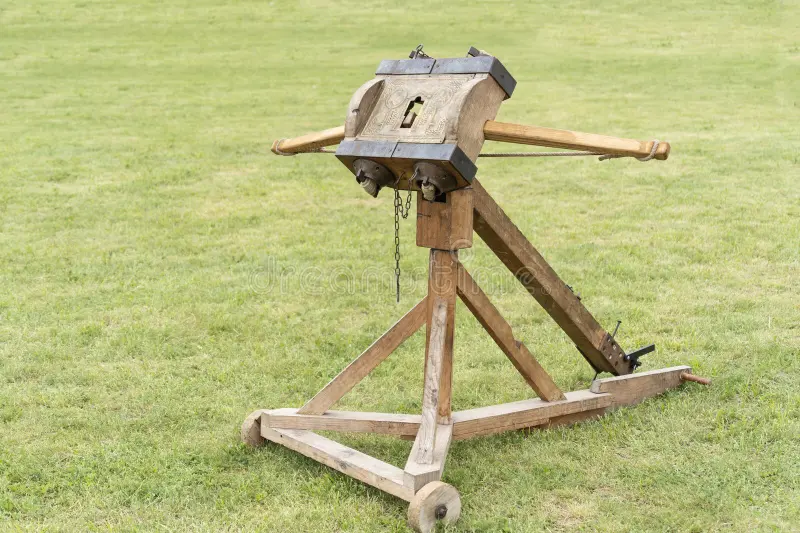
Roman Ballista
The ballista was the torsion artillery of the ancient world: a two-armed engine powered by twisted skeins of sinew or hair, shooting heavy… Continued…
-
Siege Mortar
A siege mortar was a short, wide-mouthed cannon that fired at a high angle, so that its projectile rose over walls and earthworks and fell… Continued…
-
Swedish Regimental Gun
The Swedish regimental gun was a light bronze cannon, usually a three-pounder, attached to each infantry regiment of Gustavus Adolphus's… Continued…
-
Trebuchet
The counterweight trebuchet was the heaviest artillery of the Middle Ages: a great pivoting beam whose short arm carried a box of earth or… Continued…
-
ZiS-3
The ZiS-3 was the standard Soviet 76.2mm divisional gun of the Second World War, officially the 76 mm divisional gun model 1942. Designed… Continued…