Roman Ballista
The ballista was the torsion artillery of the ancient world: a two-armed engine powered by twisted skeins of sinew or hair, shooting heavy bolts or stones. Invented by Greek engineers in the fourth century BC and perfected by the Romans, it came in sizes from the small bolt-shooting scorpio, which every legion carried in numbers, to great stone-throwers for sieges. Roman writers from Vitruvius to Ammianus described it, and its accuracy made it the most feared missile weapon of the legions.
Also known as Ballista, scorpio, carroballista, cheiroballistra, torsion bolt-thrower
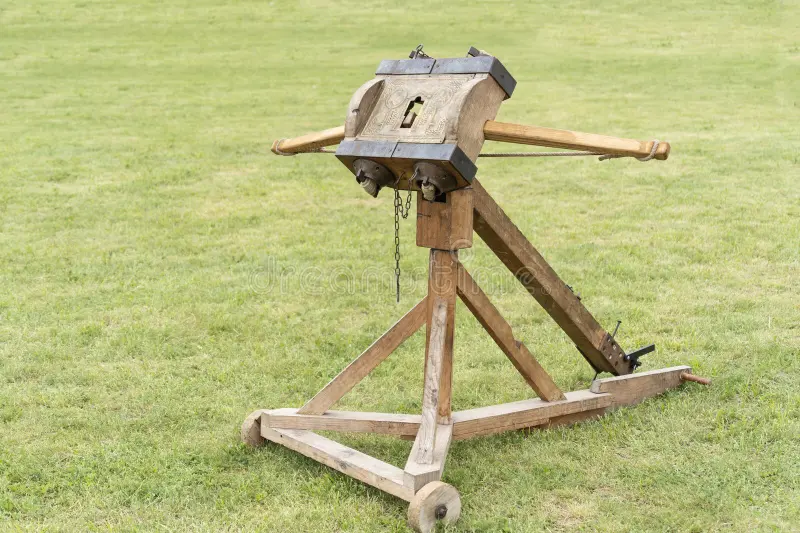
Origins
The first artillery of the Greek world, around 400 BC at Syracuse, was the gastraphetes, a giant crossbow bent by body weight. Its power was limited by the bow itself, and within a few decades Greek engineers found a far better source of energy: torsion. Two arms were set into tightly twisted bundles of sinew or hair; drawing back the bowstring twisted the bundles further, and releasing it let them spring back with great force. Philip II and Alexander of Macedon used torsion engines in their sieges, and the Romans adopted them as they conquered the Hellenistic world. Latin usage changed over time — in the Republic the ballista was the stone-thrower and the catapulta the bolt-thrower — but by the late Empire "ballista" meant the bolt-shooting engine that most people picture today.
Design & Construction
A ballista had a wooden frame holding two spring cases, each containing a skein of sinew rope wound under enormous tension. An arm passed through each skein, and a bowstring joined the arms. A slider running in a trough carried the bolt or stone; the slider was winched back with a windlass, locked by a trigger, aimed and released. The whole machine was sized by a formula: its dimensions were multiples of the diameter of the spring holes, which the engineers calculated from the weight of stone or length of bolt it was meant to shoot. From the first century AD Roman engineers improved the design with iron frames and wider-set springs, as in the cheiroballistra, and mounted small engines on carts as carroballistae, a kind of field artillery.
Combat Use
The small bolt-shooting scorpio was accurate enough to pick off individual men at a few hundred yards, and by the early Empire each legion is said to have carried around sixty of them. Caesar describes a scorpio bolt killing a Gallic warrior on the walls of Avaricum, and then the next man who stepped into his place, and the next. Larger engines hurled stones against walls and defenders in sieges from Jerusalem to the Rhine frontier, and Trajan's Column shows carroballistae in action in the Dacian Wars. The ballista was primarily a siege and defensive weapon, mounted on walls and towers, but it was also used in open battle to break up enemy formations before the infantry closed with the Roman Gladius and Roman Pilum.
Legacy
Torsion artillery was one of the most sophisticated machines of antiquity, and the treatises of Heron, Philo and Vitruvius preserve its engineering in detail. It survived in the Byzantine Empire, but in the medieval West it was gradually replaced by the simpler counterweight Trebuchet for throwing stones and by the large crossbow for shooting bolts. The name lived on: the ballista gave its name to the science of ballistics.
Sources
Marsden, E. W. Greek and Roman Artillery: Historical Development. Clarendon Press, 1969.
Marsden, E. W. Greek and Roman Artillery: Technical Treatises. Clarendon Press, 1971.
Campbell, Duncan B. Greek and Roman Artillery 399 BC-AD 363. Osprey Publishing, 2003.
Vitruvius. De Architectura, Book X.
Suggest an edit · account required · reviewed before publishing · how it works