Origin
Greek City-States
The Greek city-states developed the hoplite phalanx as a dominant infantry formation, built around the aspis shield, dory spear, and xiphos sword. Alexander the Great's Macedonian armies refined this with the sarissa pike phalanx, conquering from Greece to India.
Overview
The Greek city-states of the classical period (c. 800–323 BCE) developed one of the ancient world's most effective military systems — the hoplite phalanx — that dominated Mediterranean warfare for three centuries. Greek weapons were heavily influenced by bronze technology and later iron, and were refined through constant interstate warfare (the Persian Wars, Peloponnesian War, and the campaigns of Alexander the Great).
The Hoplite's Equipment (Panoply)
Dory (Spear)
The primary hoplite weapon — an ash-shafted spear 2–2.5 meters long with an iron leaf-shaped head. The butt spike (sauroter, "lizard-killer") counterbalanced the head and could be used as a secondary weapon if the head broke. In a phalanx, hoplites in the first three ranks could bring their spears to bear simultaneously.
Hoplon (Aspis) — Shield
The defining piece of hoplite equipment — a round shield approximately 90 cm in diameter, made from wood covered with bronze. The distinctive double grip (porpax arm band + antilabe handgrip) left the right arm free while securely anchoring the shield. Crucially, the right half of each hoplite's shield protected the left side of the man to his right — requiring mutual trust and unit cohesion.
Xiphos (Sword)
A short, double-edged sword 45–60 cm long; used as a backup weapon when the spear broke or fighting became too close for spears. The leaf-shaped blade was effective for both cut and thrust. Some hoplites carried the kopis (a forward-curved slashing sword) instead.
Armor
- Corinthian helmet — Full-face bronze helmet with cheek guards and nasal bar; iconic Greek helmet form
- Linothorax — Laminated linen corselet; lighter than bronze but surprisingly effective
- Bronze cuirass (muscle armor) — Shaped bronze breastplate and backplate
- Greaves — Bronze shin guards
The Macedonian Sarissa Phalanx
Philip II of Macedon (r. 359–336 BCE) replaced the standard hoplite spear with the sarissa — a pike up to 6 meters long. In the Macedonian phalanx, the sarissas of the first five ranks could all project beyond the front rank, creating a wall of overlapping spear points that was nearly impossible to approach frontally. Alexander the Great used this formation combined with heavy cavalry (the Companion cavalry) to conquer from Greece to India.
This article is a stub.
Battles & Operations
-
Battle of Marathon (August or September 490 BC)
The Battle of Marathon, fought in late summer 490 BC on the coastal plain northeast of Athens, ended the first Persian invasion of Greece.… Continued…
-
Battle of Salamis (September 480 BC)
The Battle of Salamis, fought in September 480 BC in the narrow strait between the island of Salamis and the coast near Athens, was the… Continued…
-
Battle of Thermopylae (August or September 480 BC)
The Battle of Thermopylae was fought in late summer 480 BC in the narrow coastal pass of Thermopylae in central Greece, where a Greek force… Continued…
-
Battle of Gaugamela (1 October 331 BC)
The Battle of Gaugamela, fought on 1 October 331 BC near Arbela in northern Mesopotamia, decided the war between Alexander the Great and… Continued…
Weapons
-
Corinthian Helmet
The Corinthian helmet is the classic helmet of the Greek hoplite: a bronze helmet beaten from a single sheet, covering the whole head and… Continued…
-
Greek Aspis
The aspis was the great round shield of the Greek hoplite: a deep bowl of laminated wood about 90 centimeters across, often faced in thin… Continued…
-
Greek Kopis
The kopis was the forward-curved, single-edged chopping sword of classical Greece. Its blade is concave near the hilt and swells toward the… Continued…
-
Greek Trireme
The trireme was the main warship of the eastern Mediterranean from the late sixth century BC to the fourth century BC. It was a long… Continued…
-
Greek Xiphos
The xiphos was the sidearm of the Greek hoplite: a double-edged, leaf-bladed short sword drawn when the spear — always the primary weapon … Continued…
-
Hoplite Dory
The dory was the thrusting spear of the Greek hoplite, the main weapon of the citizen soldiers who fought in the phalanx from the seventh… Continued…
-
Linothorax
The linothorax was a body armor made of many layers of linen glued or stitched together, worn by Greek hoplites and later by the Macedonian… Continued…
-
Macedonian Sarissa
The sarissa was the great two-handed pike of the Macedonian phalanx, introduced by Philip II around 359 BC and carried by the infantry of… Continued…
-
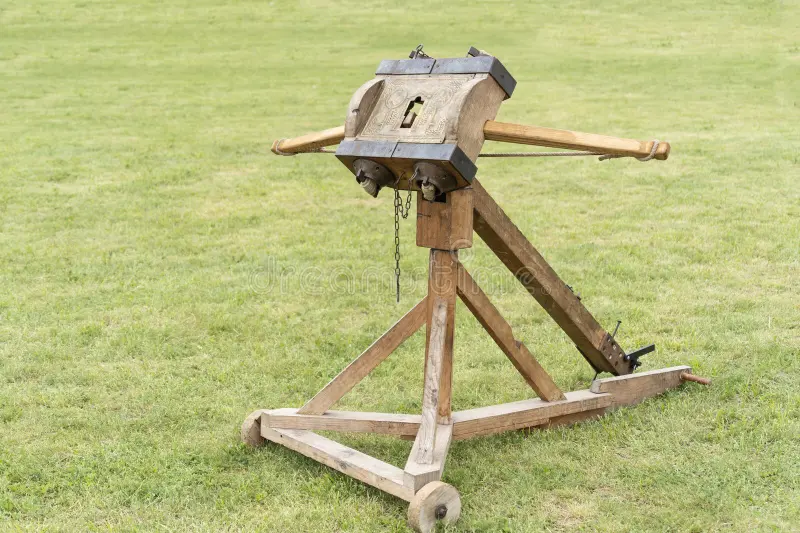
Roman Ballista
The ballista was the torsion artillery of the ancient world: a two-armed engine powered by twisted skeins of sinew or hair, shooting heavy… Continued…