Historical Context
Iron Age
Iron gradually replaced bronze, producing harder and cheaper weapons available to larger armies. The Iron Age gave rise to longer swords, iron-tipped spears, and scale armor, enabling the large professional armies of Persia, Greece, Rome, and Carthage.
c. 1200 BCE – 550 CE
Overview
The Iron Age is the period during which iron became the dominant material for weapons and tools, replacing the bronze that had defined military technology for two millennia. Iron's adoption was not uniform — different regions transitioned at different times, and for several centuries iron weapons were actually inferior to the best bronze. Iron's advantage was not initial quality but availability: iron ore is common where tin (required for bronze) is rare, so iron weapons could be produced in far greater quantities and at lower cost, equipping larger armies.
Iron vs. Bronze
Early Iron (1200–800 BCE)
Early iron was often inferior to bronze:
- Wrought iron — Pure iron; too soft; bent rather than held an edge
- Inconsistent carburization — Early smiths could not reliably control the carbon content that produces steel
Steel Development (800 BCE onward)
As smiths learned to carburize iron (introducing carbon through charcoal heating) and harden it through quenching:
- Steel blades became harder than bronze
- The edge held longer
- Steel could flex and return to shape rather than shatter (unlike bronze)
The key insight — that controlling carbon content produced predictably different properties — was not fully understood theoretically but was mastered empirically over centuries.
Iron Age Weapons by Region
Celtic Iron Age (800 BCE – 100 CE)
Celtic smiths were among the early Iron Age's finest:
- La Tène sword — Long (80–90 cm) iron sword; double-edged; primarily a slashing weapon; used by Celtic cavalry and infantry across Europe; the form influenced Roman, Germanic, and Viking swords
- Carnyx — Boar-headed war horn; used to intimidate enemies
- Celtic shield — Elongated oval wooden shield with central iron boss; varied decoration
- Slinger — Celtic slingers were feared; lead sling bullets (glandes) inscribed with messages have been found at siege sites
Greek and Macedonian (800–200 BCE)
- Xiphos — Short (45–60 cm) double-edged iron sword; leaf-shaped; the standard Greek warrior's sidearm
- Kopis — Single-edged, forward-curving cutting sword; favored by Greek cavalry; similar to the later falcata
- Sarissa (Macedonian) — Philip II's key innovation; a 6–7 meter (21-foot) pike; carried by both hands; the sarissa phalanx of Alexander the Great was nearly unbeatable frontally; required the opposing force to close 6+ meters before reaching the phalangite's body
- Xyston — Shorter (3.5 m) cavalry lance; used by Macedonian Companion cavalry
Roman Iron Age (500 BCE – 400 CE)
Roman weapons combined Greek, Etruscan, Celtic, and original Roman design:
- Gladius — The short (40–55 cm) double-edged stabbing sword; the iconic Roman infantry weapon; in a close-packed formation, only a short thrusting weapon was practical — the gladius's short point could thrust between shields
- Pilum — The Roman heavy javelin; 2 meters long; iron shank (60 cm) designed to bend on impact, preventing the enemy from throwing it back and often dragging shields down
- Scutum — Large rectangular (later oval) laminated wood and leather shield; curved to wrap around the body; with the pilum volley and gladius thrust, this was the Roman killing system
- Spatha — Longer (60–85 cm) sword adopted from Celtic cavalry; became the standard Late Roman sword; ancestor of the medieval sword
Germanic and Norse Iron Age (300–1000 CE)
- Seax — Single-edged utility knife/short sword; universal among Germanic peoples; the Saxons were named for it
- Framea — Germanic throwing and thrusting spear; Tacitus described the Germans as relying primarily on the framea
- Francisca — The Frankish throwing axe; could be thrown to disrupt shield walls before closing
Near Eastern Iron Age (900–500 BCE)
Assyrian and Persian weapons:
- Khopesh — Curved Egyptian/Levantine sword; carried into the Iron Age from the Bronze Age
- Akinakes — Short Persian/Scythian iron sword-dagger; typically 35–45 cm
- Persian bow — Persian archers using iron-tipped composite-bow arrows were a decisive weapon at Marathon (before Greek countermeasures were developed)
Siegecraft
The Iron Age dramatically expanded siege capabilities:
- Battering ram — Iron-shod wooden ram, often suspended from a frame; Assyrian reliefs show sophisticated siege towers and ram operations (9th–7th century BCE)
- Ballista — Torsion artillery using twisted sinew; Roman version; could propel bolts or stones accurately at 400+ meters
- Catapult (onager) — Single-arm stone-throwing engine; Roman; less accurate than the ballista but threw heavier projectiles
This article is a stub. Contributions covering specific cultures, battles, and weapons are welcome.
Battles & Operations
-
Battle of Marathon (August or September 490 BC)
The Battle of Marathon, fought in late summer 490 BC on the coastal plain northeast of Athens, ended the first Persian invasion of Greece.… Continued…
-
Battle of Salamis (September 480 BC)
The Battle of Salamis, fought in September 480 BC in the narrow strait between the island of Salamis and the coast near Athens, was the… Continued…
-
Battle of Thermopylae (August or September 480 BC)
The Battle of Thermopylae was fought in late summer 480 BC in the narrow coastal pass of Thermopylae in central Greece, where a Greek force… Continued…
-
Battle of Gaugamela (1 October 331 BC)
The Battle of Gaugamela, fought on 1 October 331 BC near Arbela in northern Mesopotamia, decided the war between Alexander the Great and… Continued…
-
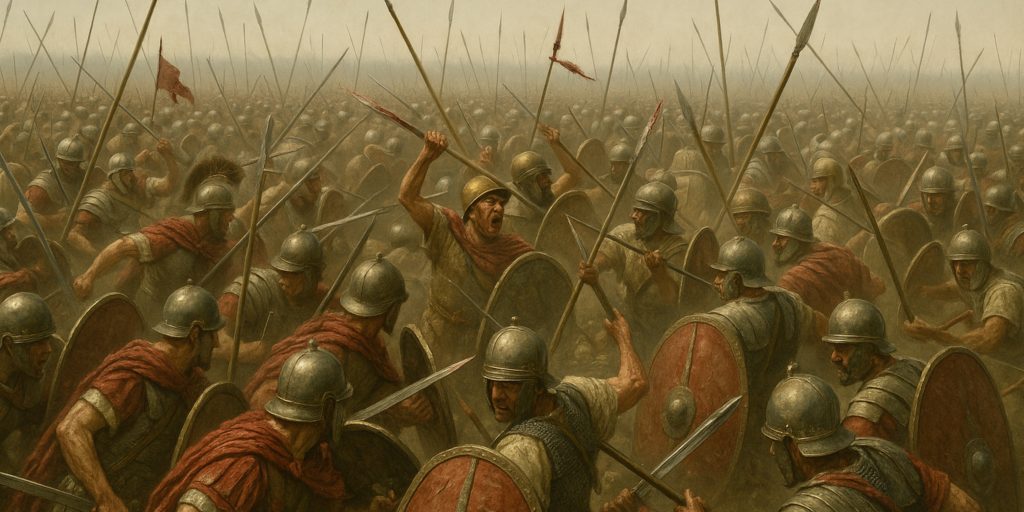
Battle of Cannae (2 August 216 BC)
The Battle of Cannae, fought on 2 August 216 BC in Apulia in southern Italy, was Hannibal's masterpiece and one of the worst defeats in… Continued…
-
Battle of Zama (October 202 BC)
The Battle of Zama, fought in North Africa in 202 BC, ended the Second Punic War. The Roman general Publius Cornelius Scipio, with the help… Continued…
-
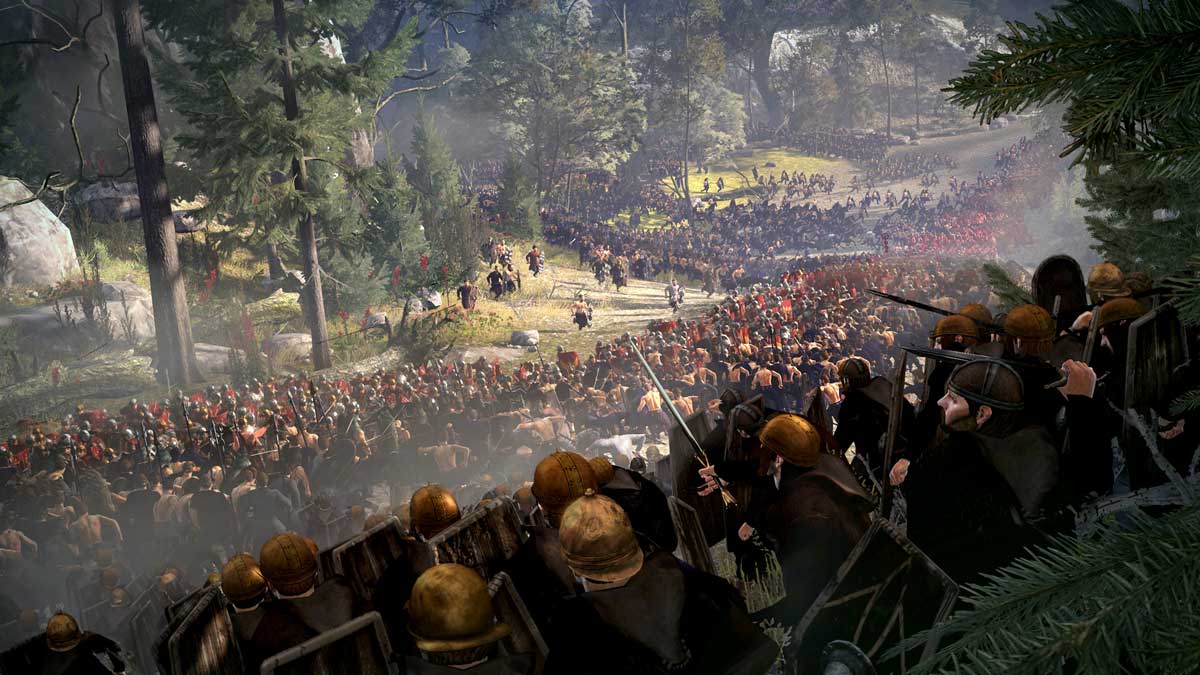
Battle of Teutoburg Forest (September 9 AD)
The Battle of the Teutoburg Forest was the destruction of three Roman legions — the XVII, XVIII and XIX — with their auxiliaries by an… Continued…
Weapons
-
Assyrian Composite Bow
The composite bow of the Neo-Assyrian Empire, built of wood, horn and sinew bonded with glue, was the principal weapon of the most… Continued…
-
Celtic La Tène Sword
The La Tène sword was the iron sword of the Celtic peoples of Europe from about 450 BC until the Roman conquest, named after an… Continued…
-
Chinese Ji
The ji is the Chinese halberd: a spear point combined with a side blade on a long shaft, able to thrust, hook and cut. It grew out of the… Continued…
-
Chinese Jian
The jian is the double-edged straight sword of China, in continuous use for more than two and a half thousand years. It began as a short… Continued…
-
Corinthian Helmet
The Corinthian helmet is the classic helmet of the Greek hoplite: a bronze helmet beaten from a single sheet, covering the whole head and… Continued…
-
Greek Aspis
The aspis was the great round shield of the Greek hoplite: a deep bowl of laminated wood about 90 centimeters across, often faced in thin… Continued…
-
Greek Kopis
The kopis was the forward-curved, single-edged chopping sword of classical Greece. Its blade is concave near the hilt and swells toward the… Continued…
-
Greek Trireme
The trireme was the main warship of the eastern Mediterranean from the late sixth century BC to the fourth century BC. It was a long… Continued…
-
Greek Xiphos
The xiphos was the sidearm of the Greek hoplite: a double-edged, leaf-bladed short sword drawn when the spear — always the primary weapon … Continued…
-
Han Crossbow
The Han crossbow was the mass-issue missile weapon of Chinese armies from the Warring States period through the Han dynasty, more than a… Continued…
-
Hoplite Dory
The dory was the thrusting spear of the Greek hoplite, the main weapon of the citizen soldiers who fought in the phalanx from the seventh… Continued…
-
Iberian Falcata
The falcata is the curved, single-edged sword of the Iberians of pre-Roman Spain, used from about the fifth to the first century BC. Its… Continued…
-
Linothorax
The linothorax was a body armor made of many layers of linen glued or stitched together, worn by Greek hoplites and later by the Macedonian… Continued…
-
Macedonian Sarissa
The sarissa was the great two-handed pike of the Macedonian phalanx, introduced by Philip II around 359 BC and carried by the infantry of… Continued…
-
Montefortino Helmet
The Montefortino helmet was the most common helmet of the Roman Republic, worn by legionaries from the fourth century BC into the first… Continued…
-
Persian Akinakes
The akinakes is the straight, double-edged short sword of the Achaemenid Persian Empire, borrowed from the Scythian horsemen of the steppe… Continued…
-
Prehistoric Sling
The sling is one of the oldest and simplest projectile weapons: a pouch on two cords, whirled and released to throw a stone or a shaped… Continued…
-
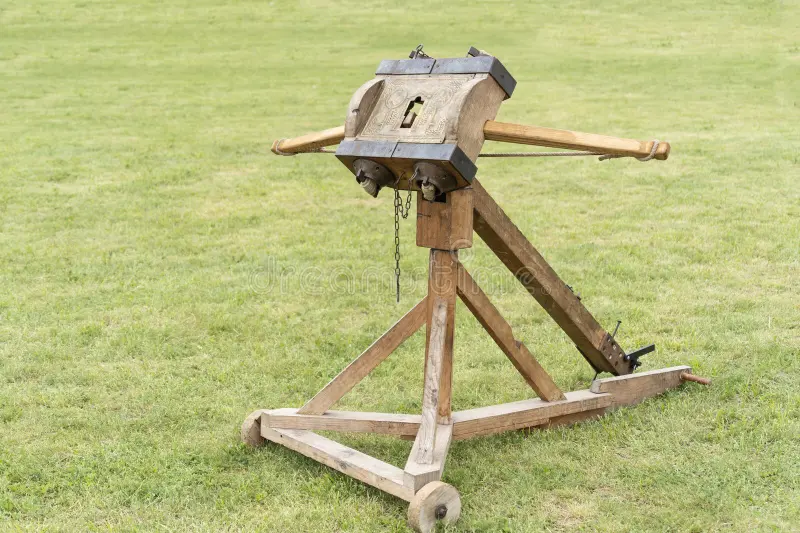
Roman Ballista
The ballista was the torsion artillery of the ancient world: a two-armed engine powered by twisted skeins of sinew or hair, shooting heavy… Continued…
-
Roman Gladius
The gladius was the short sword of the Roman legionary and the weapon that conquered the Mediterranean world. Adopted from Iberian patterns… Continued…
-
Roman Hasta
The hasta was the thrusting spear of the early Roman army. In the manipular legion of the Punic Wars it was the weapon of the triarii, the… Continued…
-
Roman Lorica Segmentata
The lorica segmentata is the articulated iron plate cuirass that has come to define the Roman legionary in the modern imagination… Continued…
-
Roman Pilum
The pilum was the Roman legionary's heavy javelin: a barbed iron head on a long, thin iron shank socketed into a wooden shaft, thrown in a… Continued…
-
Roman Pugio
The pugio was the dagger of the Roman soldier, worn on the left hip opposite the gladius. Its broad, leaf-shaped double-edged blade, often… Continued…
-
Roman Scutum
The scutum was the large shield of the Roman legionary: an oval, and later rectangular, shield curved to wrap around the body, made of… Continued…
-
Roman Spatha
The spatha was the long, straight, double-edged sword of the Roman Empire. First carried by auxiliary cavalry in the first century AD… Continued…