Battle of Cannae
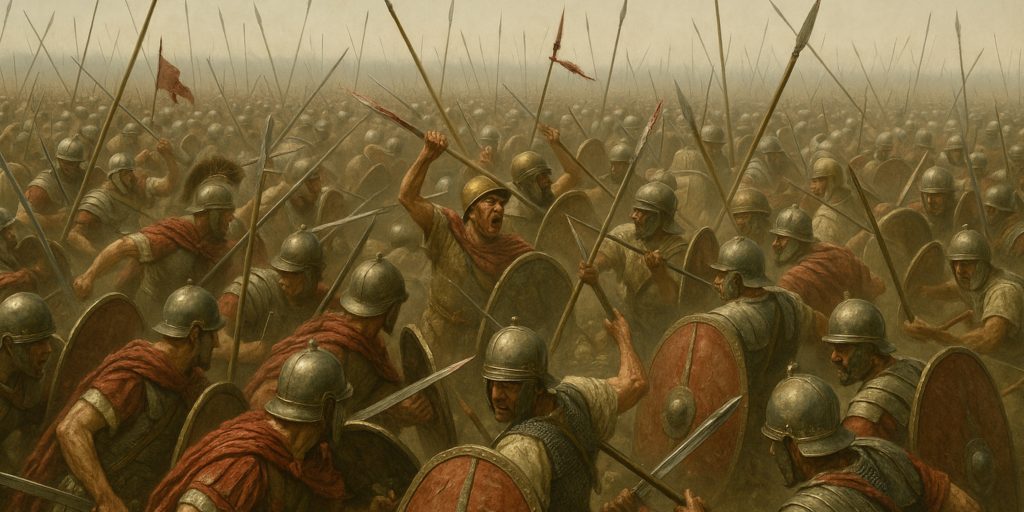
The Battle of Cannae, fought on 2 August 216 BC in Apulia in southern Italy, was Hannibal's masterpiece and one of the worst defeats in Roman history. A Roman army of some 86,000 men under the consuls Lucius Aemilius Paullus and Gaius Terentius Varro attacked Hannibal's smaller force of Africans, Iberians, Gauls and Numidians. Hannibal let his center bend back under the Roman weight while his African infantry closed on both flanks and his cavalry struck the Roman rear. Surrounded, tens of thousands of Romans were killed in an afternoon. It remains the classic example of double envelopment.
Also known as Cannae, Battle of Cannae 216 BC
Background
In 218 BC the Carthaginian general Hannibal marched from Spain across the Pyrenees and the Alps into Italy, beginning the Second Punic War. He destroyed Roman armies at the Trebia in 218 and at Lake Trasimene in 217. The Romans then adopted the delaying strategy of the dictator Fabius Maximus, avoiding battle, but by 216 the Senate had resolved to crush Hannibal with the largest army Rome had ever raised: eight legions and as many allied troops, some 86,000 men, under the two consuls of the year, Lucius Aemilius Paullus and Gaius Terentius Varro. Hannibal had seized the supply depot at Cannae in Apulia, near the Aufidus River, and the Romans marched to meet him there.
The Battle
On 2 August, on the day Varro held command, the Romans drew up their infantry in unusually deep formations, meaning to smash through Hannibal's center by weight. Hannibal, with about 40,000 infantry and 10,000 cavalry, placed his Gallic and Iberian infantry in the center in a line that bowed forward toward the enemy, with his veteran African infantry held back on either flank and his cavalry on the wings. As the legions advanced, the Gauls and Iberians gave ground slowly, and the bow became a hollow; the Romans pressed into it, crowding ever closer together. Meanwhile Hasdrubal's heavy cavalry routed the Roman horse on the Roman right, swept around behind the Roman army and drove off the allied cavalry on the other wing as well. At the decisive moment the African infantry turned inward against both Roman flanks, and the cavalry fell on the Roman rear. Packed so tightly that many could not raise their weapons, the Roman army was destroyed. Paullus was among the dead.
Weapons
The legionaries of the Roman Legions threw the Roman Pilum and fought behind the Roman Scutum with the Roman Gladius, a sword the Romans had probably begun to copy from the Iberians. Hannibal's Iberians carried the curved Iberian Falcata, his Gauls the long Celtic La Tène Sword, and his Africans had re-equipped with Roman arms taken at Trasimene. Balearic slingers with the Prehistoric Sling opened the fighting; one of their stones wounded Paullus early in the day.
Aftermath
Polybius puts the Roman dead at 70,000, Livy at about 48,000; either way it was one of the bloodiest single days of battle in history, and about a fifth of Rome's senators died. Hannibal lost perhaps 6,000 men, most of them Gauls. Several cities of southern Italy, including Capua, went over to him. Yet Rome refused to negotiate, raised new legions, and returned to the Fabian strategy; Hannibal never had the siege train to take Rome itself, and the war was finally won at Zama in 202 BC. Cannae has been studied by commanders ever since as the model of encirclement.
Weapons used
-
Iberian Falcata
The curved chopping sword of Hannibal's Iberian infantry, who held the center with the Gauls. Continued…
-
Celtic La Tène Sword
The long slashing sword of Hannibal's Gallic infantry in the center of his line. Continued…
-
Roman Pilum
The heavy javelin each legionary threw before closing with the enemy. Continued…
-
Roman Scutum
The legionary's large curved shield, useless once the Romans were packed too tightly to fight. Continued…
-
Roman GladiusFor sale
The Roman infantry sword, probably still in the process of being adopted from Spanish models at this date. Continued…
-
Prehistoric Sling
Hannibal's Balearic slingers opened the battle, and one wounded the consul Aemilius Paullus. Continued…
Sources
Polybius. The Histories, Book 3, 107-117.
Livy. History of Rome, Book 22, 40-52.
Goldsworthy, Adrian. Cannae: Hannibal's Greatest Victory. Cassell, 2001.
Daly, Gregory. Cannae: The Experience of Battle in the Second Punic War. Routledge, 2002.
Suggest an edit · account required · reviewed before publishing · how it works