Battle of Teutoburg Forest
The Battle of the Teutoburg Forest was the destruction of three Roman legions — the XVII, XVIII and XIX — with their auxiliaries by an alliance of Germanic tribes in September 9 AD. Led by Arminius, a Cheruscan prince who had served Rome as an officer and was trusted by the governor Publius Quinctilius Varus, the tribes ambushed the marching column over several days in the wooded hills of northern Germany. Varus killed himself, the legions' eagles were taken, and Rome gave up its plan to make Germania east of the Rhine a province. The battlefield was found at Kalkriese in 1987.
Also known as Teutoburg Forest, Varian Disaster, Clades Variana, Varusschlacht, Battle of Kalkriese, Hermannsschlacht
Background
In 9 AD, three Roman Legions marched into the forests of Germania under Publius Quinctilius Varus. Rome had campaigned east of the Rhine for twenty years, and under Augustus the lands between the Rhine and the Elbe were being organized as a province: roads, markets and a new town at Waldgirmes were taking shape, and Varus, a senior administrator with experience in Syria, had been sent to bring in Roman law and taxes. His trusted adviser was Arminius, son of a chief of the Cherusci, who had grown up as a hostage in Rome, commanded Germanic auxiliaries in Roman service and been granted Roman citizenship and equestrian rank. Arminius was secretly building a coalition of the Cherusci, Bructeri, Marsi and other tribes. Another Cheruscan noble, Segestes, warned Varus of the plot; Varus did not believe him.
The Battle
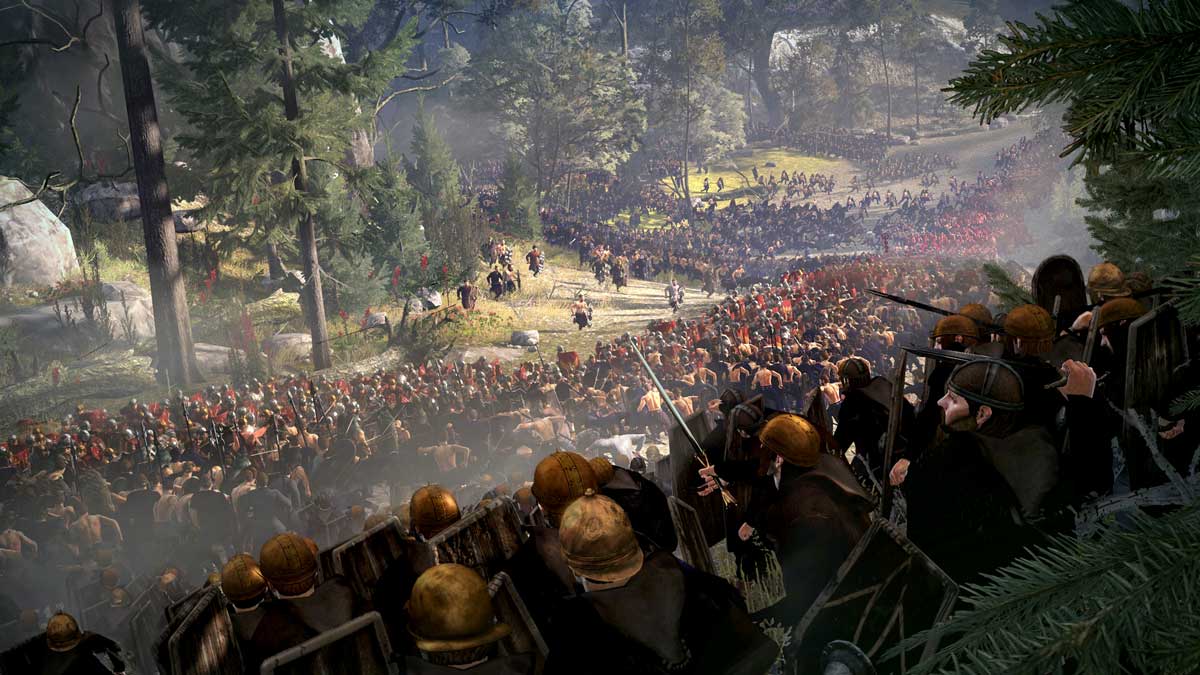
In September, as the army left its summer camp near the Weser for winter quarters on the Rhine, Arminius reported a rising along the route and persuaded Varus to detour to put it down. Arminius then rode ahead, supposedly to gather his auxiliaries, and joined the rebels. Led by Arminius — a Germanic prince raised, trained, and trusted by Rome — the tribes of Germania drew Legions XVII, XVIII, and XIX into one of the deadliest ambushes in ancient history. The column — three legions, three cavalry wings, six auxiliary cohorts and a long baggage train with families and servants, perhaps 15,000 to 20,000 people — was strung out along narrow tracks in wet, wooded country when the tribes attacked from the flanks. Over three or four days the Romans fought their way on, built a fortified camp and burned their wagons, but at a bottleneck between the Kalkriese hill and a great bog, where the Germans had built a turf wall along the track, the column was trapped and destroyed. Varus and his senior officers killed themselves. Rome lost all three legions.
Weapons
The legionaries carried the Roman Gladius, the Roman Pilum and the curved rectangular scutum, and the excavations at Kalkriese have produced fittings of the Roman Lorica Segmentata, among the earliest known evidence for it. Their tactics depended on formation, and in the forest they could not form. The Germans fought as light infantry with spears — the framea described by Tacitus — shields, javelins and a few swords, many of them men trained in Roman auxiliary service.
Aftermath
Augustus is said to have beaten his head against a door, crying "Quinctilius Varus, give me back my legions!" The numbers XVII, XVIII and XIX were never used again. Germanicus campaigned beyond the Rhine from 14 to 16 AD, buried the dead on the battlefield, and recovered two of the eagles; the third was found in 41 AD. But Rome never again tried seriously to make Germania a province, and the Rhine remained the empire's frontier for four centuries. Arminius became a German national hero in the nineteenth century, when the Hermannsdenkmal was raised near Detmold. The real battlefield was found at Kalkriese near Osnabrück in 1987, when a British officer, Tony Clunn, turned up Roman coins and sling shot with a metal detector; excavation has since recovered thousands of Roman objects, including a silver-sheathed cavalry face mask.
Weapons used
-
Roman GladiusFor sale
The legionary's short sword, of little use to men strung out along a forest track under attack from the flanks. Continued…
-
Roman Pilum
The legionary's heavy javelin; pilum fragments are among the Roman finds at Kalkriese. Continued…
-
Roman Lorica Segmentata
Fittings of segmented plate armor from Kalkriese are among the earliest known evidence for the type. Continued…
Sources
Wells, Peter S. The Battle That Stopped Rome. W. W. Norton, 2003.
Murdoch, Adrian. Rome's Greatest Defeat: Massacre in the Teutoburg Forest. Sutton, 2006.
Tacitus. Annals, Book I, 55-71.
Cassius Dio. Roman History, Book LVI, 18-24.
Suggest an edit · account required · reviewed before publishing · how it works