Weapon Type
Katana & Japanese
Japanese curved swords and related forms.
Edged Weapons → Swords — Subcategory
Overview
Japanese swords represent a distinct and highly refined tradition of sword-making, developed over a millennium within the context of the samurai warrior culture. The katana is the most iconic, but the Japanese sword tradition encompasses a family of related blades — from the long tachi of the mounted archer to the short tanto — all sharing distinctive metallurgy and aesthetics.
The Japanese Sword-Making Tradition
Tamahagane Steel
Japanese sword steel is produced from iron sand (satetsu) in a clay furnace called a tatara, using charcoal fuel:
- The resulting tamahagane ("jewel steel") contains varying carbon content throughout the bloom
- The smith selects pieces with appropriate carbon content — high-carbon for the edge, low-carbon for the body
- These are forge-welded together and folded repeatedly to distribute the carbon evenly and remove slag
Differential Hardening (Hamon)
The defining Japanese metallurgical technique:
- Before quenching, the blade is coated with clay — thick on the spine, thin on the edge
- When quenched in water, the edge cools rapidly and hardens to martensite (very hard); the spine cools slowly and remains tougher pearlite
- The boundary between the two zones — the hamon (temper line) — is visible as a misty white line along the blade
- The result: an edge hard enough to hold an extremely sharp edge, backed by a spine tough enough to absorb shock without snapping
The Polish
Finishing a Japanese sword requires extensive polishing with progressively finer stones (nugui) — a separate craft from smithing. The final polish reveals the hamon and the grain pattern (jihada) of the steel.
The Sword Family
Tachi (長刀)
- Blade length: 60–80 cm; significantly curved
- Worn edge-down suspended from the belt; the earlier cavalry sword
- Used by mounted samurai of the Heian and Kamakura periods (8th–14th century)
- Predecessor to the katana
Katana (刀)
- Blade length: ~60–75 cm; moderately curved; double-handed grip
- Worn edge-up in the obi (belt) — allows a faster draw-and-cut (iaijutsu)
- The standard samurai sidearm from the Muromachi period (15th century) onward
- Paired with the wakizashi as the daisho (long-short pair); the daisho identified a samurai by law in the Edo period
Wakizashi (脇差)
- Blade length: 30–60 cm
- Worn with the katana as the daisho pair
- Used indoors where the katana was too long; used for seppuku (ritual suicide)
Tanto (短刀)
- Blade length: 15–30 cm
- Dagger; single or double edge
- Everyday carry; used in seppuku; also a ceremony and artistic object
Nodachi / Odachi (野太刀)
- Blade length: 90+ cm; very large two-handed sword
- Used against cavalry; required exceptional strength
- Some examples exceed 150 cm
Ninjato (忍者刀)
- Associated with ninja; historical existence debated; likely a later construction
- Short, straight blade; square guard
Cultural Significance
The Japanese sword achieved a cultural and spiritual significance unmatched by any other weapon:
- The sword was one of the Three Imperial Treasures of Japan
- Swords were given names and treated as living objects
- Swordsmanship (kenjutsu, later kendo) became a formal discipline and spiritual practice
- Under the Meiji Restoration (1868), only military officers could carry swords; the samurai class's sword-carrying right was abolished in 1876
This article is a stub. Contributions covering specific sword schools, smiths, and historical examples are welcome.
-
Kai Gunto
The kai gunto, 'navy military sword', was the sword of officers of the Imperial Japanese Navy from the late 1930s through the Second World… Continued…
-
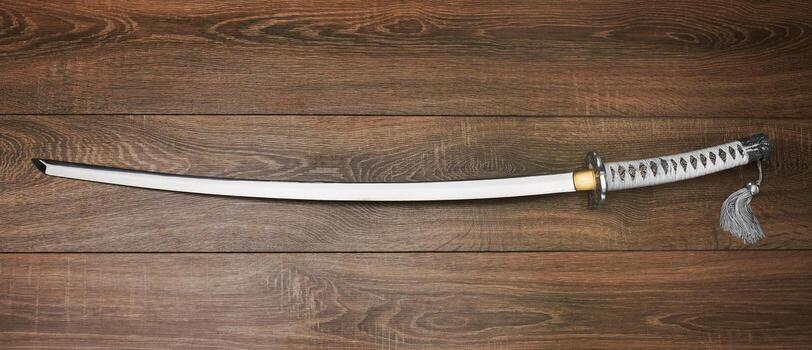
Katana
The katana is the curved, single-edged long sword of the samurai, worn edge-up through the sash and drawn in the same motion that cuts. Its… Continued…
-
Nodachi
The nodachi, or ōdachi, is an extra-long Japanese sword with a blade of three shaku (about 36 inches) or more, and often much longer. It… Continued…
-
Tanto
The tanto is the dagger of the samurai: a single- or double-edged Japanese blade under thirty centimeters, forged, hardened, and polished… Continued…