Katana
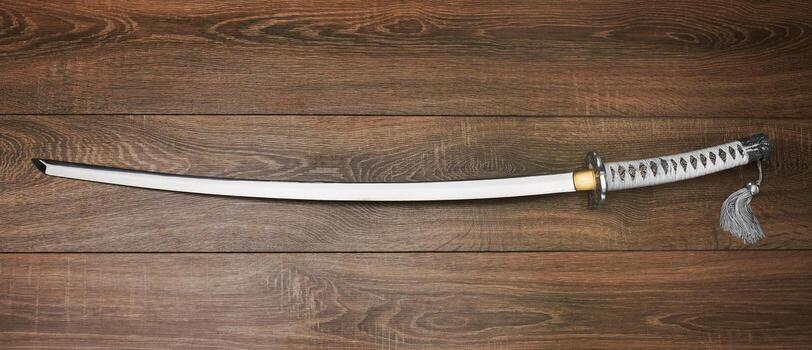
The katana is the curved, single-edged long sword of the samurai, worn edge-up through the sash and drawn in the same motion that cuts. Its blade unites two demands that defeat most swordmakers — a hard edge that takes a razor polish and a resilient body that survives impact — through differential hardening of folded steel, the visible signature of which is the hamon along the edge. It is at once a battlefield weapon, a spiritual object, and the most recognized sword form on earth.
Also known as Uchigatana, daitō, samurai sword
Origins
The katana emerged in the Muromachi period (1336–1573) as fighting moved from horseback archery duels toward massed infantry war. The older tachi hung edge-down from the belt of a mounted archer; the katana was thrust edge-up through the sash (obi), which let a man on foot draw and strike in a single motion — the root of the iaijutsu drawing arts. Paired with the short wakizashi it formed the daishō, the two-sword badge of the samurai class that Tokugawa law would later restrict to that class alone.
Design & Construction
A traditional blade begins as tamahagane, steel smelted from iron sand in a charcoal-fired tatara furnace. The smith folds and welds the billet repeatedly to drive out slag and even the carbon, then wraps a hard high-carbon jacket around a softer core. The defining step is the differential quench: the blade is coated in clay, thin along the edge and thick over the spine, and quenched from cherry-red heat. The edge cools fast into hard martensite; the spine cools slow and stays tough — and the boundary between them appears as the hamon, the temper line that polishers spend weeks revealing. Classic dimensions run to a cutting edge (nagasa) of 60 to 73 centimeters with a gentle curve, mounted in a hilt of ray skin and silk wrap with an iron or soft-metal guard (tsuba) that became an art form in itself.
Combat Use
On the battlefield the katana was, honestly reckoned, a sidearm — the spear, the bow, and later the matchlock did most of Japan's killing. Its dominion was the close fight: castle corridors, boarding actions, street affrays, and the duel. Schools of swordsmanship (kenjutsu ryūha) multiplied into the hundreds, codifying distance, timing, and the two-handed cut delivered from the draw. Against the armor of its own tradition it targeted gaps — wrists, neck, thighs — while its geometry and edge let a practiced cutter sever limbs through cloth and flesh with appalling ease, a capacity the tameshigiri test-cutting tradition documented on rolled mats and, in the Edo period's darker corners, on condemned criminals.
Legacy
The Meiji sword ban of 1876 ended the katana's daily wear, but not its line: smiths licensed under Japan's living cultural-property system still make blades by the classical method, and the study of old schools — Bizen, Sōshū, Yamato and the rest — supports a connoisseurship literature centuries deep. No sword has projected further into world culture, from cinema to the collector's market, where papered blades by named smiths command prices that rival painting. It shares with the Longsword of Europe the status of a martial tradition's central object, preserved as much by art as by war.
Sources
Kapp, Leon, Hiroko Kapp, and Yoshindo Yoshihara. The Craft of the Japanese Sword. Kodansha, 1987.
Ogawa, Morihiro, ed. Art of the Samurai: Japanese Arms and Armor, 1156-1868. Metropolitan Museum of Art, 2009.
Nagayama, Kōkan. The Connoisseur's Book of Japanese Swords. Kodansha, 1997.
Suggest an edit · account required · reviewed before publishing · how it works