Longsword
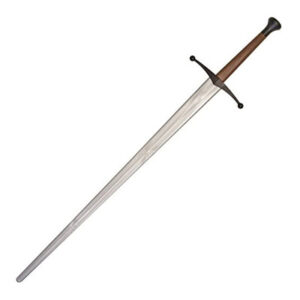
The longsword is the two-handed knightly sword of the late Middle Ages and Renaissance: a straight, double-edged blade of roughly 33 to 43 inches on a grip long enough for both hands, with a simple cross guard and a heavy pommel that balances the whole. It was a cut-and-thrust weapon carried by men-at-arms in war, by gentlemen in the duel, and by the students of the great German and Italian fencing masters, whose surviving manuals make it the best-documented sword in European history.
Also known as Long sword, hand-and-a-half sword, bastard sword, Langes Schwert, spada a due mani
Origins
The longsword grew out of the single-handed arming sword of the high Middle Ages as armor improved. Through the thirteenth century a knight fought with sword and shield, but the spread of plate defenses over the fourteenth made the shield less necessary and rewarded a weapon that could be swung and thrust with both hands. Blades lengthened, grips stretched to accommodate a second hand, and by the era of the Hundred Years War the type was standard equipment for men-at-arms across Europe. In the Holy Roman Empire Arms & Weapons it was simply the langes Schwert; in Italy the spada a due mani; English writers of the period called it a "bastard" or "hand-and-a-half" sword when the grip fell between one-handed and true two-handed length.
Design & Construction
Ewart Oakeshott's typology, the standard reference for the medieval sword, records the longsword in several distinct forms. Earlier types (XIIa, XIIIa) carry broad, parallel-edged blades meant chiefly for cutting; later ones (XVa, XVIa, XVIIIb) taper sharply to a reinforced point for driving into the gaps of plate armor. Blades run from about 33 to 43 inches with an overall length of 45 to 55 inches, and despite the two-handed grip a good example weighs only two and a half to three and a half pounds — the popular image of a ponderous slab of steel is wrong. The hilt is a straight cruciform cross with a substantial pommel, wheel-, scent-stopper- or fish-tail-shaped, whose mass pulls the balance point back toward the hand and lets the sword pivot quickly. Grips were wood cored, bound in cord and leather.
Combat Use
No medieval weapon is better documented in use. The German tradition descends from Johannes Liechtenauer, whose fourteenth-century verses were expanded by Sigmund Ringeck, Peter von Danzig, and Hans Talhoffer into a complete system of guards, master strokes and binds; the Italian tradition is preserved above all in Fiore dei Liberi's Fior di Battaglia of about 1409, which teaches the sword alongside wrestling, the dagger and the spear. Both schools stress that the longsword is a weapon of the thrust as much as the cut, and both teach half-swording — gripping the blade itself to drive the point into an armored opponent — and the Mordschlag, reversing the sword to strike with the pommel like a hammer. On the battlefield the longsword served the dismounted man-at-arms as the Halberd and pike served the infantry; in civilian life it was the weapon of the judicial duel and of the fencing guilds, the Marxbrüder and Federfechter, who kept its practice alive into the seventeenth century.
Legacy
The longsword faded from war as pike blocks and firearms took over the field, and from the street as the lighter Swept-Hilt Rapier became the gentleman's sidearm. It survived longest in the fencing schools, where Joachim Meyer's treatise of 1570 still teaches it, and it is the ancestor of the great two-handers of the Landsknechts, the Landsknecht Zweihänder. Today the manuals have given it a second life: historical European martial arts clubs worldwide train from Fiore and Liechtenauer with blunt steel, and museum originals in Leeds, Vienna and Paris remain the reference for a thriving trade in reproductions.
Sources
Oakeshott, Ewart. Records of the Medieval Sword. Boydell Press, 1991.
Fiore dei Liberi. Fior di Battaglia (c. 1409), Getty MS Ludwig XV 13.
Tobler, Christian Henry. Fighting with the German Longsword. Freelance Academy Press, 2015.
Royal Armouries, Leeds — European edged weapons collection.
Suggest an edit · account required · reviewed before publishing · how it works