Historical Context
Feudal Japan
Japan's centuries-long feudal period was defined by the samurai warrior class and its strict code of bushido. The katana, naginata, yumi bow, and after 1543 the tanegashima matchlock musket are its signature weapons, forged under metallurgical traditions that set Japanese blades apart globally.
1185 – 1868
Overview
Feudal Japan spans from the establishment of the Kamakura Shogunate in 1185 to the Meiji Restoration in 1868 — nearly seven centuries of warrior culture (the samurai class) that produced some of history's most sophisticated edged weapons and a unique military aesthetic. Japanese weaponry evolved from horse-archer warfare in the early period through pike-heavy infantry formations in the Sengoku era (1467–1615) to the preservation of traditional arms alongside Western firearms in the final decades.
The Katana and Sword Family
Japanese sword-making reached a technical peak that remains unsurpassed for single-purpose cutting weapons:
Katana
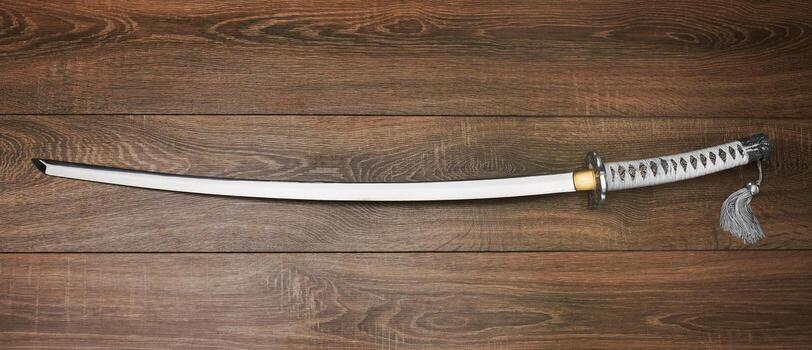
The katana (c. 1400 onward; length: ~70–75 cm blade) is the iconic Japanese sword:
- Differential hardening — The hamon (temper line) is produced by coating the spine with clay before quenching; the edge hardens while the spine remains tough; the result combines extreme cutting edge hardness with spine flexibility
- Tamahagane steel — Produced in the tatara furnace from iron sand and charcoal; a complex layered steel with varying carbon content
- Single-edge, curved, two-handed grip — Optimized for drawing and cutting in a single motion (iaijutsu)
- Worn — Edge up in the obi (belt) when paired with the shorter wakizashi; the daisho (long-short pair) identified a samurai
Related Swords
- Tachi — Older curved sword; worn edge down; cavalry sword of the Heian and Kamakura periods
- Wakizashi — Shorter companion sword (30–60 cm blade); worn by samurai indoors; ritual suicide (seppuku) weapon
- Tanto — Dagger; 15–30 cm blade; everyday carry; also used in seppuku
- Nodachi / Odachi — Oversized two-handed sword (90+ cm blade); used against cavalry; required exceptional strength
Polearms
Naginata
The naginata — a curved blade on a 5–6 foot shaft — was the weapon of warrior monks (sohei) and later associated with women's self-defense and the defense of castles. It combined the reach of a spear with the cutting power of a sword.
Yari (Spear)
The yari in its various forms was the most common weapon of Japanese infantry:
- Su yari — Straight double-edged blade; the basic infantry spear
- Jumonji yari — Cross-shaped blade; could trap and deflect enemy weapons
- Nagamaki — Long handle with long blade; between naginata and nodachi
Bo (Staff)
The hardwood bo was the weapon of those who could not carry blades — monks, farmers, and in practice a foundation for multiple martial arts traditions.
Archery
Yumi (Longbow)
The Japanese yumi is one of history's most distinctive bows:
- Asymmetric construction — About 2.2 meters long; grip positioned one-third from the bottom; the upper limb is significantly longer than the lower
- Composite laminate — Bamboo, wood, and leather; the specific Japanese composite construction produces a bow that shoots from horseback without catching the ground
- Kyudo — Japanese archery became a formal martial art and spiritual practice; the yumi is central to Zen archery traditions
Armor
Japanese armor (yoroi) is among the world's most sophisticated:
Early Armor (Heian–Kamakura)
- Ō-yoroi — "Great armor"; suspended from the shoulders; optimized for mounted archery; heavy, wide; provided 360-degree protection for a stationary mounted archer
- Laminar construction — Horizontal lames of lacquered leather (kozane) or iron laced together with silk or leather cords (odoshi)
Later Armor (Muromachi–Edo)
- Dō-maru — Wrapped around the body and fastened at the back; lighter; suited to infantry combat
- Tosei gusoku — "New armor"; integrated plate elements (do/cuirass); influenced by European contact after 1543; accommodated the proliferation of firearms; the standard armor of the Sengoku period
The Sengoku Period and Firearms (1467–1615)
The Sengoku period (Warring States) drove the most rapid military evolution in Japanese history:
Ashigaru (Infantry)
The rise of peasant infantry armed with yari transformed warfare. Massed ashigaru pike formations replaced cavalry as the battle-decisive arm — Japan independently developed the same solution as Swiss pikemen.
Teppo (Arquebus)
Portuguese traders introduced the matchlock arquebus to Japan in 1543. Within decades:
- Japanese smiths were producing arquebuses in large numbers
- Oda Nobunaga's Battle of Nagashino (1575) — 3,000 musketeers organized in rotating volley fire destroyed the Takeda cavalry; one of the first major demonstrations of volley fire anywhere in the world
- By 1600, Japan may have had more firearms than any European country
The Tokugawa Suppression
After the Tokugawa Shogunate consolidated power (1603), firearms were progressively regulated and marginalized — a deliberate policy to protect the samurai class's martial monopoly. Sword culture was intentionally elevated as firearms declined.
This article is a stub. Contributions covering specific weapons, clans, and battles are welcome.
Battles & Operations
Weapons
-
Bō Staff
The bō is the Japanese and Okinawan fighting staff, most often the rokushakubō, a straight pole of hardwood six shaku (about 180 cm) long.… Continued…
-
Caltrops
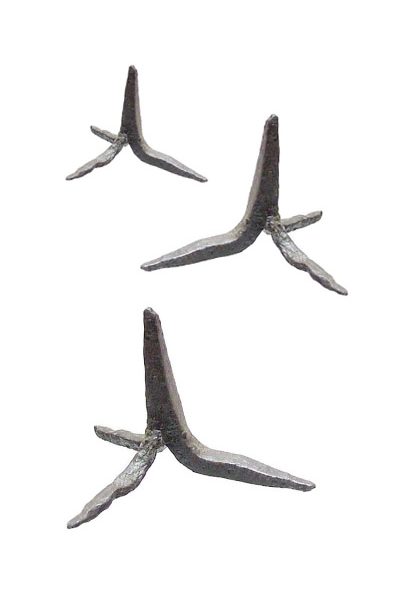
A caltrop is a small iron device of four spikes joined at the center so that however it lands, one spike always points up. Scattered on the… Continued…
-
Katana
The katana is the curved, single-edged long sword of the samurai, worn edge-up through the sash and drawn in the same motion that cuts. Its… Continued…
-
Naginata
The naginata is a Japanese pole arm with a long, curved, single-edged blade on a wooden shaft, used from the Heian period onward. The… Continued…
-
Nodachi
The nodachi, or ōdachi, is an extra-long Japanese sword with a blade of three shaku (about 36 inches) or more, and often much longer. It… Continued…
-
Tanegashima
Tanegashima is the Japanese name for the matchlock arquebus, taken from the island of Tanegashima where, by the traditional account… Continued…
-
Tanto
The tanto is the dagger of the samurai: a single- or double-edged Japanese blade under thirty centimeters, forged, hardened, and polished… Continued…
-
Yari
The yari is the Japanese straight-bladed spear. It came into wide use in the fourteenth century and by the Sengoku period of the sixteenth… Continued…
-
Yumi
The yumi is the Japanese longbow, more than seven feet long and unusual among the world's bows because it is gripped well below the middle… Continued…