Caltrops
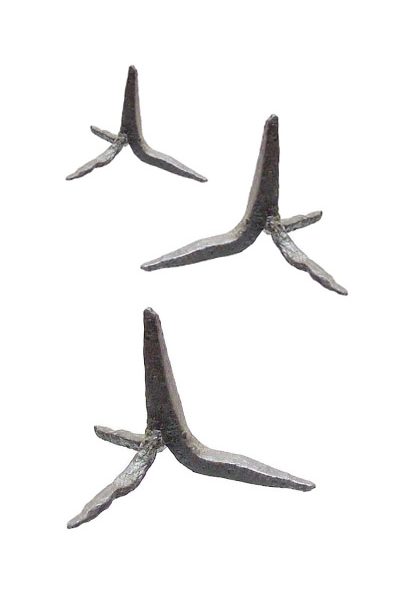
A caltrop is a small iron device of four spikes joined at the center so that however it lands, one spike always points up. Scattered on the ground in the path of cavalry, infantry or war elephants, caltrops pierced hooves and feet and slowed or broke a charge. Persians, Romans and medieval armies used them for more than two thousand years, Japanese warriors carried them as makibishi, and in the twentieth century they returned as a weapon against vehicle tires, from OSS airfield raids to the police spike strip.
Also known as Caltrop, crow's foot, crowsfoot, tribulus, tribuli, makibishi, tetsubishi, jack rocks, cheval trap, calthrop, galtrap
Origins
The caltrop solves a simple problem. A single iron spike must be set in the ground to be any use, but four spikes joined at the center in the shape of a tetrahedron will land with one point up no matter how they are thrown. A handful scattered across a road or a ford becomes a hidden barrier that needs no digging. The Latin name was tribulus, after a thorny plant that catches the feet of animals, and the English word comes from the Latin for "foot trap." Caltrops were in use by the fourth century BC. The Roman historian Curtius Rufus writes that Darius III of Persia had them sown across the ground at Gaugamela in 331 BC in the Wars of Alexander the Great, hoping to cripple the Macedonian cavalry; Alexander, warned, kept his horsemen off the prepared ground.
Design & Construction
A caltrop is nothing more than iron. The usual form is four spikes two to four inches long, forged or welded to a common center at equal angles, with points sharpened and sometimes barbed so that they tear when pulled out. Smiths made them by twisting two bent rods together or by welding four short spikes to a core. Larger versions with longer spikes were used against horses, smaller ones against men, and the Japanese made some with hollow centers so they floated and could be dropped into a stream at a crossing. Because they were cheap and reusable, armies carried them by the sackful. Being so small, they were almost impossible to see in grass or mud, and after a fight they had to be collected with rakes or magnets so that friendly troops did not walk into them.
Service
The Roman Legions used caltrops as part of their field defenses. Caesar describes how, at the siege of Alesia in 52 BC, his legionaries set iron hooks he called stimuli into the ground between their lines of trenches and sharpened stakes, so that the Gauls attacking the works were caught by the feet in the dark. Later Roman and Byzantine manuals list caltrops among the stores a camp should carry, to be thrown out at night in front of the ramparts against cavalry. Medieval armies kept the habit. Caltrops appear in sieges and in the defense of narrow passes across Europe, and chroniclers of the Crusades describe them strewn across approaches against charging horsemen.
In Japan the makibishi, or "scattered water chestnut," served the Samurai and, in popular tradition, the ninja of Feudal Japan. Iron tetsubishi and the dried seed pods of the water caltrop plant were flung behind a man who was being chased, so that pursuers in straw sandals stepped onto the spikes. Caltrops went to sea as well. Sailors scattered them on decks to slow boarders, and they found a place beside the Roman Pilum and the pike as a weapon that stopped a charge before it struck.
The device almost vanished when horses left the battlefield, then came back for a new target: the pneumatic tire. In World War II the American Office of Strategic Services and the British Special Operations Executive issued hollow-spiked caltrops to resistance groups and to raiding parties. Thrown onto a runway or a road, a few dozen could stop convoys and ground aircraft, and the hollow spikes let the air out of a tire even when the caltrop was not driven in. Police forces adopted the same idea in the spike strip, and caltrops reappeared in United States and allied operations from Vietnam to the present.
Legacy
The caltrop is one of the oldest weapons still in use and one of the few that has never needed a redesign. Its descendants include the spike strip, the road barriers that tear tires, and the field mines such as the M18 Claymore Mine that carry the same idea of denying ground to the enemy with something small and hidden. The word itself has entered the language, from heraldry, where the caltrop is a charge on coats of arms, to the "jack rocks" thrown by strikers in twentieth-century labor disputes. Reproductions are sold today for reenactment and for display, and genuine Roman tribuli turn up at excavated forts from Britain to the Danube.
Sources
Caesar, Julius. The Gallic War, Book VII. Translated by H. J. Edwards. Loeb Classical Library, Harvard University Press, 1917.
Quintus Curtius Rufus. The History of Alexander, Book IV. Translated by John Yardley. Penguin Classics, 1984.
Turnbull, Stephen. Ninja AD 1460-1650. Warrior 64. Osprey Publishing, 2003.
Brunner, John W. OSS Weapons. 2nd ed. Phillips Publications, 2005.
Suggest an edit · account required · reviewed before publishing · how it works