Historical Context
Wars of Alexander the Great
Alexander the Great's conquest of the Persian Empire and campaigns to Central Asia and India, 336–323 BC. The Macedonian army combined the sarissa phalanx with shock cavalry, light troops and siege engineers into the most effective force of its day.
336 – 323 BC
Overview
Alexander became king of Macedon in 336 BC after the murder of his father Philip II, who had built the Macedonian army and made himself master of Greece. In 334 BC Alexander crossed into Asia with about 40,000 men to attack the Persian Empire. He won at the Granicus River that year, defeated Darius III at Issus in 333 BC, took Tyre after a seven-month siege, and entered Egypt. In 331 BC he destroyed Darius's last great army at the Battle of Gaugamela. Over the next years he fought through Bactria and Sogdiana and into India, where he defeated the king Porus and his war elephants at the Hydaspes in 326 BC. His army refused to go further, and he died in Babylon in 323 BC, aged thirty-two.
The Macedonian Army
Philip had created a new kind of army and Alexander used it to its limit. Its center was the phalanx of infantry armed with the Macedonian Sarissa, a pike of five to six meters held in both hands with a small shield slung from the shoulder, presenting a hedge of points that no enemy infantry could break frontally. Beside it fought the hypaspists, elite infantry, and the Companion cavalry, heavy horsemen with lances and the Greek Kopis, who delivered the decisive charge, usually led by Alexander himself. Many wore the Linothorax. Light infantry, archers, allied Greek cavalry and a siege train of torsion catapults and towers made it a complete army.
The Persian Opponent
The Persian Empire fought with huge levies from across its provinces, cavalry of high quality, Greek mercenary hoplites, and at Gaugamela scythed chariots and elephants. Its infantry, armed with spears, bows and the Persian Akinakes, could not stand against the Macedonian combination once the line was broken.
Legacy
Alexander's empire split among his generals after his death, but the Hellenistic kingdoms they founded spread Greek culture from Egypt to Afghanistan for three centuries. His campaigns became the model of generalship studied by commanders from Hannibal and Caesar to Napoleon.
Battles & Operations
Weapons
-
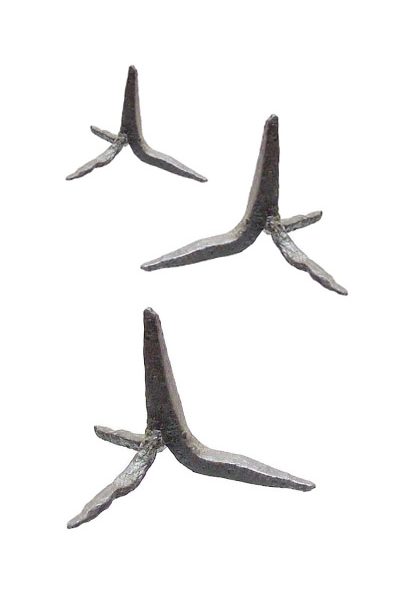
Caltrops
A caltrop is a small iron device of four spikes joined at the center so that however it lands, one spike always points up. Scattered on the… Continued…
-
Fire Ship
A fire ship was a vessel filled with flammable material, set alight and sent drifting or sailing into an enemy fleet. Wooden ships with… Continued…
-
Greek Aspis
The aspis was the great round shield of the Greek hoplite: a deep bowl of laminated wood about 90 centimeters across, often faced in thin… Continued…
-
Greek Kopis
The kopis was the forward-curved, single-edged chopping sword of classical Greece. Its blade is concave near the hilt and swells toward the… Continued…
-
Linothorax
The linothorax was a body armor made of many layers of linen glued or stitched together, worn by Greek hoplites and later by the Macedonian… Continued…
-
Macedonian Sarissa
The sarissa was the great two-handed pike of the Macedonian phalanx, introduced by Philip II around 359 BC and carried by the infantry of… Continued…
-
Persian Akinakes
The akinakes is the straight, double-edged short sword of the Achaemenid Persian Empire, borrowed from the Scythian horsemen of the steppe… Continued…