Origin
Persia
Persia (modern Iran) has one of the oldest continuous military traditions in the world. The Persian Immortals used spears, bows, and wicker shields. Later Persian and Safavid forces adopted curved shamshir sabers, compound bows, and eventually gunpowder weapons from both East and West.
Overview
Persian military power spanned three major imperial periods — Achaemenid (550–330 BCE), Parthian (247 BCE–224 CE), and Sassanid (224–651 CE) — before the Islamic conquest, and continued through the Safavid, Qajar, and Pahlavi dynasties into the modern era. Each period produced distinctive weapon traditions that influenced neighbors from Greece to India to Central Asia.
Achaemenid Empire (550–330 BCE)
The Immortals
The Achaemenid elite infantry — the Ten Thousand Immortals — were the royal guard and the strike force of the Persian army. They carried:
- Spara (wicker shield) — Large wicker and leather shields set in a wall
- Takabara (short spear/javelin)
- Akinakes (short sword) — A short straight sword used as a sidearm
- Composite bow — The decisive Persian ranged weapon; Persian infantry were primarily archers
Scythed Chariot
The Achaemenids deployed war chariots with scythes mounted on the wheel hubs, designed to scatter infantry formations. They were spectacularly effective psychologically but could be defeated by disciplined infantry who opened lanes to let the chariots through.
Parthian and Sassanid Empires
Cataphract Cavalry
Both Parthian and Sassanid armies relied heavily on cataphracts — heavily armored cavalry where both horse and rider wore iron lamellar or mail armor. These heavily armed shock cavalry were the forerunner of the European medieval knight.
Parthian Shot
Parthian horse archers were famous for the Parthian shot — firing the composite bow backward while in a feigned retreat, a tactic that destroyed Roman armies at Carrhae (53 BCE).
Sassanid Arms
Sassanid cavalry carried:
- Kontos — A heavy lance 3.5–4.5 meters long, couched under the arm
- Shamshir (early form) — A curved saber
- Composite bow — Still the dominant Persian ranged weapon
The Shamshir
The Persian shamshir — a deeply curved single-edged saber with a near-circular arc — became the definitive blade of the Islamic world. The curve is so pronounced that the shamshir is primarily a cutting and drawing weapon; it has almost no point for thrusting. The shamshir influenced the Turkish kilij, Indian talwar, and Mamluk sabers.
This article is a stub.
Battles & Operations
-
Battle of Marathon (August or September 490 BC)
The Battle of Marathon, fought in late summer 490 BC on the coastal plain northeast of Athens, ended the first Persian invasion of Greece.… Continued…
-
Battle of Salamis (September 480 BC)
The Battle of Salamis, fought in September 480 BC in the narrow strait between the island of Salamis and the coast near Athens, was the… Continued…
-
Battle of Thermopylae (August or September 480 BC)
The Battle of Thermopylae was fought in late summer 480 BC in the narrow coastal pass of Thermopylae in central Greece, where a Greek force… Continued…
-
Battle of Gaugamela (1 October 331 BC)
The Battle of Gaugamela, fought on 1 October 331 BC near Arbela in northern Mesopotamia, decided the war between Alexander the Great and… Continued…
Weapons
-
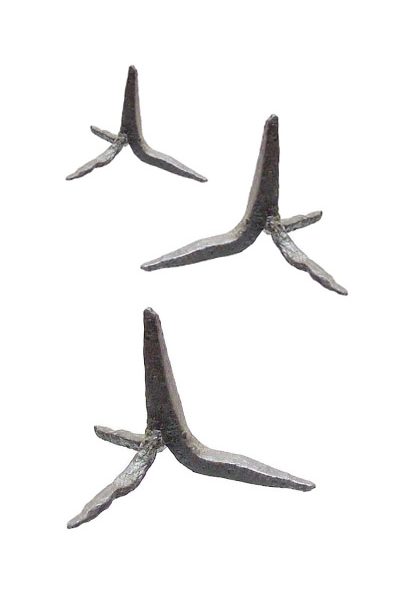
Caltrops
A caltrop is a small iron device of four spikes joined at the center so that however it lands, one spike always points up. Scattered on the… Continued…
-
Greek Trireme
The trireme was the main warship of the eastern Mediterranean from the late sixth century BC to the fourth century BC. It was a long… Continued…
-
Persian Akinakes
The akinakes is the straight, double-edged short sword of the Achaemenid Persian Empire, borrowed from the Scythian horsemen of the steppe… Continued…
-
Persian Shamshir
The shamshir is Persia's deeply curved saber — the blade whose silhouette gave Europe the word 'scimitar.' Perfected under the Safavids, it… Continued…
-
Persian Tabar
The tabar is the war axe of Persia and the wider Islamic world, from the Middle East to Mughal India. The name is Persian for axe, and the… Continued…