Weapon Type
Longswords
Two-handed or hand-and-a-half blades.
Edged Weapons → Swords — Subcategory
Overview
The longsword — sometimes called the "hand-and-a-half sword" or "bastard sword" — was the primary military sword of the late medieval period (roughly 1300–1550). Its defining characteristic is a grip long enough to allow a second hand to be placed on it, enabling greater power, leverage, and control than a one-handed sword while remaining lighter and more maneuverable than a dedicated two-handed sword.
Characteristics
- Blade length — Typically 85–115 cm; total length 115–145 cm
- Grip — 15–20 cm; long enough for two hands, usable one-handed by a strong fighter
- Cross-section — Varies by purpose: broad and hexagonal for cutting swords; narrower and diamond for thrusting (armor-piercing) swords
- Point — Acute; capable of thrusting into armor gaps
- Weight — Typically 1.1–1.8 kg; well-balanced; not as heavy as popular imagination
Fighting System
Unlike the cut-and-slash sword fighting of Hollywood, medieval longsword technique was a sophisticated combat system:
German School (Liechtenauer tradition)
Johannes Liechtenauer (14th century) codified a comprehensive fighting system (Fechtkunst):
- Five master cuts (Meisterhau) — Zwerchhau, Zornhau, Schielhau, Krumphau, Scheitelhau; each designed to defeat specific attacks
- Half-swording (Halbschwert) — Gripping the blade with the gauntleted hand for close-quarters control and thrusting into armor gaps
- Murder stroke (Mordschlag) — Reversing the sword and striking with the pommel or crossguard as a hammer against armored opponents
- Extensive wrestling and grappling as part of the system
Italian School (Fiore dei Liberi, Filippo Vadi)
Fiore's Flos Duellatorum (c. 1410) documented a parallel Italian tradition with different techniques and organization but similar core principles.
Historical Context
The longsword's development paralleled the development of plate armor:
- As chainmail gave way to transitional and then full plate armor, swords needed to thrust into gaps rather than cut through mail
- The longsword's acute point and the half-swording technique addressed this directly
- By 1500, as plate armor declined and firearms rose, the longsword was increasingly replaced by the rapier for civilian dueling and the basket-hilted broadsword for military use
Two-Handed Swords (Zweihänder / Spadone)
True two-handed swords — with blades of 120–160 cm and grips of 30+ cm — were a related but distinct category:
- Used by specialist Doppelsöldner (German mercenary double-pay soldiers) who received extra pay for their dangerous frontline role
- Tasked with breaking enemy pike formations by cutting off pike heads
- The Flamberge (flame-bladed) two-handed sword; wavy blade created vibration in parried weapons
This article is a stub. Contributions covering specific longsword examples, masters, and historical use are welcome.
-
Estoc
The estoc was a sword made to defeat plate armor: a long, stiff blade with no real cutting edge, triangular, square or diamond in section… Continued…
-
Landsknecht Zweihänder
The zweihänder was the great two-handed sword of the German Landsknecht mercenaries: up to 1.8 meters of steel with side rings, parrying… Continued…
-
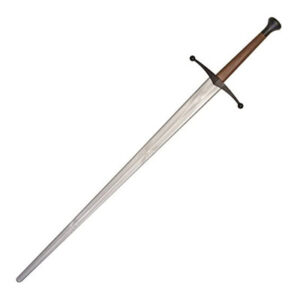
Longsword
The longsword is the two-handed knightly sword of the late Middle Ages and Renaissance: a straight, double-edged blade of roughly 33 to 43… Continued…