Weapon Type
Muskets
Pre-rifle smoothbore long arms.
Firearms — Subcategory
Overview
The musket is a smoothbore long arm — the standard infantry firearm of the period from roughly 1680 to the 1850s, when rifled percussion weapons replaced it. The term covers both matchlock and flintlock versions, though the flintlock musket was the definitive military form. The musket's smoothbore barrel meant it was inherently inaccurate; tactics relied on volley fire — massed simultaneous shots at close range — rather than individual marksmanship.
Mechanism: The Flintlock
The standard military musket used the flintlock mechanism:
- A piece of flint is clamped in the cock (hammer)
- Pulling the trigger releases the cock, which strikes the frizzen (steel plate over the flash pan)
- The flint scrapes sparks into the powder in the flash pan
- The flash pan powder ignites and fires through the touch-hole into the main charge
- The main charge propels the ball
Reliability — Flintlocks misfired roughly 1 in 5–8 shots in good conditions; rain made them unreliable Speed — 3–4 rounds per minute for a trained soldier; 2 per minute in combat conditions
Major Musket Patterns
British: Brown Bess (Land Pattern Musket)
- .75 caliber; 46-inch barrel (Long Land) or 42-inch (Short Land / India Pattern)
- Used from c. 1722 through the 1840s; over 3 million produced
- The most widely used military musket in the English-speaking world
- Used in the American Revolution, Napoleonic Wars, and many colonial conflicts
French: Charleville (Model 1766, AN IX)
- .69 caliber; 44.8-inch barrel
- The Charleville Model 1766 supplied to American forces in the Revolution was the basis for the American Model 1795
- AN IX version (1801) was the primary Napoleonic Wars French musket
Prussian/German: Pattern 1782 and variants
- .75 caliber; similar to British and French patterns
- Prussian infantry drill was the most rigorous in Europe; Frederick the Great's fire discipline produced the fastest musketry in the 18th century
American: Model 1795 and Model 1816
- Based on the Charleville; .69 caliber; produced at Springfield and Harper's Ferry armories
- The Model 1816 was the most-produced American musket before the Civil War percussion conversions
The Percussion Musket
In the 1840s, flintlock muskets were converted or replaced by percussion cap muskets:
- A copper cap containing mercury fulminate replaced flint and pan
- Cap fired reliably in rain and damp conditions; nearly eliminated misfires
- Rate of fire slightly increased; the same smoothbore accuracy (or inaccuracy)
- The Mexican-American War (1846–48) was largely fought with percussion muskets
Decline
The musket was made obsolete by:
- The rifle musket — Minié ball allowed muzzle-loading rifles to be loaded as fast as smoothbores; superior accuracy; the American Civil War was the rifle musket's war
- Breech-loading rifles — Faster loading; no need to stand to load; weather-independent ignition
This article is a stub. Contributions covering specific musket patterns, battles, and drill are welcome.
-
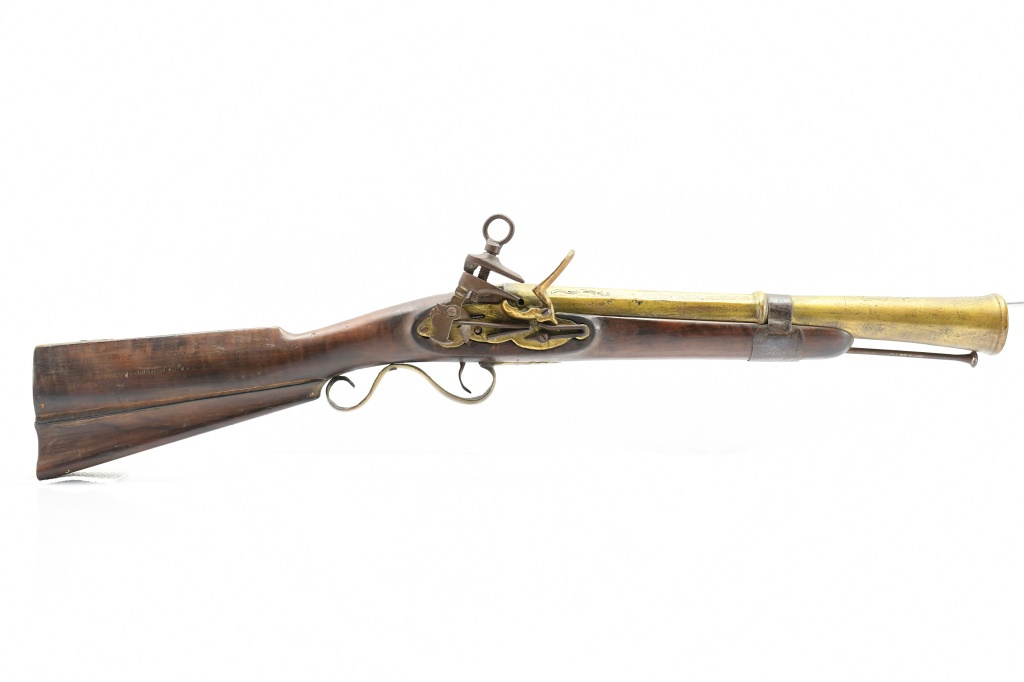
Blunderbuss
The blunderbuss was a short, large-bore, muzzle-loading gun with a flared muzzle, built to fire a handful of shot at very close range. From… Continued…
-
Brown Bess Musket
Brown Bess is the affectionate name for the British Land Pattern flintlock musket, the longest-serving firearm in British history. A .75… Continued…
-
Charleville Musket
'Charleville' is the collector's name — taken from the great arsenal in the Ardennes — for the French service flintlock muskets of the… Continued…
-
Fusil de Chasse
The fusil de chasse was a light French flintlock hunting musket, made in large numbers at Tulle for the Ministry of Marine and shipped to… Continued…
-
Janissary Tüfek
The tüfek, the Turkish word for a gun, was the long-barreled musket carried by the Janissaries, the elite infantry of the Ottoman Empire.… Continued…
-
Matchlock Musket
The matchlock was the first firearm a soldier could aim and fire without taking his eyes off the enemy: a serpentine lever lowered a… Continued…
-
Model 1845 musket
The Model 1845 was the standard infantry musket of the Russian army in the Crimean War. A 7-line (17.8 mm) smoothbore fired by a percussion… Continued…
-
Pattern 1853 Enfield
The Pattern 1853 Enfield was the British Army's .577 caliber percussion rifle-musket, adopted in 1853 and made at the Royal Small Arms… Continued…
-
Springfield Model 1842
The Springfield Model 1842 was the United States Army's first regulation percussion musket and the last of its .69 caliber smoothbores.… Continued…
-
Springfield Model 1861
The Springfield Model 1861 was the standard infantry arm of the Union in the Civil War: a .58 caliber single-shot muzzleloading… Continued…