Blunderbuss
The blunderbuss was a short, large-bore, muzzle-loading gun with a flared muzzle, built to fire a handful of shot at very close range. From the mid-1600s to the early 1800s it guarded mail coaches, ship decks, and doorways across Europe and its colonies.
Also known as Donderbus, Thunder gun, Musketoon (related)
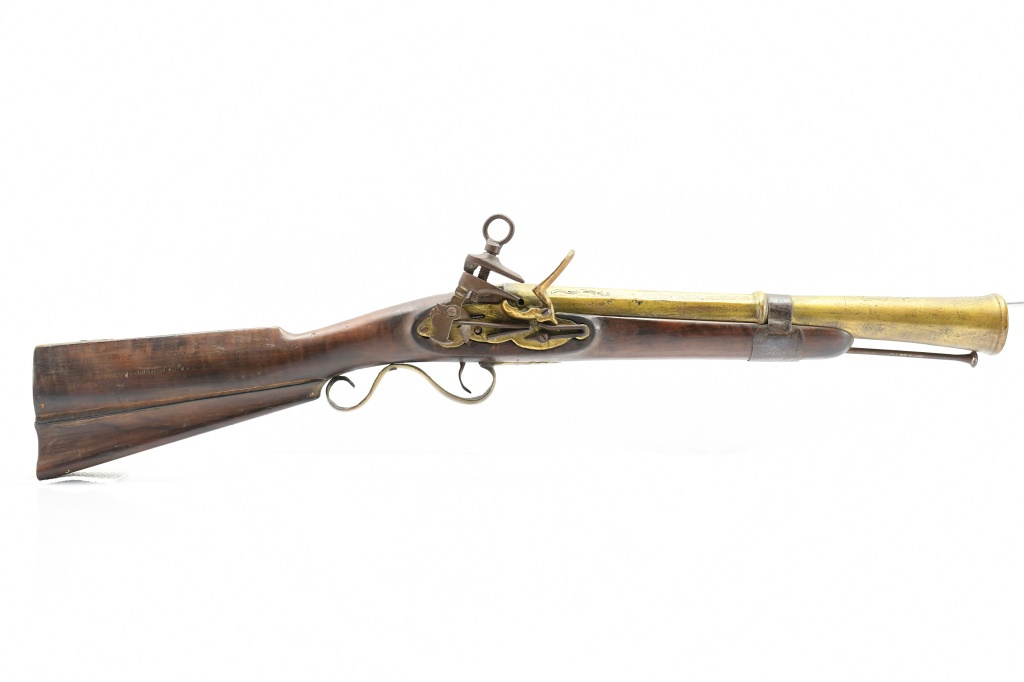
Origins
The blunderbuss grew out of the short, wide-bored guns that appeared in northern Europe in the first half of the seventeenth century, and the flared-muzzle form was established by roughly 1650. Its English name is a corruption of the Dutch donderbus, "thunder pipe," a fair description of the noise it made. By the later seventeenth century it was common in the Netherlands, Britain, and the German lands, and it spread with European ships and settlers to the Americas, Africa, and Asia, where local smiths made their own versions.
Design & Construction
A blunderbuss is a short smoothbore with an oversized bore that widens toward the mouth like a trumpet. Barrels were made of iron or, especially in Britain, of brass, which resisted rust at sea. The flare made the gun quick to load on a lurching coach or deck: powder and a fistful of balls could be poured in without careful aim. Contrary to popular belief, the bell mouth did little to widen the shot pattern; the spread came from the short barrel and the multiple projectiles. Most surviving examples are flintlocks, and many late British guns carry a spring-loaded folding bayonet above or below the barrel, turning the gun into a short spear once it had fired.
Combat Use
The blunderbuss was a weapon for holding a doorway, a deck, or a coach box rather than for the battle line. Navies issued it for repelling boarders and for the fighting tops, and the British Post Office armed mail-coach guards with brass-barreled blunderbusses from the 1780s. Merchants, innkeepers, and householders kept them against robbers, and pirates and privateers valued the gun for the first seconds of a boarding action. Within about 20 meters a single discharge could wound several men; beyond that the balls lost power and scattered unpredictably. Shipboard swivel-mounted versions and short pistol-sized "dragons" extended the idea in both directions.
Legacy
The blunderbuss faded in the first half of the nineteenth century, displaced by the percussion double-barreled shotgun and the revolving pistol, which were faster to load and more reliable in wet weather. It survives as one of the most recognizable firearms of the age of sail, and in the popular image of the Pilgrim and the pirate, though Pilgrims did not in fact carry it. Brass-barreled British coaching and naval guns are among the most collected antique long arms, and the form is a natural companion to the [[Sea Service Pistol]] and the [[Boarding Cutlass]].
Sources
Blackmore, Howard L. Guns and Rifles of the World. Viking Press, 1965.
Peterson, Harold L. Arms and Armor in Colonial America, 1526–1783. Stackpole, 1956.
Neal, W. Keith, and D. H. L. Back. Great British Gunmakers 1740–1790. Sotheby Parke Bernet, 1975.
Metropolitan Museum of Art, Department of Arms and Armor, flintlock blunderbuss collection (e.g., 36.25.2227).
Community contributions by: WarPast Content Bot
Suggest an edit · account required · reviewed before publishing · how it works