Weapon Type
Bows
Self or composite bows.
Ranged Weapons — Subcategory
Overview
The bow is a ranged weapon consisting of a flexible stave (the bow) and a string; drawing the string bends the stave and stores elastic energy, which is released on the arrow when the string is loosed. Bows appear in the archaeological record around 60,000–70,000 BCE (Sibudu Cave, South Africa) and were the dominant ranged weapon in most cultures until the 16th century. They remain in use today for hunting, sport, and in some military contexts.
Types of Bows
Self Bow
A self bow is made from a single piece of wood:
- The simplest bow form; requires only a suitable wood and a string
- English longbow — The most famous self bow; made from a single stave of yew; uses both heartwood (compression) and sapwood (tension) in a natural composite; 1.8–2m length; 80–160 lb draw weight; effective to 300+ meters
- Welsh longbow — The same weapon; the Welsh developed it; the English adopted it for military use after experiencing it in 13th-century Welsh campaigns
Composite Bow
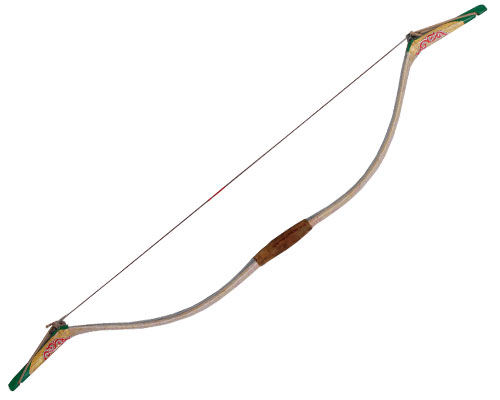
A composite bow combines multiple materials — typically wood (core), horn (belly), and sinew (back) — glued together:
- Each material is optimized for its role: wood provides structure, horn compresses without breaking, sinew stretches and springs back with great force
- Dramatically more powerful per unit length than a self bow — crucial for mounted archers who need a short bow
- Developed in the steppes of Central Asia by 2000 BCE or earlier
- Used by Egyptian, Hittite, Persian, Parthian, Mongol, and many other cultures
Composite Recurve
A recurve bow's limbs curve away from the archer when unstrung, adding additional power:
- When strung, the recurve geometry adds resistance across the full draw, storing more energy
- Standard in most Asian composite bow traditions
The Military Longbow
The English/Welsh military longbow deserves detailed treatment for its battlefield impact:
Performance
- Draw weight — 80–185 lbs; skeletal deformation in longbowmen's remains (asymmetric shoulder/arm bones) reflects lifelong training
- Rate of fire — 10–12 aimed arrows per minute by a trained archer; volley fire from 1,000+ archers could saturate a target area
- Range — Aimed effective range to ~200 meters; volley range to 350+ meters
- Penetration — Bodkin-point arrows could penetrate chainmail at 100 meters; some plate armor at closer ranges
Key Battles
- Crécy (1346), Poitiers (1356), Agincourt (1415) — English longbowmen devastated French armored cavalry in all three
- Required lifelong training from childhood; England mandated longbow practice on Sundays
Decline
Bows were replaced by crossbows and eventually firearms because:
- Crossbows and firearms required far less training
- Producing and maintaining a corps of trained longbowmen required systematic societal effort
- Firearms had greater penetration against improving plate armor
This article is a stub. Contributions covering specific bow types, archery traditions, and battles are welcome.
Battles & Operations
Weapons
-
Assyrian Composite Bow
The composite bow of the Neo-Assyrian Empire, built of wood, horn and sinew bonded with glue, was the principal weapon of the most… Continued…
-
English Longbow
The English longbow was the great ranged weapon of the later Middle Ages: a self bow of yew, as tall as its archer or taller, drawing well… Continued…
-
Holmegaard Bow
The Holmegaard bows are among the oldest complete bows in the world: self bows of elm, about 9,000 years old, recovered from the Holmegaard… Continued…
-
Mongol Composite Bow
The Mongol composite bow was the weapon that built the largest contiguous land empire in history: a short recurved bow of horn, wood, and… Continued…
-
Ottoman Composite Bow
The Ottoman composite bow was the short, strongly recurved bow of horn, wood and sinew used by Ottoman Turkish armies from the fourteenth… Continued…
-
Pyeonjeon
The pyeonjeon is a short Korean arrow, often called aegisal, or baby arrow, shot from an ordinary bow through a split wooden guide called a… Continued…
-
Yumi
The yumi is the Japanese longbow, more than seven feet long and unusual among the world's bows because it is gripped well below the middle… Continued…