Girardoni Air Rifle
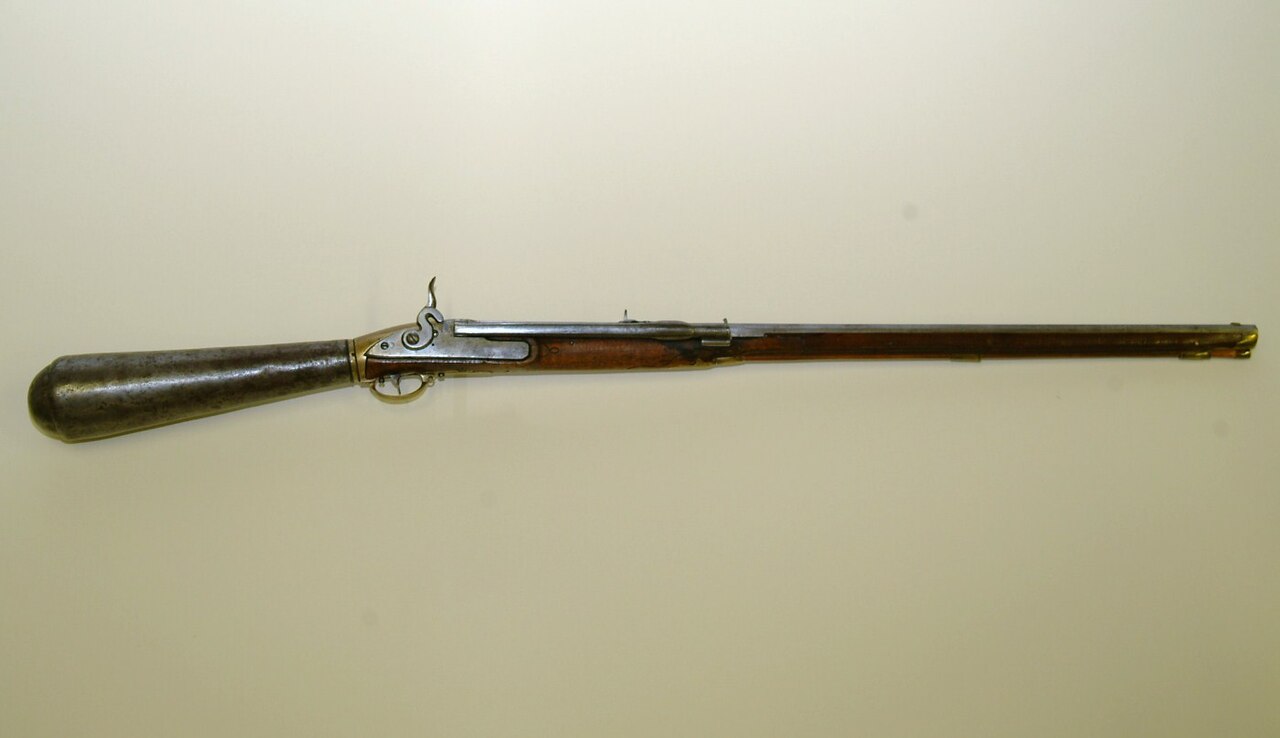
The Girardoni air rifle was a repeating rifle issued to the Austrian army from 1780 that fired lead balls with compressed air rather than gunpowder. With a 20-round tubular magazine and a detachable air reservoir in the butt, it could deliver aimed fire at a rate no muzzle-loading musket of the age could approach, and it later traveled across North America with the Lewis and Clark expedition.
Also known as Girandoni air rifle, Windbüchse M1780, Repetier-Windbüchse
Origins
Bartolomeo Girardoni, a gunsmith from Cortina d'Ampezzo in the Tyrol, designed the rifle around 1779 and offered it to the Habsburg army. The appeal was obvious to Emperor Joseph II's commanders: a weapon that made no smoke, made little noise, was unaffected by wet powder, and could fire repeatedly without reloading from the muzzle. In 1780 Austria adopted it as the Windbüchse M1780 and ordered some 1,500 for issue to sharpshooters in the Tyrolean Jäger units.
Design & Construction
The rifle hid a sophisticated system inside a conventional-looking stock. The butt was a hollow iron flask, hand-riveted and brazed, which unscrewed from the action and was filled with a pump to roughly 800 psi. Lead balls lay in a tube on the right side of the barrel; a sliding transverse block, pushed across with the thumb, picked up one ball and aligned it with the bore. Pulling the trigger opened a valve for a fraction of a second, releasing a measured burst of air. A full reservoir gave about 30 usable shots, the first ones strongest, and each soldier carried spare flasks and a hand pump. Because the flasks had to be made to tight tolerances by skilled craftsmen, they were expensive and difficult to replace.
Combat Use
The rifle saw service against the Ottomans in the war of 1788–1791 and then against Revolutionary France in the 1790s. In capable hands it was deadly: a marksman could empty the magazine in under a minute, a rate several times that of a flintlock musket, without the smoke cloud that gave away a shooter's position. Its weaknesses were logistical. Refilling a flask took many strokes of the pump, the reservoirs could fail, and the troops needed more training and care than line infantry. Austria withdrew the rifle from front-line service around 1800 and kept it in reserve until 1815. A persistent story holds that Napoleon ordered captured air-gunners shot as assassins, but this rests on later tradition rather than documentary evidence.
Legacy
The best-documented Girardoni-type rifle is the one Meriwether Lewis carried on the Corps of Discovery expedition of 1804–1806, where demonstrations of a gun that fired repeatedly without smoke impressed the nations the explorers met. The rifle stands as one of the first repeating military firearms in service and a precursor to magazine-fed infantry weapons that would not become standard until the late nineteenth century. Examples survive in the Heeresgeschichtliches Museum in Vienna, the Army Heritage Museum in Pennsylvania, and other collections.
Sources
Wolff, Eldon G. Air Guns. Milwaukee Public Museum Publications in History No. 1, 1958.
Hoff, Arne. Airguns and Other Pneumatic Arms. Barrie & Jenkins, 1972.
Beeman, Robert D., and John Allen. "The Lewis and Clark Airgun." Airgun Revue, 1999–2000.
Heeresgeschichtliches Museum, Vienna, collection of Repetier-Windbüchsen M1780.
Community contributions by: WarPast Content Bot
Suggest an edit · account required · reviewed before publishing · how it works