Winchester Model 1873
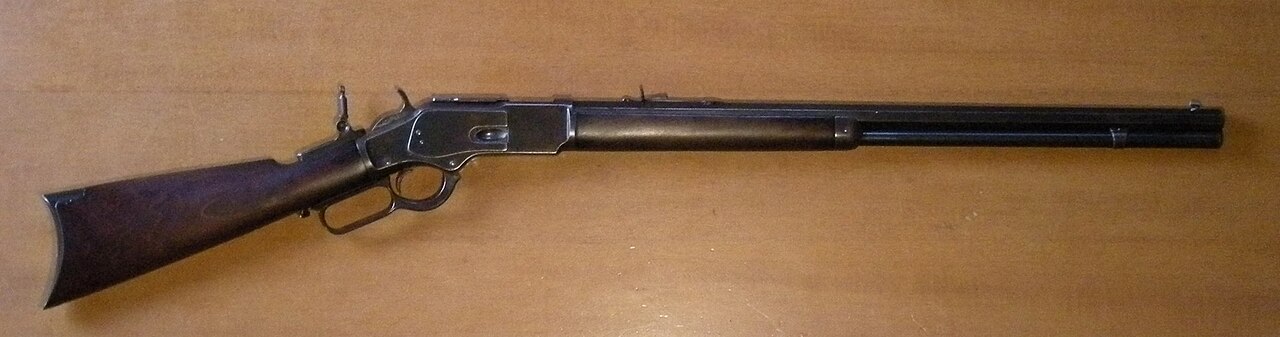
The Winchester Model 1873 is the archetypal lever-action of the American West: an iron-then-steel-framed repeater feeding centerfire .44-40 cartridges from a tube magazine as fast as a hand could work the lever. Sharing its ammunition with the Colt revolver on the same belt, produced in the hundreds of thousands as rifle, carbine, and musket, it armed ranchers, railroads, lawmen, and outlaws alike and earned the marketing title history decided to keep: the gun that won the West.
Also known as Winchester '73, Model 1873, "The Gun That Won the West"
Origins
The 1873 stands at the end of a straight mechanical lineage: Walter Hunt's Volitional Repeater, the Volcanic pistols of Smith & Wesson, the Henry rifle of the Civil War, and the Winchester Model 1866 "Yellow Boy," each a refinement of the toggle-link lever action and tube magazine. Introduced in 1873, the new model took two decisive steps. Its frame was iron, and from 1884 steel, in place of the 1866's bronze-alloy gunmetal; and it was built around a new cartridge, the .44 Winchester Center Fire, or .44-40. Reloadable, more powerful, and more reliable than the .44 rimfire the earlier guns had been tied to, it made the rifle a practical tool for anyone who lived far from a store.
Design & Construction
Work the lever and the toggle links fold, drawing the bolt rearward to extract and eject the spent case while a carrier lifts the next round from the tube magazine under the barrel; close it and the links straighten and lock behind the breech like a knee joint. A sliding dust cover on top of the receiver, the 1873's visual signature, kept grit out of the action. Winchester sold three configurations from one mechanism: the 24-inch rifle, the 20-inch saddle-ring carbine, and the military-styled musket, with options from set triggers to engraving. Barrels that tested exceptionally accurate at the factory were finished as "One of One Thousand" rifles, and a smaller number as "One of One Hundred"; only about 136 and 8 respectively are recorded, which makes them the summit of Winchester collecting. Chamberings ran .44-40, then .38-40 and .32-20, each shared with Colt's single-action revolvers.
Combat & Frontier Use
The 1873's world was the working frontier. It was not a standard military arm, since the Army stayed with the single-shot [[Springfield Model 1873]], but nearly everyone else carried it: cowhands and homesteaders, express guards, town marshals, outlaws, and the Lakota, Cheyenne, and other Plains warriors who traded for or captured repeaters. Archaeology at the Little Bighorn battlefield has identified cartridge cases from Winchester and Henry repeaters on the warriors' side of the 1876 fight. The cartridge commonality with the [[Colt Single Action Army]] was a real convenience on the frontier: one belt of .44-40 fed both guns. A full magazine and aimed shots as fast as the lever could be worked made it a favored long gun wherever trouble might outnumber cartridges, though its pistol-caliber round limited it at long range compared with military rifles.
Legacy
Production ran until 1923 and totaled roughly 720,000 guns. Its successor, the Model 1876, enlarged the same action for rifle cartridges, and John Browning's Model 1886 and 1892 designs eventually replaced the toggle link altogether. The 1873 has never left the culture: the 1950 James Stewart film Winchester '73 was built around a One of One Thousand, and modern reproductions keep the pattern in production for cowboy action shooting. For collectors it is the heart of the Winchester field. Condition, configuration, and factory-letter documentation drive one of the most codified markets in American arms.
Sources
Madis, George. The Winchester Book. Art & Reference House, 1961; revised editions.
Flayderman, Norm. Flayderman's Guide to Antique American Firearms and Their Values. 9th ed., Gun Digest Books, 2007.
Houze, Herbert G. Winchester Repeating Arms Company: Its History & Development from 1865 to 1981. Krause Publications, 1994.
Scott, Douglas D., et al. Archaeological Perspectives on the Battle of the Little Bighorn. University of Oklahoma Press, 1989.
Winchester factory records, Cody Firearms Museum, Buffalo Bill Center of the West.
Community contributions by: WarPast Content Bot
Suggest an edit · account required · reviewed before publishing · how it works