Origin
Arabia / Caliphate
The Arab Caliphates (Rashidun, Umayyad, Abbasid) created an Islamic empire stretching from Spain to Central Asia. Arab and Persian weapon traditions blended, producing the iconic curved scimitar, fine chain mail, and composite bows used by cavalry forces across the medieval Islamic world.
Overview
The Arab Islamic Caliphates — Rashidun (632–661), Umayyad (661–750), and Abbasid (750–1258) — expanded with extraordinary speed from the Arabian Peninsula across the Middle East, North Africa, Spain, and Central Asia. Arab armies initially relied on tribal cavalry and camel-mounted warriors, but rapidly absorbed the weapons traditions of the Persian and Byzantine empires they conquered.
Pre-Islamic Arabian Weapons
- Sayf (sword) — The pre-Islamic Arab sword was typically a straight or slightly curved single-edged blade; the famous Dhu al-Faqar, the sword of Ali ibn Abi Talib, had a distinctive forked tip in tradition
- Rumh (spear) — Long spear; the primary weapon of Arab cavalry
- Qaws (bow) — Arabian composite bows; not as powerful as Persian or Central Asian examples but effective
- Camel as weapons platform — Arab warriors fought from camel back in desert environments where horses were impractical
Islamic-Era Developments
The Scimitar (Saif/Kilij)
Contact with Persian and Central Asian cultures introduced the curved cavalry saber — the "scimitar" — to Arab armies. Several distinct blade forms emerged:
- Shamshir — Deeply curved Persian saber; predominantly a thrusting weapon
- Kilij — Turkish-influenced saber with a pronounced widened tip (yelman); effective for slashing from horseback
- Saif — Generic Arabic term for sword; covers many blade forms
Armor
Arab cavalry adopted Persian and Byzantine armor as those empires were absorbed — chainmail, lamellar armor, and iron helmets became standard for elite cavalry.
Islamic Golden Age and Military Technology
The Abbasid Caliphate's translations of Greek, Persian, and Indian texts included military engineering knowledge. Islamic scholars preserved and extended knowledge of metallurgy, producing high-quality steel blades. Damascus steel (wootz imported from India and worked in Syrian workshops) became the most prized blade material in the medieval world.
This article is a stub.
Battles & Operations
-
Battle of Tours (October 732)
The Battle of Tours, also called the Battle of Poitiers, was fought in October 732, or possibly 733, between Tours and Poitiers in western… Continued…
-
Battle of Hattin (3-4 July 1187)
The Battle of Hattin, fought on 3 and 4 July 1187 near Tiberias in Galilee, destroyed the field army of the crusader Kingdom of Jerusalem.… Continued…
Weapons
-
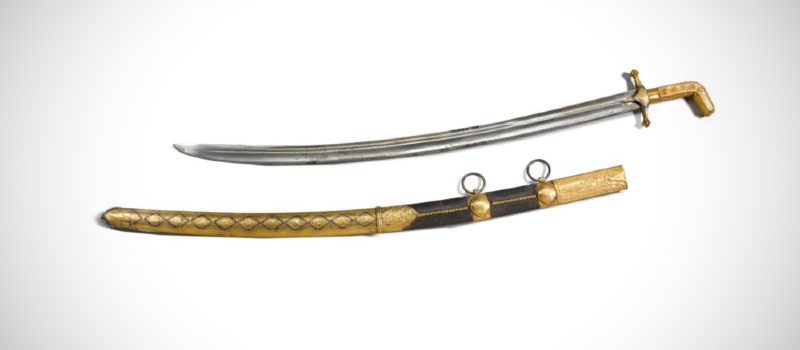
Arab Saif
The saif, from the Arabic word for sword, was the straight, double-edged sword carried by the Arab armies of the early Islamic conquests.… Continued…
-
Jambiya
The jambiya is the curved, double-edged dagger of Arabia, worn at the front of the belt in a sheath with a sharply upturned tip. It is most… Continued…