Arab Saif
The saif, from the Arabic word for sword, was the straight, double-edged sword carried by the Arab armies of the early Islamic conquests. It was similar in size and shape to the Roman and Byzantine swords of the same period, and the best blades were imported from India and Yemen. Arab poets praised it above all other weapons. The saif was used from Syria and Persia to Spain, and by the horsemen defeated at Tours in 732. Curved sabers replaced it only centuries later, with Turkish influence.
Also known as Saif, Sayf, Seif, Arab sword, early Islamic sword, Arab straight sword, Muhannad
Origins
Saif (also written sayf) is simply the Arabic word for sword. Long before Islam, the sword was the most honored weapon in Arabia. Pre-Islamic poetry is full of praise for fine blades, and poets used many names for them according to where they came from. A sword called hindi or muhannad had an Indian blade, and one called yamani came from Yemen. Arab tribes such as the Ghassanids and Lakhmids served as allies of the Byzantine and Persian empires, and they knew the swords of both. Several swords said to have belonged to the Prophet Muhammad and the early caliphs are kept in the Topkapı Palace Museum in Istanbul. Most are straight and double-edged, although many of them were remounted, and some of their blades may be later than the traditions claim. The most famous sword of early Islam, Dhu al-Fiqar, belonged to Ali, the Prophet's cousin. Later art shows it with a split, two-pointed tip, but the earliest accounts do not make its shape clear.
Design & Construction
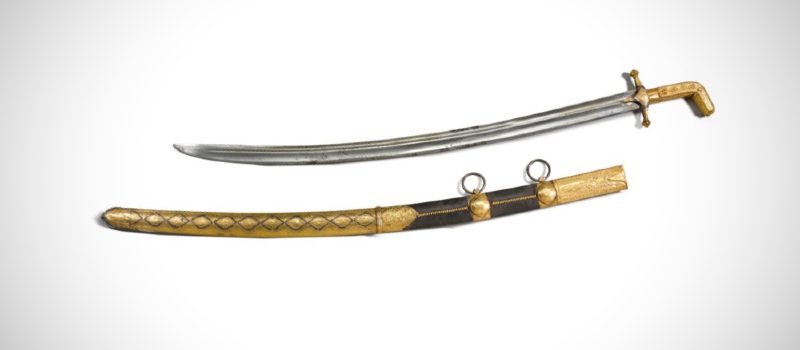
The early saif was a straight, double-edged cutting sword with a fairly broad blade, a short crossguard and a simple grip and pommel. In size it was close to the Roman Spatha and the Byzantine Spathion of the same centuries, and surviving examples suggest an overall length of very roughly 90 centimeters (about 3 feet), though sizes varied. Early Arab warriors usually hung the sword from a baldric, a strap worn over the shoulder, rather than from a waist belt. The scabbard was of wood covered in leather, often with metal fittings. Blade quality varied widely. In the ninth century the philosopher al-Kindi wrote a treatise on swords that sorted blades by the kind of iron or steel used and the place where they were made, and it shows how highly the best imported steel was valued.
Combat Use
The armies that spread out of Arabia after 632 were built mainly around infantry, with horsemen used for scouting, raiding and pursuit. A warrior fought with spear, bow and sword, and the saif was the weapon for close combat. Battles often began with single combats between champions, and the sword was the weapon of these duels. The general Khalid ibn al-Walid, who led Arab armies in Iraq and Syria, was given the title Saif Allah, the Sword of God. The saif was carried at the victories over the Byzantines at the Yarmuk in 636 and over the Persians at Qadisiyya, and on across North Africa and into Spain during the Early Muslim Conquests. By the eighth century the armies of al-Andalus included many Arab and Berber horsemen armed with lance and sword. At the Battle of Tours they attacked the Frankish line again and again but could not break it, and their commander Abd al-Rahman al-Ghafiqi was killed.
Legacy
The straight sword remained common in Arab lands for centuries, and many swords of the Crusades era were still straight. Curved sabers came west with the Turkish peoples of Central Asia and slowly became the main sword of the Middle East between about the twelfth and fifteenth centuries, producing the Ottoman Kilij and the Persian Shamshir. Straight double-edged swords survived in some regions, such as the Sudanese kaskara. The word lives on in names such as Saif al-Din, 'Sword of the Faith', and a sword appears on the national flag of Saudi Arabia.
Sources
Nicolle, David. Armies of the Muslim Conquest. Osprey Publishing, 1993.
Kennedy, Hugh. The Armies of the Caliphs: Military and Society in the Early Islamic State. Routledge, 2001.
Hoyland, Robert G. In God's Path: The Arab Conquests and the Creation of an Islamic Empire. Oxford University Press, 2015.
Alexander, David. Islamic Arms and Armor in the Metropolitan Museum of Art. Metropolitan Museum of Art, 2015.
Suggest an edit · account required · reviewed before publishing · how it works