Force
Cossacks
Frontier horsemen of the Pontic steppe, famed for the shashka saber and light cavalry tactics in Russian service.
Origins
The Cossacks arose on the wild steppe frontier between Muscovy, Poland-Lithuania and the Tatar khanates. From the late fifteenth century runaway serfs, adventurers and borderers built free communities along the rivers, most famously the Dnieper and the Don. Their name comes from a Turkic word usually translated as "free man" or "adventurer", and that was the whole idea: no lord, leaders called atamans or hetmans elected by the community, and war as a way of life. The Zaporozhian Cossacks had their fortified camp, the Sich, on islands below the Dnieper rapids. The Don Cossacks lived along the Don to the east.
Organization & Training
Each Cossack community, or host, governed itself through an assembly of its fighting men. Boys learned to ride and shoot from childhood, and a Cossack was expected to provide his own horse, clothing and weapons. Over time the tsars bought what they could not tame. In return for land, freedom from serf labor and other privileges, Cossack men owed long military service to Russia. By the early twentieth century there were eleven Cossack hosts, from the Don, Kuban and Terek in the south to the Amur and Ussuri in the Far East. Their cavalry regiments were divided into sotnias, units of about a hundred men.
Weapons & Equipment
Cossack warfare was light cavalry mastery: raid, scout, screen and pursue. The lance and the guardless Cossack Shashka saber were the classic arms, and the nagaika whip was their badge. Firearms were used from early on, including matchlock guns in the sixteenth and seventeenth centuries. In the Zaporozhian period river fleets raided the Black Sea coasts of the Ottoman Empire in light oared boats called chaiky. By 1914 Cossack cavalry carried a special version of the Mosin-Nagant M1891 rifle, and officers and some men carried the Nagant M1895 Pistol.
Notable Actions
In 1648 the Zaporozhian hetman Bohdan Khmelnytsky led a great rising against Poland-Lithuania. With Crimean Tatar allies, the Cossacks routed Polish armies at Zhovti Vody and Korsun, and in 1654 Khmelnytsky accepted the protection of the Muscovite tsar, a decision that redrew the map of Eastern Europe. Russia also faced Cossack revolts, led by Stenka Razin in 1670-71 and Yemelyan Pugachev in 1773-75, and Catherine the Great destroyed the Zaporozhian Sich in 1775. During the Napoleonic Wars Cossack cavalry under Matvei Platov harried Napoleon's army without mercy on its retreat from Moscow in 1812, and Cossacks rode into Paris in 1814. Cossacks conquered and guarded the empire's frontiers in the Caucasus, Central Asia and Siberia. They were also used to break up strikes and protests, as in the 1905 revolution, which made them hated by many Russians.
Legacy
Revolution and civil war shattered the hosts. Many Cossacks fought for the Whites, and the Bolsheviks' policy of "de-Cossackization" from 1919 brought executions and deportations. In World War II Cossack cavalry fought in the Red Army, while others joined the Germans and were handed back to the Soviets by the British in 1945. Ilya Repin's famous painting of the Zaporozhians writing an insulting reply to the Ottoman sultan shows the swagger remembered in legend. After 1991 Cossack groups revived, to mixed reactions, in Russia and Ukraine.
-
Cossack Shashka
The shashka is the guardless saber of the Caucasus and the Cossacks — a slightly curved, single-edged blade carried edge-up in the scabbard… Continued…
-
Mosin-Nagant M1891
The Mosin-Nagant was Russia's service rifle for over sixty years: a five-shot bolt action in the powerful rimmed 7.62x54R cartridge… Continued…
-
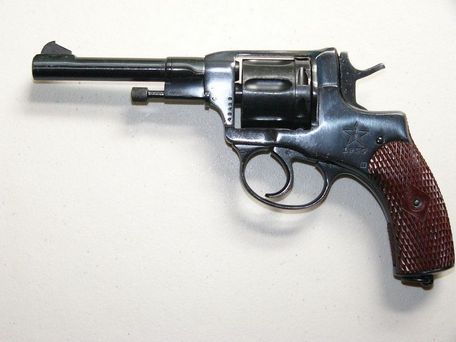
Nagant M1895 Pistol
The Nagant M1895 is the seven-shot Belgian-designed service revolver of Imperial Russia and the Soviet Union, unique among military… Continued…