Nagant M1895 Pistol
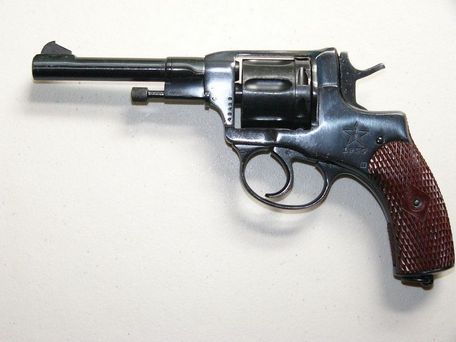
The Nagant M1895 is the seven-shot Belgian-designed service revolver of Imperial Russia and the Soviet Union, unique among military revolvers for its gas-seal mechanism: on cocking, the cylinder slides forward to press the cartridge's extended brass mouth into the barrel's forcing cone, sealing the gap that lets every other revolver leak gas. Adopted in 1895, made at Liège and then at Tula, it served through the Russo-Japanese War, the First World War, the Revolution and the Second World War, and the seal made it one of the few revolvers that can be usefully suppressed.
Also known as Nagant M1895, Nagant revolver, 1895 Nagant, gas-seal revolver, Nagan
Origins
The brothers Émile and Léon Nagant of Liège in Belgian Arms & Weapons were already Russia's partners — their name is on the Mosin-Nagant M1891 rifle for the magazine they contributed — when Léon offered the Russian Army a revolver built around the gas-seal principle patented by Henri Pieper. Russia adopted it on 13 May 1895 in two forms: a double-action model for officers and, in a display of the Tsarist army's distrust of its rankers' marksmanship, a single-action version for enlisted men to discourage rapid fire. The first 20,000 came from Liège; from 1898 the Tula arsenal produced it, and Tula went on making Nagants, with interruptions, until 1945.
Design & Construction
A conventional revolver leaks a fraction of its propellant gas through the gap between cylinder and barrel. In the Nagant, cocking the hammer cams the cylinder forward a couple of millimeters so that the case mouth of the special 7.62x38mmR cartridge — whose brass extends beyond the bullet — enters the forcing cone and seals it. The result is a velocity gain of perhaps 50 to 100 feet per second and, more usefully, a revolver that a suppressor can actually quiet, which the Soviet Bramit device of the 1930s exploited. The price is complexity, a heavy double-action pull, and loading and ejection by a gate and rod one chamber at a time, slower than any swing-out design. The 4.5-inch barrel and solid frame carry seven rounds of a 108-grain bullet at about 1,000 feet per second, modest ballistics even in 1895. The revolver weighs 1.75 pounds.
Combat Use
Nagants armed Russian officers in the Boxer Rebellion, in Manchuria against Japan in 1904-05 and throughout the World War I, where the single-action enlisted models were mostly converted to double action. Both sides carried it in the Civil War that followed the Revolution, and the Soviet Union kept it in production alongside the Tokarev TT-33 Pistol that was meant to replace it — the revolver was cheaper, and officers trusted it — so that the Nagant was still being issued to Red Army officers, NKVD units, partisans and pilots through the World War II. Poland, Greece, Sweden and Norway had their own models before 1914. Some remained with Soviet police and railway guards into the 1950s and beyond.
Legacy
The Nagant is a technical curiosity that turned out to be one of the longest-serving military handguns in history, produced for fifty years and used for over sixty. It was superseded by the Makarov, and the great surplus release of the 2000s put hundreds of thousands of Tula revolvers, many refurbished and dated from the 1930s and 1940s, into the hands of Western collectors, for whom the gas-seal action and the peculiar cartridge remain the attraction.
Sources
Bolotin, David N. Soviet Small-Arms and Ammunition. Finnish Arms Museum Foundation, 1995.
Ezell, Edward C. Handguns of the World. Stackpole, 1981.
Thompson, Leroy. Soviet Pistols: Tokarev, Makarov, Stechkin and Others. Osprey Weapon 84, 2022.
Taylerson, A.W.F. The Revolver, 1889-1914. Barrie & Jenkins, 1970.
Suggest an edit · account required · reviewed before publishing · how it works