Tokarev TT-33 Pistol
The Tokarev TT-33 was the service pistol of the Red Army from the 1930s until the Makarov replaced it in the 1950s: Fedor Tokarev's stripped-down Browning short-recoil design, chambered for the powerful bottlenecked 7.62x25mm cartridge derived from the Mauser C96's, with no manual safety and a hammer-and-sear assembly that lifts out as one unit for cleaning. About 1.7 million were made in the Soviet Union, and China, Yugoslavia, Poland, Hungary, Romania and North Korea built millions more, arming communist forces in Korea, Vietnam and every Cold War proxy conflict.
Also known as Tokarev, TT, TT33, TT-33, TT-30, TT pistol, Tula-Tokarev, Type 54 (China), M57 (Yugoslavia), TTC (Romania)
Origins
The Red Army of the 1920s carried the Nagant M1895 Pistol and a large number of Mauser C96 "Bolo" pistols bought from Germany, whose 7.63mm cartridge the Soviets liked for its flat trajectory and penetration. The 1929 competition for a self-loading service pistol specified a near-identical round, the 7.62x25mm, and Fedor Tokarev of the Tula arsenal won it with a design that owed everything to John Browning's M1911 Pistol and FN Model 1903 but simplified them for a peasant army's maintenance. The TT-30 was adopted in 1930; the TT-33 of 1933 simplified the frame and barrel lugs further, and it was the Soviet sidearm of the Great Patriotic War.
Design & Construction
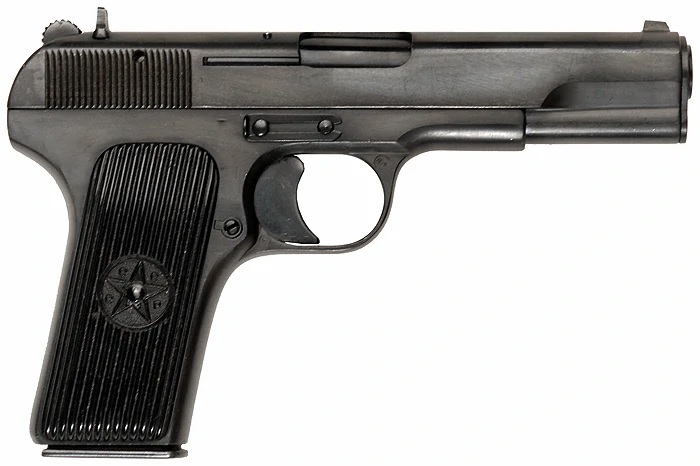
The TT is a locked-breech, short-recoil pistol on the Browning tilting-barrel pattern, with the barrel's locking lugs machined as full rings around it to save machining time. Its trademark is the removable fire-control group: hammer, sear, disconnector and their springs sit in a single steel module that lifts out of the frame for cleaning without tools, and the magazine lips are machined into the frame rather than the magazine so a damaged magazine still feeds. There is no manual safety — only a half-cock notch — a decision that troubled every importing country later. The 4.6-inch barrel and 7.7-inch length hold eight rounds of 7.62x25mm, an 85-grain bullet at about 1,400 feet per second that penetrates helmets and light cover in a way no 9mm can. The grips are black plastic with a star; the pistol weighs under two pounds.
Combat Use
Issued to officers, tank and aircraft crews, machine gunners and NKVD troops throughout the World War II, the Tokarev was a reliable, accurate pistol with a poor trigger and a reputation for going off when dropped, and Soviet soldiers valued it chiefly as a badge of rank. Its wider service came afterward. China's Type 51 and Type 54 armed the People's Liberation Army and the Chinese volunteers in Korean War, and Chinese and Soviet Tokarevs were the standard pistol of the North Vietnamese Army and Viet Cong in Vietnam War, where a captured TT was the prized souvenir of an American tour. Yugoslavia's M57 added a ninth round and later a safety; Poland, Hungary, Romania and North Korea built their own.
Legacy
The Soviet Union replaced the TT-33 with the Makarov PM in 1951, preferring a smaller pistol with a safety and a blowback action, but production elsewhere continued into the 1990s and the design remains in use in Pakistan, Bangladesh and across Africa. Millions of surplus Tokarevs, most fitted with import-mandated safeties, have reached Western collectors, and the 7.62x25mm cartridge, with its extraordinary penetration, retains a following of its own.
Sources
Bolotin, David N. Soviet Small-Arms and Ammunition. Finnish Arms Museum Foundation, 1995.
Ezell, Edward C. Handguns of the World. Stackpole, 1981.
Thompson, Leroy. Soviet Pistols: Tokarev, Makarov, Stechkin and Others. Osprey Weapon 84, 2022.
Hogg, Ian V. and John Weeks. Military Small Arms of the 20th Century, 7th ed. Krause, 2000.
Suggest an edit · account required · reviewed before publishing · how it works