Force
GROM
Poland's elite counter-terrorism and special operations unit — Grupa Reagowania Operacyjno-Manewrowego, 'thunder'.
Origins
GROM, short for Grupa Reagowania Operacyjno-Manewrowego, a name that also spells the Polish word for "thunder", is Poland's tier-one special operations unit. It was raised on 13 July 1990, as the Cold War ended and Poland began to rebuild its forces on Western lines. Its founder, Sławomir Petelicki, was a Polish officer who argued that the country needed its own force to protect Poles threatened by terrorism abroad. He shaped it deliberately on the pattern of the British SAS and America's Delta Force, and American and British special forces helped train its first members. The unit honors the Cichociemni, "the Silent Unseen", the parachute agents trained in Britain who dropped into occupied Poland in the Second World War, and it formally carries their name and traditions.
Organization & Training
The unit's mandate spans counterterrorism, hostage rescue, direct action and reconnaissance at home and abroad. It is based in Warsaw, with a naval element in Gdańsk that specializes in operations at sea and on ships and oil platforms. GROM is now part of Poland's Special Forces Component. Candidates face a hard selection course of long marches and tests of endurance, followed by long training in shooting, close-quarter battle, parachuting, diving and medicine. As in the SAS, small teams are the basic unit. For its first years the unit's existence was kept secret.
Weapons & Equipment
GROM uses modern Western special forces weapons. The HK MP5 submachine gun was an early choice for hostage rescue work, and the unit is among the many special forces that have adopted the HK416 rifle. Its operators also use a range of sniper rifles, pistols, night-vision equipment and diving gear, and the unit has a reputation for testing and adopting equipment quickly.
Notable Actions
The unit showed its abilities to allies early. In 1994 GROM operators went to Haiti with the American-led multinational force, where they protected officials. In the Balkans they took part in operations to arrest people indicted for war crimes. In June 1997, in Eastern Slavonia, GROM helped seize Slavko Dokmanović, one of the first men arrested for trial at the international tribunal in The Hague. In the opening days of the 2003 invasion of Iraq, GROM operators worked with US Navy SEALs and other coalition forces to seize offshore oil terminals and the port of Umm Qasr before they could be destroyed. Rotations in Afghanistan during the Global War on Terror followed.
Legacy
For a force barely three decades old, GROM's standing is the achievement itself. American and British partners have praised its skill, and it is regularly counted among NATO's most capable special forces. It proved that an SAS-pattern unit, with selection over equipment and the team over the individual, could be built from scratch in a country leaving the Soviet bloc. It also showed that Poland's special operations tradition did not end with the Silent Unseen.
-
HK MP5
The Heckler & Koch MP5 is the submachine gun by which every other has been judged since the 1970s. It shrank the roller-delayed blowback… Continued…
-
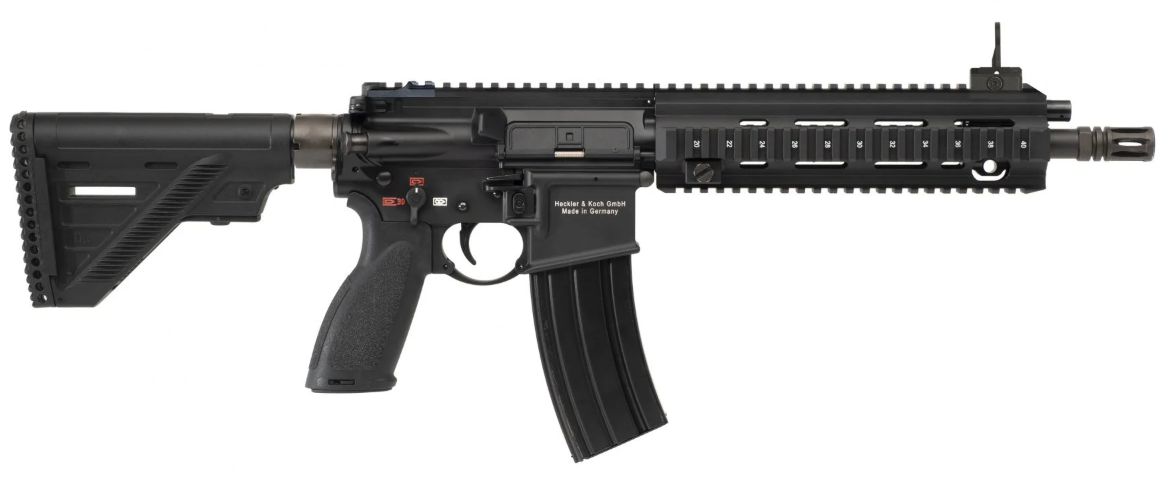
HK416
The Heckler & Koch HK416 is a 5.56mm assault rifle and carbine that keeps the ergonomics, magazines and accessories of the American M4 but… Continued…