HK416
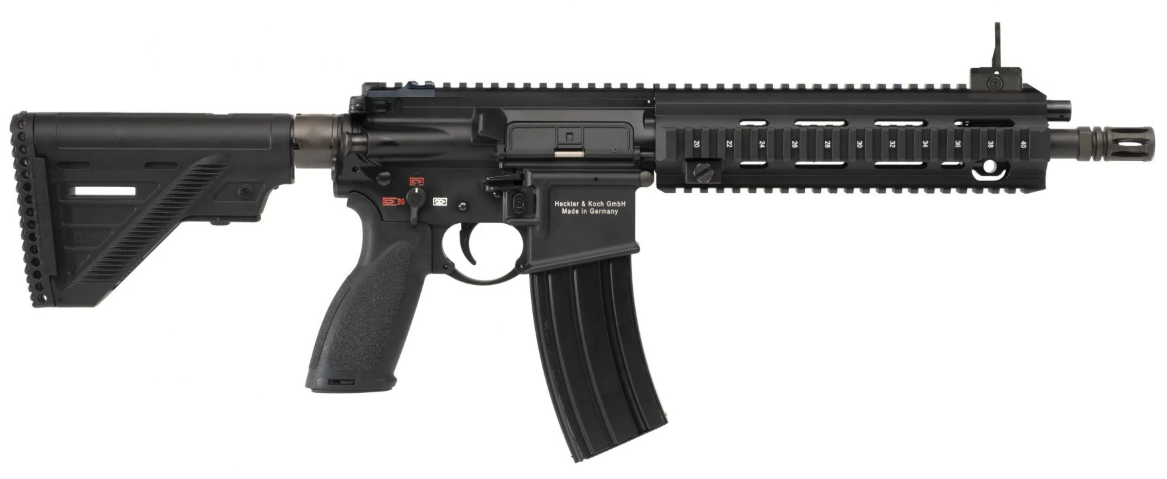
The Heckler & Koch HK416 is a 5.56mm assault rifle and carbine that keeps the ergonomics, magazines and accessories of the American M4 but replaces its direct-impingement gas system with a short-stroke piston derived from the G36, so that no combustion gas enters the receiver. Developed from 2004 at the request of Delta Force, it runs cleaner, cooler and more reliably with short barrels and suppressors than the M4, and it became the weapon of American special operations, the rifle that killed Osama bin Laden, the Marine Corps' M27 Infantry Automatic Rifle, and the service rifle of Norway, France and other armies.
Also known as HK416, HK416 A5, HK416 D10RS, HK416 D14.5RS, M27 IAR, HK416F, HK416N
Origins
The M4 carbine's direct-impingement gas system, which vents hot combustion gas straight into the bolt carrier, fouls the action, cooks the lubricant and, with a short barrel and a suppressor, cycles violently enough to break parts; American special operations units that fired the M4 far harder than line infantry had lived with the consequences since the 1990s. Around 2004 Delta Force approached Heckler & Koch, which had built the SA80 rebuild for Britain and had a proven short-stroke piston in the G36, and asked for an M4 upper receiver with a piston. HK's answer, first called the HK M4 and then, after Colt objected, the HK416, entered Delta service in 2004-05 and was followed by a complete rifle.
Design & Construction
The HK416 is an AR-15-pattern rifle in every respect a user would notice: the same lower receiver layout, controls, STANAG magazines, buffer tube and stock, so a soldier trained on the M4 needs no retraining. Above the magazine well it is different. A short-stroke gas piston and operating rod above the barrel drive the bolt carrier, which is redesigned with no gas key; the barrel is cold-hammer-forged and chrome-lined; the buffer and springs are heavier; the free-floating quad-rail handguard mounts directly to the upper receiver. Barrels of 10.4, 11, 14.5, 16.5 and 20 inches are offered, with the 10.4-inch D10RS the special-operations favorite. The A5 of 2013 added ambidextrous controls, a tool-free adjustable gas regulator for suppressed fire and a slimmer handguard. The rifle weighs about half a pound more than an equivalent M4, the price of the piston.
Combat Use
Delta and then the US Navy SEALs' Naval Special Warfare Development Group (DEVGRU) made the HK416 their standard carbine, and it was the primary weapon of the assault element in Operation Neptune Spear on 2 May 2011. Norway adopted it as the HK416N for its whole army in 2008, the first nation to do so; the US Marine Corps adopted a heavy-barreled version as the M27 Infantry Automatic Rifle in 2010 and from 2018 as the standard rifle of its infantry; France chose the HK416F to replace the FAMAS in 2017, and Germany's Bundeswehr selected it as the G95 to replace the G36. Polish GROM, the Dutch, Turkish and many other special forces use it. Its record is one of reliability under exactly the conditions — short barrels, suppressors, dust, sustained fire — that trouble the M4.
Legacy
The HK416 settled the piston-versus-impingement argument for the users who fire most, and its adoption by the Marine Corps as a general-issue rifle is the most significant change to American infantry small arms since the M16. Its influence is visible in every piston AR made since, and the rifle itself, now in its A5 and A7 forms, has become one of the standard military rifles of the Western world. HK sells a semi-automatic version, the MR223 (MR556 in the United States), to civilians.
Sources
Heckler & Koch GmbH. HK416 A5 technical data.
Cutshaw, Charles Q. Tactical Small Arms of the 21st Century. Gun Digest, 2006.
Owen, Mark, with Kevin Maurer. No Easy Day. Dutton, 2012.
Jane's Infantry Weapons, 2012-2013.
US Marine Corps. M27 Infantry Automatic Rifle program documentation.
Suggest an edit · account required · reviewed before publishing · how it works