Force
French Foreign Legion
France's legendary volunteer corps of foreign nationals, forged in colonial campaigns and both World Wars.
Origins
The Légion étrangère was founded by King Louis-Philippe in March 1831. Paris at the time held many foreign refugees and former soldiers, and the new corps put them under arms and conveniently overseas, since the law said it could not serve in mainland France. It was sent to Algeria, which France had invaded in 1830, and Algeria stayed its home for more than 130 years. In 1835 the whole Legion was handed over to Spain to fight in the Carlist War, and a new Legion was raised in its place.
Organization & Training
Recruits enlist under any name they choose. The Legion calls this "declared identity" and asks few questions, though it now runs background checks. Its officers are mostly French, while the rank and file come from well over a hundred countries. Training takes place at Castelnaudary in southern France, where recruits learn French along with soldiering. The Legion's motto is "Legio Patria Nostra", "The Legion is our homeland", and it is famous for its traditions: the white képi, the slow march of 88 steps a minute and a code of honor every legionnaire learns. A legionnaire can apply for French citizenship after several years' service, and since 1999 one wounded in action can claim it at once, "Français par le sang versé", French by spilled blood. Today the Legion has about 9,000 men in infantry, cavalry, engineer and parachute regiments, with its headquarters at Aubagne.
Weapons & Equipment
The Legion has always carried the French Army's standard arms. In the colonial wars and the First World War legionnaires carried the Lebel Model 1886 rifle. After 1945, in Indochina, they used a mix of French and American weapons. The FAMAS bullpup rifle was standard from the late 1970s, and since 2017 it has been replaced by a French version of the HK416.
Notable Actions
The founding legend is Camerone, 30 April 1863, during the French intervention in Mexico. Sixty-five men of the Legion under Captain Jean Danjou were attacked at the hamlet of Camarón by some two thousand Mexican troops, by the usual estimate. They held a walled farmyard for most of the day. Danjou was killed, and at the end the last five men still standing made a bayonet charge. Danjou's wooden hand, recovered afterward, is the Legion's most treasured relic and is paraded each year on Camerone Day.
The Legion fought in Crimea, Italy, Indochina, Madagascar and Morocco, and suffered huge losses on the Western Front in World War I. In World War II legionnaires fought at Narvik in 1940 and helped hold Bir Hakeim in the Libyan desert in 1942. In the war in Indochina the Legion made up a large part of the garrison at Dien Bien Phu, which fell in May 1954. After the Algerian War, which ended in 1962, the Legion moved to France. In 1978 its 2nd Foreign Parachute Regiment dropped on Kolwezi in Zaire to rescue Europeans held by rebels, and legionnaires have since served in the Gulf War, the Balkans, Afghanistan and Mali.
Legacy
Legion identity is deliberately total: the white képi, the slow march and a brotherhood of men from many nations who have left their old lives behind. Behind the romance stands one of the world's most experienced professional infantry forces. It also casts a long literary shadow, from P. C. Wren's 1924 novel Beau Geste and its films to countless memoirs by former legionnaires.
-
FAMAS
The FAMAS is the French army's bullpup assault rifle, adopted in 1978 and in service for four decades. Made at the Saint-Étienne arms… Continued…
-
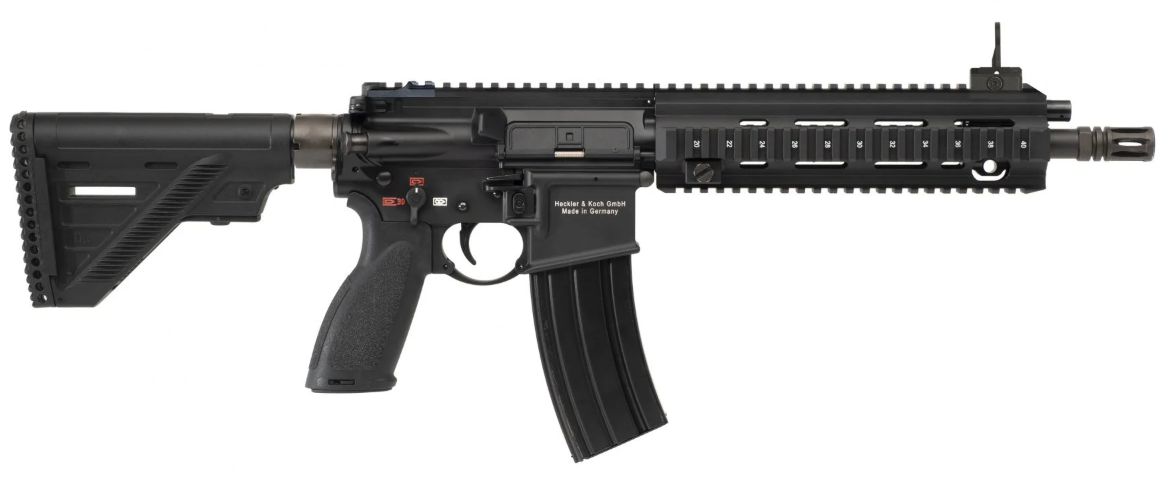
HK416
The Heckler & Koch HK416 is a 5.56mm assault rifle and carbine that keeps the ergonomics, magazines and accessories of the American M4 but… Continued…
-
Lebel Model 1886
The Lebel Model 1886 was the first military rifle to fire smokeless powder, and it made every other army's rifle obsolete overnight. Its… Continued…