G36 Rifle
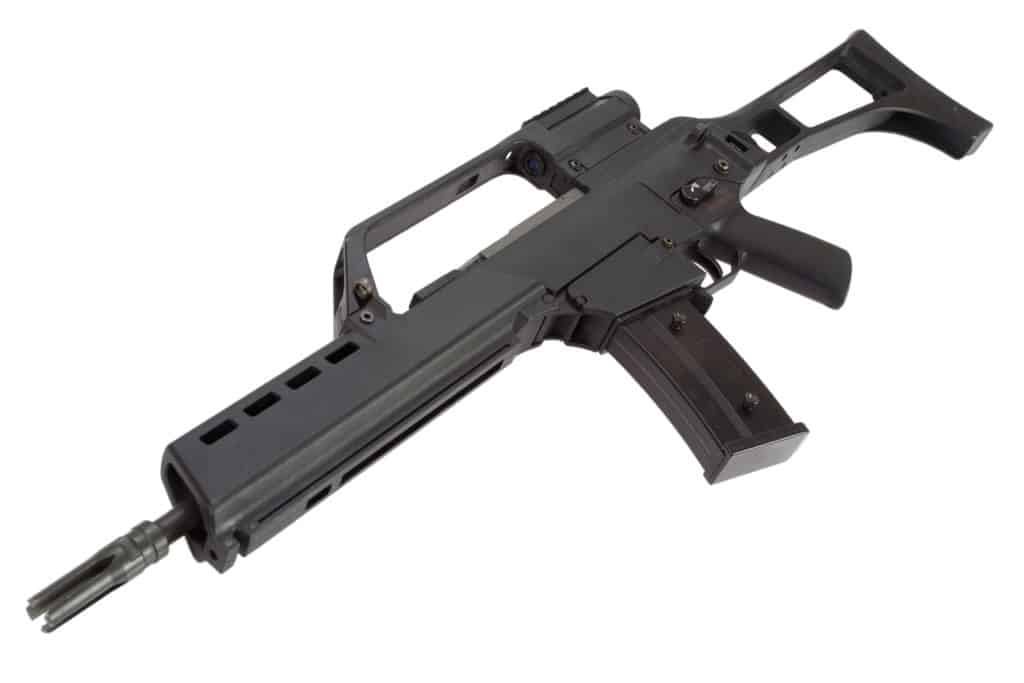
The Heckler & Koch G36 is a 5.56x45 mm NATO assault rifle adopted by the German Bundeswehr in 1997 to replace the G3. It uses a short-stroke gas piston and rotating bolt, a receiver and stock molded from glass-reinforced polymer, a side-folding stock and an optical sight built into its carrying handle. Spain adopted it in 1999, and the compact G36C became a standard weapon of police and special forces units worldwide. German troops carried it in Afghanistan, where complaints about accuracy from hot barrels led to a 2012-2015 controversy and a decision to replace it. The HK416, designated G95A1, was chosen as its successor.
Also known as G36, Gewehr 36, HK50, G36A1, G36A2, G36K, G36C, G36E, G36V, MG36
Origins
When the Cold War ended, the Bundeswehr still carried the 7.62 mm G3 Rifle, and its intended successor, the caseless-ammunition G11, had been canceled in 1990 when the money for it vanished with reunification. Germany needed a 5.56 mm rifle that would fire NATO standard ammunition and cost little. Heckler & Koch, then in financial trouble and owned by Britain's Royal Ordnance, began the HK50 project in the early 1990s. Instead of the roller-delayed action that had defined the company for forty years, the engineers chose a gas piston and rotating bolt in the tradition of the Armalite AR-18, and they built the rifle almost entirely from glass-reinforced polymer. The Bundeswehr adopted it as the Gewehr 36 in 1997 and it replaced the G3 in front-line units over the following years.
Design & Construction
The G36 fires 5.56x45 mm NATO from a 30-round translucent polymer magazine; the magazines carry studs so that two or three can be clipped side by side. A short-stroke gas piston above the barrel drives a carrier with a seven-lug rotating bolt. Receiver, stock, handguard, trigger group and magazine are all polymer, so the rifle weighs about 8 lb without a magazine, and the stock folds to the right for vehicle crews and paratroops. The carrying handle is a sight unit. On Bundeswehr rifles it holds a 3x optical sight with a red-dot sight mounted above it for close work; export G36E rifles carry a 1.5x scope. The cold hammer-forged, chrome-lined barrel is 18.9 inches long on the rifle. The G36K carbine has a 12.5 inch barrel and the G36C a 9 inch barrel with a rail in place of the sight unit, and the HK MP7 personal defense weapon followed for troops who needed something smaller still. The MG36 light support weapon, with a heavy barrel and a 100-round drum, was offered and then dropped. The AG36 grenade launcher clips under the handguard.
Combat Use
The G36 went to Kosovo in 1999 and then to Afghanistan, where German troops used it from 2002 through the long ISAF deployment that was Germany's share of the Global War on Terror. Spain adopted the G36E in 1999 to replace the CETME L, and Spanish soldiers carried it in Iraq, Afghanistan and Lebanon. Lithuania, Latvia and Saudi Arabia bought it, and the G36C became a standard weapon of European police tactical units and of special forces in many countries. After heavy fighting in Kunduz province in 2010, German soldiers reported that the rifle lost accuracy after sustained fire. Bundeswehr tests between 2012 and 2015 found that some rifles' groups opened up when the barrel was hot or the ambient temperature was high, apparently because heat softened the polymer that holds the barrel. Heckler & Koch disputed the findings, and a German court ruled in 2016 that the rifle met the specification the army had contracted for. In April 2015 the Defense Ministry nevertheless announced that the G36 had no future in the Bundeswehr in its existing form.
Legacy
The G36 was one of the first service rifles built almost entirely of polymer, and it put a magnified optic in every soldier's hands a decade before most allies did the same. Its replacement was slow. A competition launched in 2017 ended in 2020 in a legal dispute between the Haenel MK556 and the HK416, which Heckler & Koch had developed from the M16 Rifle pattern with a gas piston in place of direct impingement. The HK416 was confirmed and is entering Bundeswehr service as the G95A1, with the G36 handed down as deliveries allow. The G36 still serves in Spain and with many police and special forces units, and the SL8 sporting rifle is a semi-automatic derivative for civilian shooters.
Sources
Maxim Popenker and Anthony G. Williams. Assault Rifle: The Development of the Modern Military Rifle and its Ammunition. Crowood Press, 2004.
Richard D. Jones and Leland S. Ness (eds). Jane's Infantry Weapons 2009-2010. Jane's Information Group, 2009.
Ian V. Hogg and John Weeks. Military Small Arms of the 20th Century. Krause Publications, 2000.
Suggest an edit · account required · reviewed before publishing · how it works