Armalite AR-18
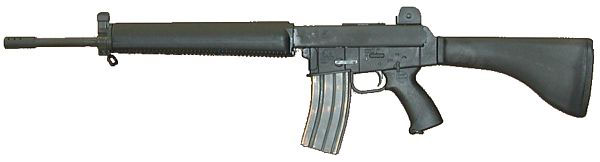
The Armalite AR-18 is a 5.56mm select-fire rifle designed in 1963 by Arthur Miller and George Sullivan at Armalite in Costa Mesa, California. It was meant to be a cheaper cousin of the AR-15, built from stamped steel with a short-stroke gas piston and a folding stock, so that countries without advanced forging plants could make it. Howa in Japan and Sterling in England built it under license, but no major army adopted it. It is remembered for two reasons: the Provisional IRA made it the 'Armalite' of republican slogans, and its mechanism shaped the British L85, the Steyr AUG, the HK G36 and many later rifles.
Also known as AR-18, AR-180, AR-180B, Armalite Rifle 18, Howa AR-18, Sterling AR-18, Widowmaker, Armalite
Origins
By 1959 Armalite had sold the rights to the AR-15 to Colt, and the small California firm needed a new product. Its answer was a rifle that would sell where the AR-15 could not. The M16 Rifle needed forged and machined aluminum receivers, which only a handful of countries could make. Armalite's chief engineer Arthur Miller, with George Sullivan and Charles Dorchester, set out in 1963 to design a rifle that fired the same 5.56mm cartridge but could be built from sheet-steel stampings and simple welds on ordinary factory tooling. The result was the AR-18, finished in 1963 and offered to the US Army for trials in 1964. The Army tested it again in 1969 and found it promising but not ready, and it never displaced the M16. Armalite built only a few thousand rifles itself.
Design & Construction
The AR-18 is a gas-operated, select-fire rifle with a rotating bolt. Unlike the M16, which vents gas straight into the bolt carrier, the AR-18 uses a short-stroke piston above the barrel that taps the carrier with a short rod. Two guide rods run above the carrier, each with its own recoil spring, so the whole action fits in a low receiver and the stock does not need to house a buffer. That layout let Armalite fit a side-folding stock, reducing the rifle from 38 inches to under 29 inches. The upper and lower receivers are welded steel pressings, hinged at the front and held by a rear pin. The 18.25-inch barrel is easily removed. The rifle weighs about 6.7 pounds empty and cycles at roughly 750 rounds a minute. It fed from 20-, 30- and 40-round magazines of its own pattern. A semi-automatic version, the AR-180, was sold to civilians from 1969. The receiver was drilled and tapped for a scope mount, an unusual touch for the period.
Production went abroad. Howa Machinery of Nagoya built the rifle from 1970 until the Japanese government stopped exports of military arms to countries at war. Sterling Armaments of Dagenham, England, took over the license in 1975 and made rifles until 1983. Total output of all types was probably under 20,000.
Combat Use
The AR-18 was never a standard-issue rifle for a major army, and its combat record is mostly irregular. Small batches went to Central America and Asia as trial or police weapons. Its name was made in Northern Ireland. In the early 1970s American sympathizers shipped AR-18s and AR-180s to the Provisional IRA, some hidden in cargo through Baltimore and New York. The light, folding rifle suited a guerrilla who had to hide the weapon under a coat and fire a few aimed shots at range, and its 5.56mm round would pierce the flak jackets British soldiers then wore. Within the movement any such rifle became 'the Armalite', and during The Troubles the word entered political speech. In 1981 Danny Morrison asked a Sinn Fein conference whether anyone objected to taking power 'with a ballot paper in this hand and an Armalite in the other'. The phrase stuck to the whole republican strategy.
Legacy
The AR-18's real influence was on other designers. Its stamped receiver, piston and twin guide rods were copied almost line for line into the Enfield rifles that became the L85A1. The Steyr AUG borrowed the bolt carrier and guide-rod arrangement, and Heckler & Koch's G36 Rifle uses a close relative of the same gas system. Singapore's SAR-80, designed by a former Sterling engineer, and Japan's Howa Type 89 are direct descendants. Later rifles such as the Magpul Masada and the Bushmaster ACR show the same family features. Like the StG 44 before it, the AR-18 was a stamped-steel rifle that few armies bought yet nearly every army ended up copying. ArmaLite, a new company using the old name, produced a modernized AR-180B with a polymer lower from 2001 to 2007.
Sources
Edward C. Ezell. Small Arms of the World, 12th edition. Stackpole Books, 1983.
Ian V. Hogg and John Weeks. Military Small Arms of the 20th Century, 7th edition. Krause Publications, 2000.
Neil Grant. SA80 Assault Rifles. Osprey Publishing, 2016.
Richard Jones and Leland Ness (eds). Jane's Infantry Weapons. Jane's Information Group, 2009.
Suggest an edit · account required · reviewed before publishing · how it works