M16 Rifle
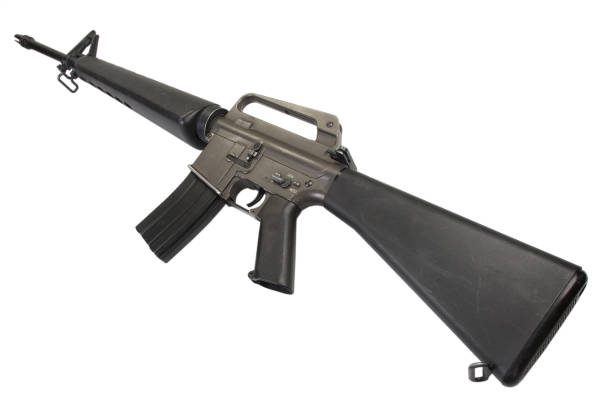
The M16 brought the assault rifle to the West: Eugene Stoner's AR-15 design in 5.56mm, built of aluminum forgings and polymer around a direct-gas action, light enough to carry all day and controllable in automatic fire. Its Vietnam introduction was marred by a self-inflicted reliability scandal, but the matured M16A1 recovered completely and became the enduring pattern for more than more than fifty continuous years of American service rifles — today's standard-issue M4 carbine is its direct descendant.
Also known as AR-15, M16A1, Armalite, black rifle
Origins
Eugene Stoner's AR-10 lost the 1950s battle-rifle trials to the M14, but the concept — aircraft aluminum, fiberglass and polymer, in-line stock, gas system venting directly into the bolt carrier — was too good to die. Scaled to the new .223/5.56mm high-velocity small-caliber round as the AR-15, it outshot the M14 Rifle in Air Force and field trials; Colt bought the design, Curtis LeMay ordered it for air base security, and Robert McNamara's Pentagon pushed it into Army hands as the M16 when Vietnam demanded a jungle-handy rifle the M14 could not be.
Design & Construction
The M16 weighs under seven pounds loaded — two and a half less than an M14 Rifle — with a 20-inch barrel, aluminum upper and lower receivers, and the direct-impingement gas system that deletes the piston entirely: gas travels down a tube and cycles the multi-lug rotating bolt inside its carrier. The in-line stock sends recoil straight back into the shoulder, keeping automatic fire on target as no previous service rifle could. The 5.56mm round's flat trajectory and light weight let a soldier carry twice the ammunition of the 7.62mm generation, conceding the AK-47's 300-meter argument and winning it with volume and precision.
Combat Use
The early Vietnam fielding became a scandal: the Army changed the specified powder, skipped chrome-lining the chamber, and told troops the rifle was self-cleaning while shipping it without cleaning kits. Rifles jammed in firefights and Marines died with cleaning rods in their hands; the 1967 Ichord subcommittee called the mishandling 'bordering on criminal negligence.' The fixes — chrome chamber and bore, buffer change, cleaning kits and training — produced the M16A1, and the rifle's reputation recovered with its function: light, flat-shooting, deadly in the assault, and by the war's end genuinely trusted. The A2 of the 1980s and the carbine M4 of the 1990s carried the platform through every American war since.
Legacy
The M16 family is the longest-serving rifle pattern in American history, and its civilian AR-15 sibling became the most widespread rifle platform in the country — an industry, a sport, and a political argument in one receiver. Alongside the M1 Garand and the AK it completes the twentieth century's service-rifle story: the Garand proved semi-auto, the AK proved the assault rifle, and the M16 proved it could be light, precise, and modular. Retro Vietnam-era configurations now anchor a fast-growing collecting field of their own.
Sources
Stevens, R. Blake, and Edward C. Ezell. The Black Rifle: M16 Retrospective. Collector Grade Publications, 1987 (the standard work).
Rottman, Gordon L. The M16. Osprey Publishing, 2011.
Ichord Subcommittee report, U.S. House of Representatives, 1967 (the Vietnam malfunction investigation).
Suggest an edit · account required · reviewed before publishing · how it works