M1 Garand
The M1 Garand was the first semi-automatic rifle adopted as the standard arm of any major power, giving the American infantryman of the Second World War a decisive firepower edge over every bolt-action rival. Gas-operated, chambered in .30-06, and fed by an eight-round en-bloc clip, it fired as fast as a man could aim. Patton's verdict — 'the greatest battle implement ever devised' — has headed every account of the rifle since he wrote it in 1945.
Also known as U.S. Rifle, Caliber .30, M1
Origins
John C. Garand, a Canadian-born engineer at Springfield Armory, spent the 1920s and early 1930s refining a service-grade self-loading rifle through the Army's glacial trials process. His gas-operated design beat Pedersen's toggle rifle, survived a caliber reversal back to .30-06, and was standardized in 1936 as the U.S. Rifle, Caliber .30, M1. Teething troubles with the gas system were fixed by 1940, just in time: American industry — Springfield Armory and Winchester during the war, joined by others for Korea — would build roughly 5.4 million.
Design & Construction
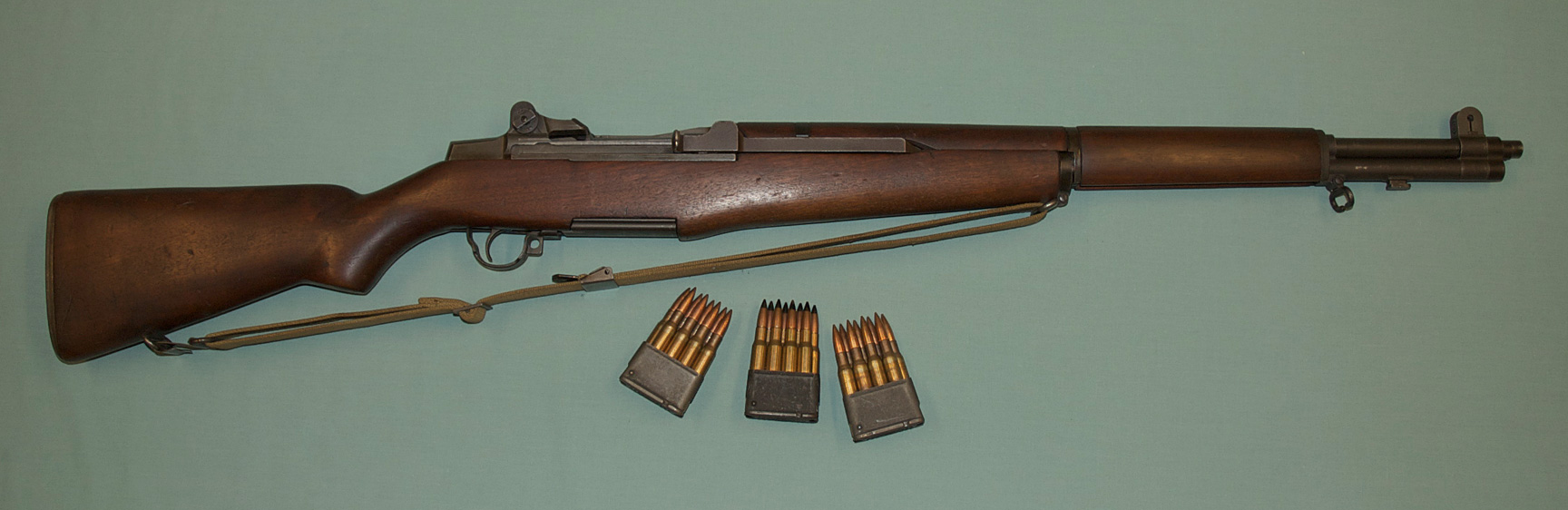
The M1 taps propellant gas near the muzzle to drive a long-stroke operating rod, rotating an accurate, massively strong two-lug bolt. Its signature is the feed: eight rounds in a steel en-bloc clip drop into the fixed magazine as a unit, and when the last round fires, the clip ejects with the famous metallic ping and the bolt locks open. The rifle is heavy — about 4.3 kilograms — with a 24-inch barrel, excellent aperture sights adjustable in precise clicks, and walnut furniture built to survive being used as a club. The clip system's real cost was doctrinal, not acoustic: topping up a partially loaded rifle was awkward, so riflemen learned to shoot the clip out and reload whole.
Combat Use
The Garand's arithmetic was brutal for its opponents. A German or Japanese rifleman worked a bolt between aimed shots; an American squad of M1s put out double or triple the aimed fire, sustained, without leaving the sights. The US Marine Corps adopted it after Guadalcanal proved the point against the Arisaka; in Europe every rifleman from Normandy hedgerows to the Bulge — the 101st Airborne jumped with them disassembled in padded cases — carried the firepower advantage as personal equipment. It fed the Thompson Submachine Gun's close-quarters partner role at squad level, digested mud, sand, and frost with legendary tolerance, and in accurized sniper forms (M1C, M1D) served into the 1950s. Korea ran the same rifle through a second war without embarrassment.
Legacy
The M14 that replaced it in 1957 was, candidly, a product-improved Garand with a box magazine — the action's DNA runs straight into it and into the Ruger Mini-14's styling besides. Millions of veterans knew the rifle intimately, and the U.S. Civilian Marksmanship Program has kept legally documented surplus Garands flowing to citizens for decades, making it the great democratic collectible of American military arms: real history, honest condition grades, and a paper trail. Among service rifles only the AK-47 and the Mauser 98 can claim comparable influence, and neither changed its own war the way the M1 changed 1944.
Sources
Canfield, Bruce N. The M1 Garand Rifle. Mowbray Publishing, 2013.
Duff, Scott A. The M1 Garand: World War II. Scott A. Duff Publications, 1993.
U.S. Army Ordnance Department records; Springfield Armory National Historic Site collections.
Suggest an edit · account required · reviewed before publishing · how it works