L85A1
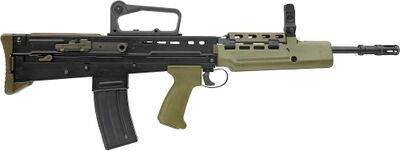
The L85A1 is the British Army's 5.56mm bullpup rifle, the individual weapon of the SA80 family. Adopted in 1985 to replace the L1A1 self-loading rifle and the Sterling submachine gun, it was designed at Enfield around a mechanism taken from the Armalite AR-18 and issued with the SUSAT 4x optical sight. Early rifles gained a poor reputation for reliability in the Gulf War of 1991 and in Sierra Leone, with weak plastic fittings and magazine faults. Heckler & Koch rebuilt about 200,000 rifles as the L85A2 between 2000 and 2002, and the L85A3 followed from 2018. The family has served from Northern Ireland to Afghanistan.
Also known as SA80, L85, Rifle 5.56mm L85A1, Individual Weapon, IW, XL70E3, L85A2, L85A3, Enfield Weapon System
Origins
Through the 1970s the British Army carried the L1A1, its version of the FN FAL, and vehicle crews and officers carried the Sterling Submachine Gun. Both fired cartridges that NATO was moving away from. The Royal Small Arms Factory at Enfield began work on a new family, Small Arms for the 1980s, or SA80. The first prototypes of 1976 fired a British 4.85mm round. When NATO chose the 5.56mm cartridge in 1980 the rifle was rechambered as the XL70E3. Enfield had no recent experience of designing a service rifle, so its engineers built the action around the Armalite AR-18, which Sterling was then making under license in Dagenham. The gas piston, bolt carrier and twin guide rods were taken over almost unchanged and turned round into a bullpup layout with the magazine behind the pistol grip. The rifle was accepted as the L85A1 and issued from October 1985, with the L86A1 Light Support Weapon as its heavy-barreled partner.
Design & Construction
The L85A1 is a gas-operated, select-fire bullpup with a 20.4-inch barrel in a rifle only 30.9 inches long. The receiver is a welded steel pressing with plastic furniture. The bolt locks by rotating into a barrel extension and is driven by a short-stroke piston with a three-position gas regulator. Ejection is to the right only, so it cannot be fired from the left shoulder. Most rifles carried the SUSAT, a 4x sight with a tritium-lit pointer, while rear-area troops had an iron-sight carrying handle. The rifle weighs about 8.4 pounds empty, closer to 11 pounds with sight and a loaded 30-round magazine, and fires at roughly 650 rounds a minute. Production moved from Enfield to Royal Ordnance's Nottingham factory when Enfield closed in 1988. About 350,000 weapons of the family were built.
Combat Use
The rifle reached the ranks in The Troubles, where the short weapon was handy in vehicles and on patrol and the optical sight was welcomed. Its faults showed in the Gulf War of 1991. Sand jammed the action, magazines fell out when the release catch snagged on equipment, plastic parts cracked and the cocking handle and firing-pin retaining pin broke. Soldiers cleaned the rifle several times a day and still had stoppages. A Ministry of Defence report in 1992 listed dozens of defects. Complaints returned from Sierra Leone in 2000, where humidity and mud caused the same trouble. In 2000 Heckler & Koch, then owned by Royal Ordnance's parent BAE, was contracted to rebuild the rifle. Between 2000 and 2002 about 200,000 rifles received new bolts, carriers, gas parts, cocking handles, magazines and a redesigned ejector, becoming the L85A2 at a cost of around 92 million pounds. The A2 performed well in Iraq from 2003 and in Afghanistan, where rail handguards, foregrips and ACOG and ELCAN sights were added. A further upgrade, the L85A3 with a new upper receiver and full-length rail, was ordered from 2018. The L22 carbine served tank crews and the L98 cadet rifle trained the youth organizations.
Legacy
The L85 gave Britain a compact rifle with a standard optic a decade before most armies did the same, and the A2 rebuild turned a troubled weapon into a serviceable one. The cost was a long public argument about Enfield's design and about how the rifle was tested and produced. Its reputation shaped later British buying: the HK416 went to special forces and the Knight's Armament KS-1 carbine, as the L403A1, to the Ranger Regiment in 2023, while the L85A3 remains the standard rifle. In the story of British Arms & Weapons it is the last service rifle to bear the Enfield name.
Sources
Neil Grant. SA80 Assault Rifles. Osprey Publishing, 2016.
Steve Raw. The Last Enfield: SA80, The Reluctant Rifle. Collector Grade Publications, 2003.
Ian V. Hogg and John Weeks. Military Small Arms of the 20th Century, 7th edition. Krause Publications, 2000.
Richard Jones and Leland Ness (eds). Jane's Infantry Weapons. Jane's Information Group, 2009.
Suggest an edit · account required · reviewed before publishing · how it works