FN FAL
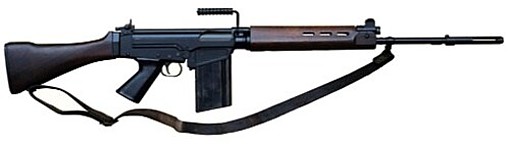
The FN FAL — Fusil Automatique Léger, or light automatic rifle — was the most widely adopted battle rifle of the Cold War. Designed by Dieudonné Saive at Fabrique Nationale in Belgium and chambered for the 7.62x51mm NATO cartridge, it served more than ninety nations, which earned it the name 'the right arm of the free world.' Britain and the Commonwealth carried it as the semi-automatic L1A1 Self-Loading Rifle, and it fought in the Falklands, Rhodesia, the Middle East and Africa, often on both sides of the same war.
Also known as FAL, Fusil Automatique Léger, L1A1, SLR, Self-Loading Rifle, C1A1, R1, Right Arm of the Free World
Origins
After the Second World War Fabrique Nationale of Herstal, Belgium, where Dieudonné Saive had worked with John Browning, set out to build a modern self-loading infantry rifle. Saive's first prototype of 1946 was chambered for the German 7.92x33mm Kurz round of the StG 44, and Britain tested versions in its own .280 intermediate caliber. But when NATO standardized on the American 7.62x51mm cartridge in 1953, FN rebuilt the rifle around the full-power round. Belgium adopted it in 1953, and it was quickly taken up by Canada, Britain, Australia, the Netherlands, Austria, Israel, South Africa, Argentina, India and dozens of others (see Belgian Arms & Weapons).
Design & Construction
The FAL is gas-operated, with a short-stroke piston above the barrel and a gas regulator that let the soldier adjust the rifle for dirty conditions or for launching rifle grenades. The breechblock locks by tilting down into a shoulder in the receiver, and the receiver hinges open, like a shotgun, for cleaning. It fed from a 20-round box magazine and fired on semi-automatic or full-automatic, though the full-power cartridge made automatic fire hard to control from a standard rifle. The British, Canadian, Australian and Indian versions were made to imperial measurements, so their parts are not fully interchangeable with the metric FALs of Belgium and its other customers, and the British L1A1 Self-Loading Rifle was semi-automatic only. A heavy-barrel version with a bipod served as a squad automatic weapon, and folding-stock paratrooper models were made for airborne troops. The rifle was long and heavy by later standards, but it was accurate, powerful at long range and reliable in desert, jungle and arctic conditions alike.
Combat Use
The FAL was carried in the bush wars of the end of empire: by British troops in Malaya, Borneo, Aden and Northern Ireland, and by the British SAS in Oman, where SAS soldiers held off an attack at Mirbat in 1972. In the Rhodesian Bush War the Rhodesian Light Infantry and Rhodesian SAS fought with FALs and South African-made R1s. Israel used it in the wars of 1967 and 1973. In the Falklands War of 1982 British L1A1s faced Argentine FALs, which, unlike the British guns, could fire on full automatic. It was the main rifle of both sides in many African wars.
Legacy
By the 1980s the NATO armies were changing to 5.56mm rifles such as the M16 Rifle, and Britain replaced the SLR with the L85 from 1985, but the FAL served on in dozens of armies into the twenty-first century. Some two million were made by FN and its licensees. Together with the American M14 Rifle and the Soviet AK-47, it defined the infantry firearms of the early Cold War, and it remains a favorite with collectors and target shooters, both as original imported rifles and in modern semi-automatic versions.
Sources
Stevens, R. Blake, and Jean E. Van Rutten. The Metric FAL: The Free World's Right Arm. Collector Grade Publications, 1981.
Stevens, R. Blake. The FAL Rifle. Collector Grade Publications, 1993.
Cashner, Bob. The FN FAL Battle Rifle. Osprey Publishing, 2013.
Suggest an edit · account required · reviewed before publishing · how it works